


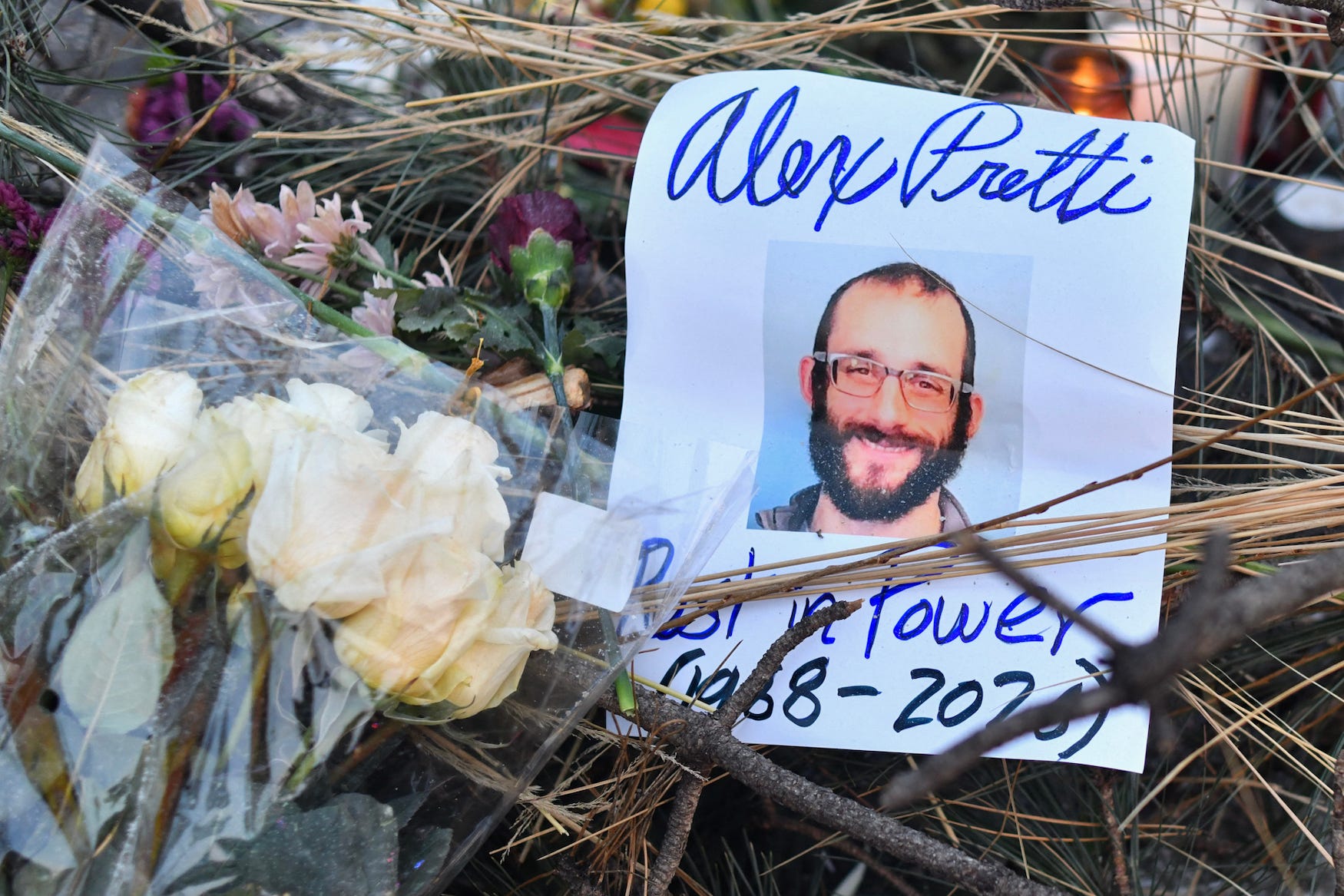
The FBI formally notified Minnesota’s Bureau of Criminal Apprehension (BCA) that the federal government will not share any evidence related to Alex Pretti’s homicide with state investigators.
“While this lack of cooperation is concerning and unprecedented, the BCA is committed to thorough, independent and transparent investigations of these incidents, even if hampered by a lack of access to key information and evidence,” the agency’s superintendent Drew Evans wrote in a statement. “Our agency has committed to the FBI and Department of Justice that should its stance change we remain willing to share information that we have obtained with that agency and would welcome a joint investigation. We will continue to pursue all legal avenues to gain access to relevant information and evidence.”
The BCA continued to request evidence about the shootings of Renee Good and Julio C. Sosa-Celis, and the agency said it was “unclear” whether the federal government would comply.
Attorneys for the families of Good and Pretti didn’t immediately respond to emails requesting comment.
“BCA investigations of these incidents continue,” Evans wrote. “The BCA will present its findings without recommendation to the appropriate prosecutorial authorities for review.”
Hennepin County Attorney Mary Moriarty, who is taking the lead on local investigations into the deaths of Good and Pretti, praised the BCA’s efforts in pursuing a joint investigation with the federal government.
“The federal government’s refusal to cooperate is unsurprising but provides a clear indication that they are not confident in their agents’ actions or their immediate response,” Moriarty wrote in a statement to All Rise News. “During the BCA’s efforts on this front, they have been valuable investigative partners and that work continues.”
The announcement falls shortly after Donald Trump’s so-called Border Czar Tom Homan announced his purported plan to withdraw federal agents from the Twin Cities.
Authorities remain skeptical that the so-called drawdown will take place.
Last week, Moriarty referred to it in a press release as the “alleged end of Operation Metro Surge.”
On Monday, U.S. Magistrate Judge Dulce Foster declined to prejudge Minnesota’s lawsuit seeking to curtail the federal surge inside Minneapolis.
“As of the date of this Order, Operation Metro Surge is still ongoing, and the Court cannot take Defendants’ stated intention into account unless and until Respondents’ withdrawal of its officers is complete,” she wrote in a footnote of an order that declined to fast-track discovery in the case.
Read the BCA’s full statement here.
The federal government’s refusal to share evidence from homicide investigations into its agents with state authorities goes so far beyond the norm that it is easily identified as a cover up.
As Mediaite’s Colby Hall writes in an insightful column, the partial and redaction-riddled releases of Epstein files fit comfortably into that category, and newsrooms have been reluctant to acknowledge it.
“Journalists and newsrooms have resisted reaching the ‘cover-up’ conclusion for understandable reasons. Calling something a cover-up implies intent, and intent is difficult to prove without internal documents that make motive explicit. Editors know the legal risks, and they know how quickly a loaded word can damage credibility if it outruns the evidence. The professional instinct is to wait for the email, the whistleblower, or the document that removes all doubt.
In the Epstein case, however, that instinct gives the DOJ a significant structural advantage, because the department controls the very documents that would establish whether anything improper occurred in the first place.
Said more plainly, the only people who can prove there is, in fact, no cover-up are the very same people accused of running one.”
Most reports indicate that the 3.5 million files released so far represent roughly half of the total universe of Epstein files. A recent investigation by the U.K.’s Channel 4 suggests that what’s in the database may represent the tip of the iceberg: roughly 2 percent.
What has been released already has been explosive.
At least half a dozen top Trump administration officials appear in the Epstein files, according to NBC News. Emails show that Howard Lutnick lied about leaving Epstein’s New York mansion in disgust with his wife, vowing never to see either of them again. In fact, Lutnick confirmed that he visited Epstein on his island, insisting that it was a brief lunch with his wife, children and their nannies.
An FBI interview indicated that Trump told Palm Beach Police Chief Michael Reiter that “everyone” knew about Epstein’s crimes and that Ghislaine Maxwell was “evil,” only after Epstein’s investigation became public in 2006. Other Justice Department documents reveal accusations that Trump sexually assaulted a girl as young as 13 years old, whose biographical details correspond closely to a witness interviewed by the FBI, according to reporting by Roger Sollenberger.
The aftershocks of the releases have been global, sparking investigations in the United Kingdom, France, Poland, Lithuania, Latvia, and elsewhere. British Prime Minister Keir Starmer is fighting to hold onto power in the wake of revelations about his former ambassador to the United States. Epstein’s closest billionaire associates like Les Wexner and Leon Black have the global spotlight on them again. The files reveal that prosecutors investigated, but ultimately didn’t pursue, the sexual abuse allegations in civil lawsuits filed against Black.
But the Justice Department’s disclosures are far from complete.
Even accepting that the line between survivors and perpetrators could be blurry in Epstein’s world — where victims were paid to find new prey — some redactions are puzzling. Some official explanations flout the terms of the Epstein Files Transparency Act.
Deputy Attorney General Todd Blanche refused to release the Justice Department’s private deliberations about whether to prosecute Epstein’s alleged co-conspirators as privileged in direct violation of the law’s mandated disclosure of “[i]nternal DOJ communications” and “decisions to charge.” Refusing to release these files deprives the U.S. public of the vital context that their elected officials demanded.
Last week, Attorney General Pam Bondi had the opportunity to explain the Justice Department’s actions. She responded with ridicule and political attacks. The result is poisonous.
As Mediaite’s column notes:
“Each move has been presented as ‘transparency’ while functioning as delay, and the cumulative effect is an atmosphere where conspiracy theories don’t just survive — they start to make sense. When the government doles out information in calculated increments while insisting the public should be satisfied, distrust isn’t a failure of the audience. It’s a predictable consequence.”
For every hard-hitting investigation fueled by the Epstein files, there are a dozen social media posts filled with misinformation, speculation, slander and lies. The public reasonably understands that the U.S. government is more concerned with managing the political and legal fallout than providing truthful context for public.
By creating the conditions that make trust impossible, Trump’s Justice Department cultivated a perception that the truth remains hidden behind redactions. It won’t be explained with credible investigations and context — at least, not by the U.S. federal government.
Read this week’s listings below.
