


Last year, ABC became the first major broadcaster to capitulate in court to Donald Trump, entering into a $16 million settlement rather than fight a defamation lawsuit widely regarded by legal experts as winnable.
Those days are over for ABC and its corporate parent, the Walt Disney Company.
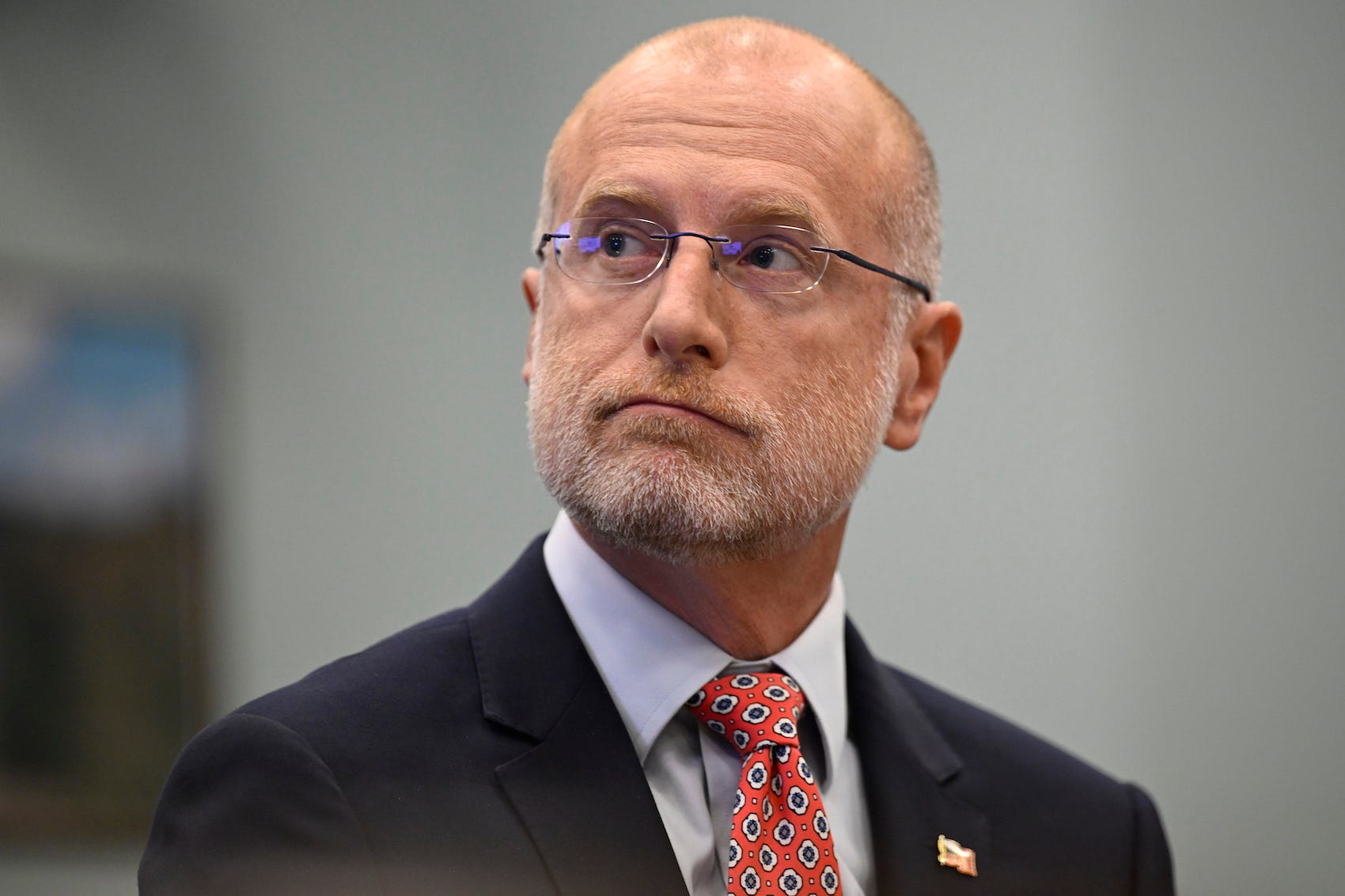
Rebuffing the retaliatory designs of Trump’s attack dog Brendan Carr, the network sued the Federal Communications Commission and its chair in a federal complaint with a blistering first sentence.
“Government censorship is deeply un-American,” the complaint begins.
‘To punish or suppress disfavored opinion’
Over the past year, ABC has gone through a remarkable transformation from appeasing Trump to aggressively defending its editorial freedom.
The low water mark came at the end of Trump’s lawsuit against ABC host George Stephanopoulos for stating that a jury found him liable for raping E. Jean Carroll. In fact, the jury found Trump sexually abused Carroll, and the judge commented that the panel’s verdict effectively amounted to a finding of rape. Had Stephanopoulos attributed the claim more carefully, there wouldn’t have been the fig leaf for a lawsuit, but Trump would have had a difficult time proving that he was damaged by a distinction without a difference.
Most observers believed that ABC’s decision had less to do with legal merit than appeasing Trump, who had the power to throw regulatory obstacles blocking the network’s Skydance merger. The Trump administration approved that merger after his settlement with Paramount.
Months later, ABC ceded ground to Trump again by suspending comedian Jimmy Kimmel. After Kimmel’s comments about Charlie Kirk’s assassination, Carr delivered an ominous threat on a right-wing podcast, telling ABC, “We can do this the easy way or the hard way.” Even Trump’s political allies thought that sounded like a mafia threat. Sen. Ted Cruz (R-Texas) went on a podcast to ridicule Carr’s comments as something out of “Goodfellas,” but the government pressure campaign worked.
ABC pulled him off the air following blowback by conglomerates Sinclair Broadcasting Corporation and Nexstar, which initially refused to carry Kimmel’s show on their affiliates. Eventually, all three companies reversed Kimmel’s suspension following nationwide protests.
After history repeated itself, ABC adopted a stronger approach.
In April, Kimmel joked that Melania Trump had “a glow like an expectant widow,” leading to a new wave of repression against ABC. Days later, a gun-wielding Cole Tomas Allen tried to break into the White House Correspondents Dinner, sparking a prosecution for attempted presidential assassination. Trump absurdly characterized Kimmel’s comments as a “despicable call to violence,” rather than a joke about his age and marriage. Carr picked up the message, immediately calling for an early review of licenses by ABC affiliates from coast to coast.
Eight of those affiliated TV stations joined the Walt Disney Company and ABC’s lawsuit, arguing that the review infringes upon their First Amendment rights.
“That fundamental principle predates the Republic, with our Founders recognizing that ‘the freedom of the press is one of the great[est] bulwarks of liberty.’ And it is no less true today, as the Supreme Court unanimously reaffirmed only two years ago: the government may not ‘use the power of the State to punish or suppress disfavored expression,’” their complaint states. “This case concerns the administration’s sustained effort to do just that.”
The ‘public interest’
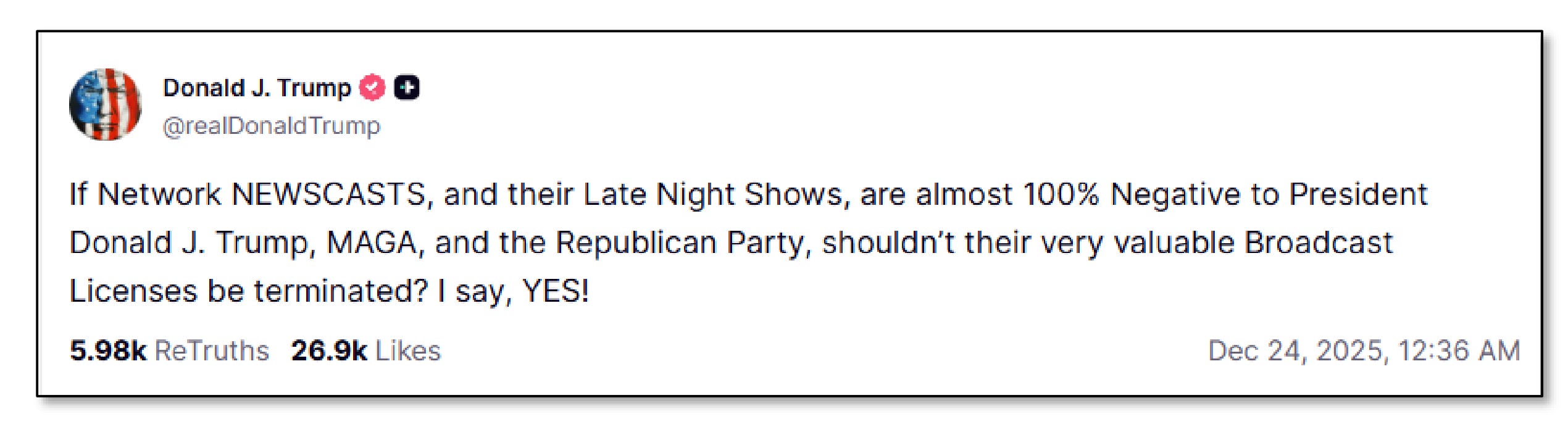
As usual, Trump has given ABC plenty of ammunition to prove that it’s being targeted for political reasons, including a Christmas Eve post embedded in the complaint.
But ABC’s more aggressive posture toward Trump administration censorship predated the lawsuit.
After Carr called for the broadcast license review, ABC harnessed the power of civic engagement by launching an ad campaign on local affiliates asking viewers to submit supportive comments to the FCC.
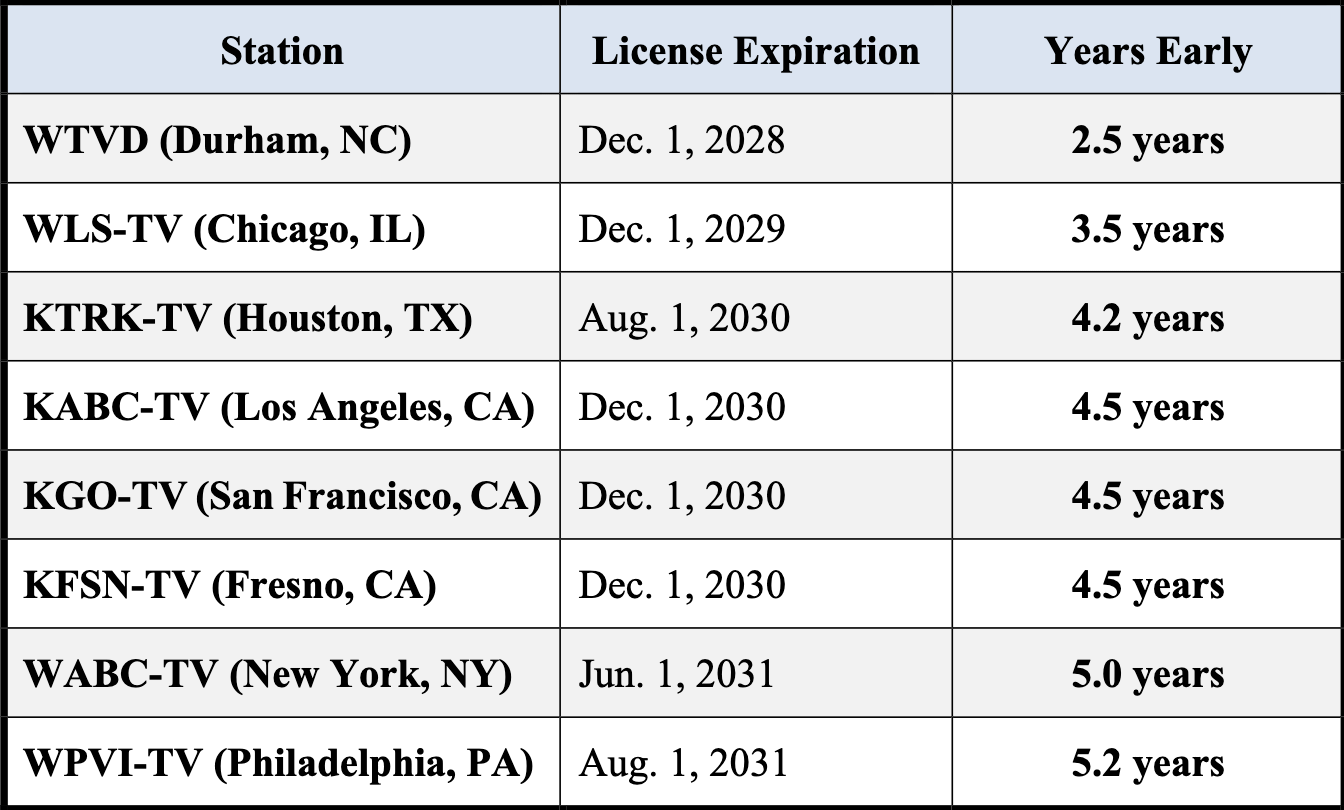
All eight of the ABC-affiliated stations behind the lawsuit were years away from requiring renewal of their broadcast licenses.
Although the FCC chair claimed the reviews were necessary to confirm that the network was “meeting its public interest obligations,” Carr barely tried to conceal his retaliatory motives, taunting the network in an interview by declaring: “If you didn’t take us seriously, now you should.”
ABC pointed out that the reviews came “extraordinarily early,” noting that all but two of the licenses hadn’t even reached the halfway point.
Trump and Carr openly threatened to revoke broadcast licenses for purely editorial decisions.
In July, Trump announced election-related conspiracy theories during primetime hours, and he fumed at major networks for refusing to air his rambling remarks in full.
“This should mean a revocation of their licenses,” Trump said.
Carr criticized the networks’ decision not to air Trump’s comments at a public FCC meeting.
ABC warns that any FCC adjudication would be a “charade.”
“The consequences of the administration’s campaign against free speech reach well beyond ABC,” the lawsuit states. “If the administration gets its way, the message to every media company in the country will be unmistakable: tell only the stories the administration deems favorable, or face the coercive machinery of the federal government. In such a world, the press could in no way be described as free.”
Read the network’s 46-page complaint here.
Thank you, Adam. We may be starting to get our media back in this war for truth we are in. So, “There's good news tonight.” …
(Was the sign-on by radio broadcaster Gabriel Heather. He used the upbeat phrase to open his news broadcasts, offering an optimistic perspective even when reporting on difficult or grim wartime events.)
"Good night, and good luck" - Edward R. Murrow
Good for ABC to finally take a stand. If Carr read All Rise News, probably he would go after the internet, too. But fortunately he is probably too dumb to read.