


By all accounts from the courtroom, the presiding federal judge was yelling.
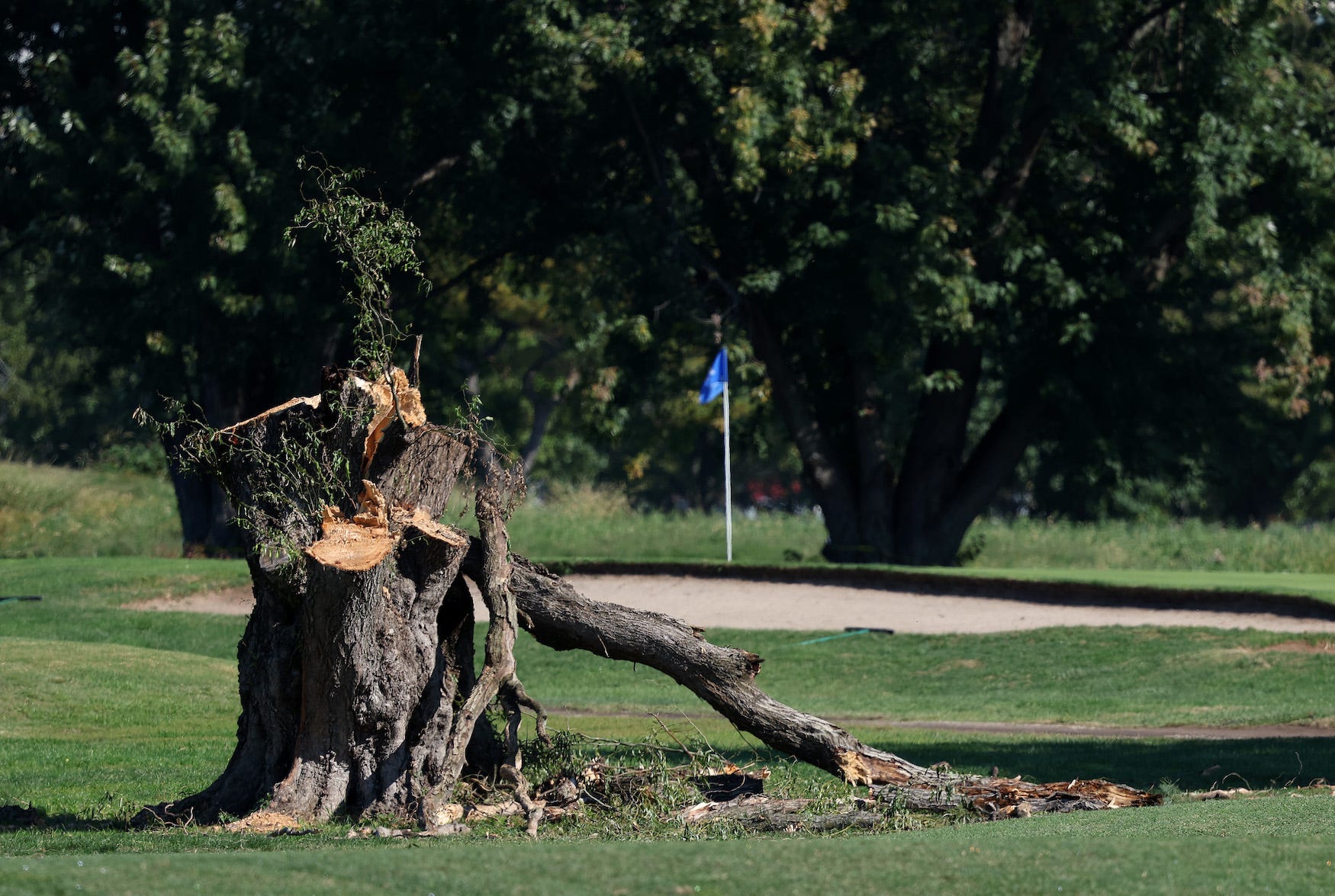
Last week, U.S. District Judge Ana Reyes was livid that the Trump administration cut down hundreds of trees along the East Potomac Golf Course, despite promising to preserve the grounds and provide ample notice before making any alterations pending the litigation.
“I was hearing from everyone on plaintiff’s side that this was going to happen,” she told the Justice Department. “I said repeatedly, ‘No, I trust the government.’ I trusted you all not to do precisely what you have done. What has happened has cost the government all of its credibility.”
Rather than reacting with contrition, the Trump Justice Department attacked the judge for the way that she expressed her outrage.
Deputy Attorney General Trent McCotter, the second highest official in the Department, sent out a post with an image of Donald Trump glaring at the judge. There was a caption on the image: “ROBES UNRAVELED,” and McCotter suggested that she didn’t have a judicial “temperament.”


McCotter must have known what it meant to put a federal judge on blast.
U.S. Marshals Service statistics show that there were 562 threats against federal judges in the last fiscal year, and Judge Reyes publicly disclosed that she became one of the targets after she ruled against Trump.
In 2019, Judge Reyes blocked Trump from revoking Temporary Protected Status against Haitian immigrants in a decision later overturned along partisan lines by the Supreme Court. The death threats poured in following the decisions, including calls to shoot and lynch her. She disclosed one chilling message that she received by email: “I hope you lose your life by lunchtime, you worthless whore.”
The Trump Justice Department has not finished attacking her: On Friday, the government filed a motion seeking her disqualification, accusing her of “histrionics,” and asking her to publicly release audio from the hearing.
“Judge Reyes’s behavior in this case is nothing short of egregious,” Associate Attorney General Stanley Woodward, the Department’s third highest official and a lawyer who represented Trump’s co-defendant Walt Nauta in the classified documents case, wrote in the motion. “And her misconduct in other high-profile litigation involving the Trump Administration only confirms that she cannot serve as an impartial arbiter of the issues in this case.”
During Trump’s first term, when then-Attorney General Jeff Sessions recused himself from the Russia investigation, Trump infamously exploded: “Where is my Roy Cohn?” The Trump mentor, a mob lawyer and chief counsel for Sen. Joseph McCarthy, taught him how to antagonize and counterpunch himself out of any situation, including a Fair Housing Act lawsuit accusing the Trump family of excluding Black people from their properties. Following Cohn’s advice, Trump countersued the federal government, launched a public relations blitz, and ultimately applied enough pressure to secure a sweetheart settlement without an admission of guilt.
In his second term, Trump has stacked the Justice Department with personal Roy Cohns following the same playbook. Led by his personal lawyers, the Department has responded to adverse rulings by judges with tactics far stronger than appeals. The Trump Justice Department sued the entire District of Maryland bench and filed misconduct complaints against nearly every judge on the District of Minnesota bench. (That first case collapsed, and the latter action remains pending.)
These actions alone targeted 22 judges, and they do not include other high-profile judicial attacks: Trump Justice Department filed a quickly dismissed misconduct complaint against Chief U.S. District Judge James Boasberg and sought the recusal of at least three other federal judges. That’s not counting the scores of other judges subjected to threats, harassment, and intimidation because Trump and his former personal attorneys leading the Department verbally attacked them online or in press conferences.
Despite the Trump Justice Department’s well-established modus operandi of judicial intimidation, Judge Reyes professed her trust in the government, and she is learning how it is repaying that grace.
Dozens of her peers already have come to the conclusion that the government does not deserve that trust. Federal judges found that the government violated court orders in at least 31 lawsuits in the first 15 months of Trump’s second term, according to the Associated Press. ProPublica found at least 40 instances where judges found that the government lost the presumption of regularity.
That’s why legal commentator Matt Ford made this connection in The New Republic: “Trump’s War on Trees Is a War on the Republic.” The article drew a straight line between felling trees and toppling pillars of the rule of law.
“The Trump administration may find all of these concerns to be tedious and pointless. They may simply regard federal public property as Trump’s personal property, as if he had acquired the United States itself in a leveraged buyout on election night in 2024. Trumpworld may tire of liberal judges and lawmakers standing in the way of Trump carrying out what they regard as the sovereign will of the American people. They would be mistaken to think this way. The American constitutional order grew over the course of centuries, watered by generations who hoped its canopy would cover future generations, as well. Trump’s allies can hack at its roots today, but they will miss its shade tomorrow.”
On Monday, Judge Reyes will hold an evidentiary hearing to investigate the felling of the trees, but the hearing will be about much more than that. The proceedings will also represent a reckoning on the Trump administration’s repeated axe strikes at the trunks of an independent judiciary in the United States.
She has invited the general public to listen to the hearing remotely.
All Rise News will cover the proceedings.
To support this work — provided in detailed, unflinching and appropriate context — please consider becoming a paid subscriber if you haven’t done so already. Most of the content of this newsletter is free, but a small number of paywalled features helps to keep this work running. One of them is a regular listing of upcoming court hearings, protests and opportunities for civic engagement.
Below the paywall:
Look out for a debrief on the latest “No Kings” day, more information about remotely accessing the East Potomac hearing and evidence that Trump’s Russian diesel antics have been animating voters.
