


Nearly six years after the 2020 presidential election, Donald Trump’s attempts to rewrite the history of his defeat in Georgia has reached dystopian heights.
On Jan. 28, the FBI seized more than 600 boxes of ballots pursuant to a search warrant predicated on an affidavit that doesn’t identify any suspect or any actions amounting to a crime or conspiracy.
The investigation originated with a referral by Kurt Olsen, a former Trump “Stop the Steal” lawyer sanctioned by multiple courts for his 2020 election lies. The affidavit supporting the search warrant rested upon claims by 11 witnesses. Their identities are redacted, but the context makes clear that many are familiar election deniers like conservative activist Kevin Moncla, who pleaded guilty to voyeurism in 2006 for surreptitiously recording his house guests with a camera in his bathroom.
Even though several investigations affirmed the 2020 election results through recounting, hand counting and auditing, the FBI’s affidavit claims there are still “defects” and “deficiencies” to probe. None of those complaints are “based in reality,” an expert witness concluded in uncontradicted testimony on Friday.
Put together, attorney Abbe Lowell said that the circumstances of the case “makes George Orwell smile in his grave.”
‘Nothing was illegal’
Browsing an antique bookstore over the holidays last year, I picked up an old copy of Orwell’s “1984.” It wasn’t a first edition, but the 1960 Signet printing was yellowed and fragile enough to be protected in a plastic wrap. I hadn’t read the book since high school. It had an attractive cover. The softcover sold for cheap, and the end of the first year of Trump’s second term seemed like an appropriate time to revisit it.
As a young student, I had associated “Orwellian” motifs with governments abusing language, encapsulated in doublethink, thoughtcrime, and the slogans “War is Peace,” “Freedom is Slavery” and “Ignorance is Strength.” In the era of the Department of Government Efficiency, this Orwellian legacy had salience enough. (At least Pete Hegseth didn’t call it the “Ministry of Peace.”) But Orwell also concerned himself with erasing the historical record in the service of destroying the rule of law.
From the book’s first pages, the reader is immersed in a lawless society the moment that protagonist Winston Smith starts the illicit act of writing in a diary.
“This was not illegal (nothing was illegal, since there were no longer any laws), but if detected it was reasonably certain that it would be punished by death, or at least by twenty-five years in a forced-labour camp.”
Orwell’s Oceania isn’t only a totalitarian state that strips the individual of language, history and consciousness. The state’s erasure of the historical record serves the function of stripping the protections of the law from its subjects. That’s why writing in a diary is so dangerous to Big Brother. More than individuality or rebellious ideas, the state fears recording history. That’s why every edition of the book’s “Newspeak” dictionary is slimmer than the last one.
As one of the novel’s most misremembered lines puts it:
‘Who controls the past,’ ran the Party slogan, ‘controls the future: who controls the present controls the past.’ And yet the past, though of its nature alterable, never had been altered. Whatever was true now was true from everlasting to everlasting. It was quite simple. All that was needed was an unending series of victories over your own memory.
The boldfaced lines rank among the book’s most famous quotations, but the full passage rebukes the Party’s empty slogan, identified in the passage as a false and oppressive premise.
Fulton County, one of the epicenters of Trump’s 2020 election subversion, is entering a new phase of Trump’s effort to control the past.
‘Pristine ballots’
At its core, Fulton County’s effort seeking the return of 2020 election ballots amount to an effort to rescue millions of ballots from manipulation and erasure from the historical record. The Trump Justice Department agreed to share photocopies of the ballots with Fulton County, but the federal government refused to return the originals or provide an inventory.
Lowell said that Fulton County authorities need those originals to respond to Trump's “constant barrage” of attacks on the election.
For example, the FBI’s affidavit rehashes a debunked conspiracy theory about “pristine ballots,” referring to absentee ballots without creases that one would expect to find when folded into an envelope. Georgia’s Secretary of State Brad Raffensperger, the Republican official Trump pressured to overturn the election, investigated these allegations and found no evidence that pristine ballots were counted.
Fulton County would need access to the original ballots to rebut any allegations about them, but that may not happen.
Even under the extraordinary circumstances of the case, Fulton County started off with a high burden. Once the FBI seizes evidence, the targets of the search can only win its return by proving the federal government’s “callous disregard” of their Fourth Amendment rights. That standard is designed to be a steep climb to limit pre-indictment attacks on an ongoing investigation.
Trump himself learned that after the Mar-a-Lago raid, and the 11th Circuit Court of Appeals overturned two of Judge Aileen Cannon’s rulings impeding the FBI’s investigation. That’s the same appellate court that would review any decision to return the seized ballots to Fulton County.
The Trump Justice Department is now citing that precedent to defeat the motion to return the Fulton County ballots.
U.S. District Judge J.P. Boulee, a Trump appointee, appeared skeptical that the country could disrupt the typical flow of the federal government’s investigation.
‘Possible cause’
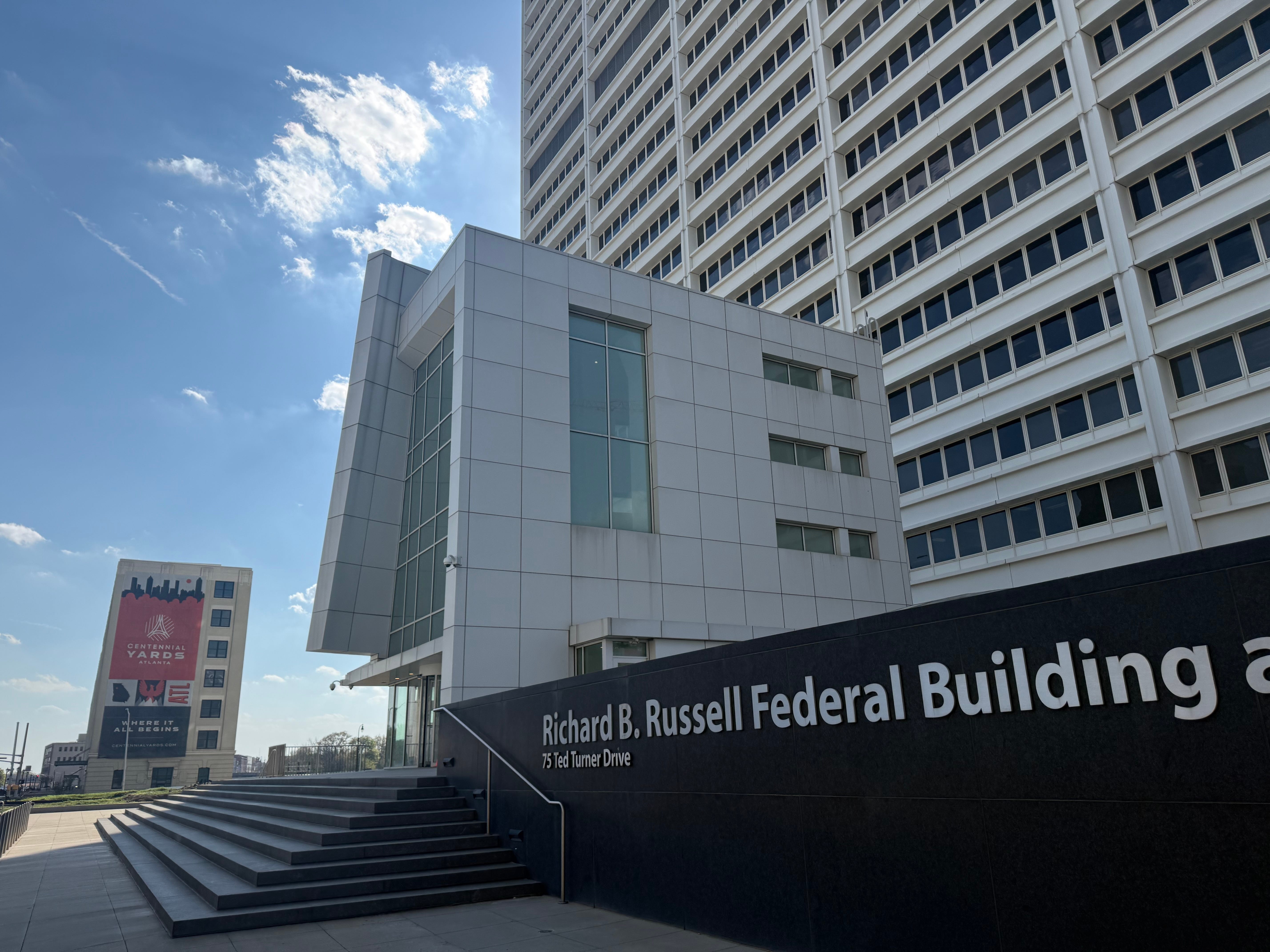
One of the most prominent attorneys defending the targets of Trump’s political retribution, Lowell could hardly contain his frustration and alarm about the ramifications of the government’s legal rationale during a daylong hearing inside the 19th floor courtroom in Atlanta.
With the midterm elections approaching, the stakes were high enough on their own, but the Trump Justice Department’s litigation position gave the hearing even more gravity. Justice Department lawyer Michael Weisbuch argued that Fulton County had no Fourth Amendment interest to protect, calling it the “silver bullet” of the case.
If this legal theory were to be accepted, Lowell warned that the government could replicate that rationale in hundreds if not thousands of other counties across the country without even requiring a warrant.
“The consequences of their position are frightening, frankly,” he said.
A 2 ½-hour countdown clock for arguments and evidence added to the tension, ticking down in red text as Lowell aimed to fit in every important point.
In the Fulton County case, the FBI successfully persuaded a magistrate judge to sign off on the warrant, which, for Lowell, was worrying enough on its own. Lowell pointed out that the warrant didn’t accuse anyone of a crime but alleged that the election had “deficiencies or defects.”
But Lowell noted that’s true of every election.
“That’s the nature of the beast,” he told the judge.
The FBI’s affidavit treats this feature of every election as probable cause of a crime.
“If these deficiencies were the result of intentional action, it would be a violation of federal law regardless of whether the failure to retain records or the deprivation of a fair tabulation of a vote was outcome determinative for any particular election or race,” the affidavit states.
Lowell told the judge that this line replaces the probable cause standard with “possible cause.”
“The magistrate made a mistake of law,” Lowell said about the signing of the warrant.
Lowell also argued that the government failed to provide U.S. Magistrate Judge Catherine Salinas with the necessary information to question the warrant, including by withholding information about the election conspiracy theorist it relied upon, the criminal record of one of the witnesses, and official reports contradicting its claims.
“You’ve got to tell the judge about something that relates to bias and credibility,” Lowell noted.
Election expert Ryan Macias testified under oath that the search warrant affidavit showed no evidence of intentional misconduct, and the supposed defects highlighted in the document happen in every election.
“It is not based in reality,” Macias said.
Fulton County’s second witness, Superior Court Clerk Ché Alexander, testified: "I have a personal interest to do my job to keep those records safe and secure,” adding that she’s under a court order to “maintain records I do not have."
The Orwellian analogy has its limits: Ballots aren’t expected to be preserved forever, and the Justice Department argues that Fulton County doesn’t have a property interest in them because they are meant to eventually be cleared and disposed of to make room for future election records.
If Judge Boulee agrees, that could doom the county’s motion. He ended the daylong hearing without a ruling.
Meanwhile, Trump’s effort to rewrite the history of the 2020 election is escalating. He celebrated the Fulton County raid at a rally in Georgia, where he told his supporters: “They cheated like dogs.”
Trump’s Justice Department lawyers didn’t even try to present any evidence of election improprieties during the hearing, claiming that litigating the claims in the affidavit could compromise an ongoing investigation. At the same time, the Justice Department criticized Fulton County’s election expert for not having a full understanding of the FBI’s investigation whose scope they refused to disclose.
Orwell might have called that doublethink.
If you can afford to support All Rise News’s live coverage of the courts, and haven’t done so already, consider becoming a paid subscriber and unlocking the weekly listings for “Rising This Week.” The Supreme Court’s upcoming birthright citizenship arguments and other high-profile cases are previewed below, along with a No Kings 3.0 recap and more.
