


It’s not just about the Iran War.
Defense Secretary Pete Hegseth is facing eight articles of impeachment scathingly and painstakingly detailed by Rep. Thomas Massie (R-Ky.) inside a 34-page resolution.
Three of those articles allege violations of the War Powers Resolution by waging an undeclared war against Iran.
From there, the resolution blames Hegseth for setting the stage for the bombing that killed more than 120 children in Minab by ignoring laws meant to minimize civilian casualties, engaging in the extrajudicial killing of more than 220 people, suppressing the free speech of his political opponents, kidnapping a foreign sovereign leader, and fighting an unlawful war in Yemen.
Here’s what to know.
Articles I-III: War Powers Resolution
The resolution accuses Hegseth of violating three separate sections of the War Powers Resolution of 1973 in his waging of the Iran War.
Professor Jamie Rowen, who teaches legal studies and international law at the University of Massachusetts at Amherst, called these three articles a striking affirmation of congressional power that Massie’s predecessors allowed to fall into disuse.
“I have never seen something so formal that actually tries to assert Congress's authority to declare war,” she noted.
Calling it a “really compelling political document,” Rowen added: “Even if presidents have gone against this over the past many decades, I saw it as an assertion of congressional authority that would rebalance power between the branches of government.”
Citing the three separate provisions of the law underlines the president’s obligation to seek reauthorization even after receiving Congress’s permission.
Article IV: Ignoring Laws That Minimize Civilian Casualties
More than 120 children died in the U.S. strike on an elementary school in Minab, Iran.
Hegseth paved the way for this tragedy through his contempt for the rules of engagement, this article alleges.
“He did so through a scheme or course of conduct that effected the systemic deterioration and removal of Department of Defense infrastructure that Congress had mandated by law to limit collateral damage to civilians and non-military objects during military operations,” the resolution states. “While doing so, Secretary Hegseth also cultivated a war-making culture at the Department of Defense which he boasts as being dismissive of ‘stupid rules of engagement’ with preference for ‘maximum lethality, not tepid legality.’”
Professor Rowen opined that this was perhaps the “most important article of impeachment” for her as a scholar of international law.
“It educates the public about the fact that there was a specialized agency within the Department of Defense that was designed to protect civilians — and that Congress intended to have that,” she said.
Among the actions cited in the resolution, Hegseth sought to repeal a law creating civilian-protection systems and reversed implementation of the Civilian Harm Mitigation and Response Action Plan.
“Basically, Hegseth — through his actions in defunding those agencies, through his statements about not following international law and through firing the lawyers — says we will openly violate international law,” Rowen said. “And Massey is saying, I believe that is an impeachable offense.”
Article V: Extrajudicial Killings
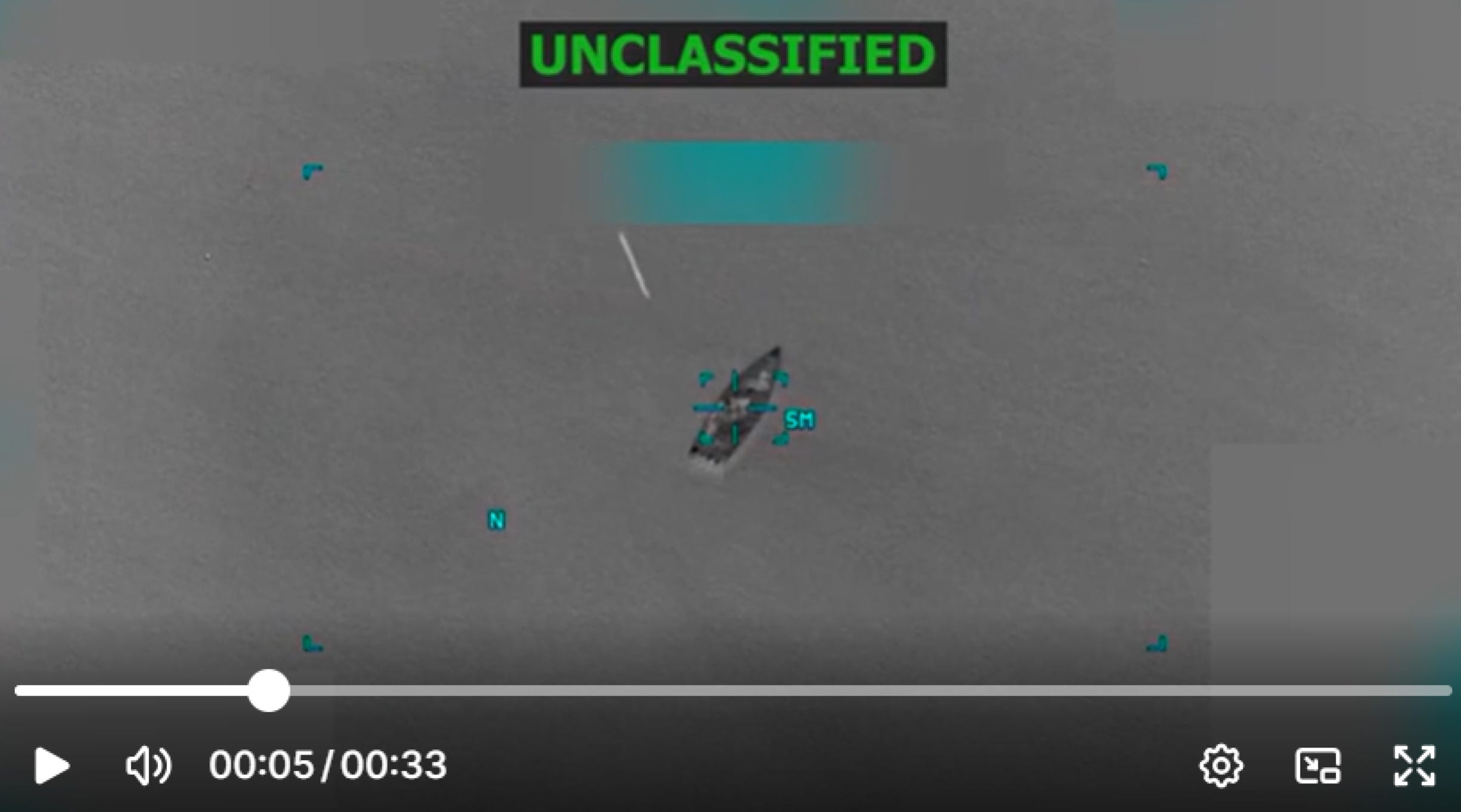
The United States has killed at least 221 people in boat strikes in the Caribbean and the Eastern Pacific Ocean, purporting to justify the attacks by claiming that the victims were suspected drug traffickers.
Rep. Massey’s resolution calls the program illegal and anathema to a civilized society.
“Secretary Hegseth arrogated to himself and the Executive Branch the roles of judge, jury, and executioner and asserted a unilateral power to determine who may live and who may die,” the resolution states. “Such a power is foreign to the rule of law, repugnant to the legal traditions and fundamental values of the United States and the Western world, and contrary to United States law and customary international law.”
Professor Rowen sees Massey’s “tea party bona fides” shining through this article of impeachment.
“So what Pete Hegseth did was direct people to murder people on boats in the Caribbean, and Thomas Massey lays it out,” Rowen said.
By designating suspected drug traffickers as terrorists, Rowen said: “The military was able to designate these people murderable, and that goes against domestic law. It goes against international law.”
Article VI: Suppressing Free Speech
On the surface, this article of impeachment is about Hegseth’s attempt to retaliate against Sen. Mark Kelly (D-Ariz.) for accurately reminding members of the military and the intelligence community that they have a right and obligation to refuse illegal orders.
As the author of the book “Worthy of Justice,” Professor Rowen said that this article of impeachment is about something much broader: respect for the troops and veterans.
“They sacrificed themselves for this country,” Rowen said. “To treat a veteran the way that Pete Hegseth treated Mark Kelly is so dishonorable.”
Kelly won his First Amendment lawsuit seeking to block retaliation by the Pentagon for his protected speech, and a criminal prosecution against him and five other lawmakers collapsed before a grand jury.
But she noted that Hegseth’s “contempt for freedom of speech” extends much farther than his failed attempt to silence the Arizona senator, Navy captain and astronaut.
“There was a massive walkout by all media outlets because they were asked to basically sign an oath of fealty — again, contrary to our freedom of association and freedom of press — to say that they would not speak to people who were disclosing information the Pentagon didn't officially approve of,” Rowen said.
A federal judge rebuked that attempt, too.
Article VII: Kidnapping of a Foreign Sovereign Leader
Rep. Massie’s account of the raid that abducted Venezuelan strongman Nicolás Maduro and brought him to New York for prosecution is blistering.
“Using the powers of his office, Secretary of Defense Peter Hegseth directed the Department of Defense to carry out an unprecedented military operation — code-named ABSOLUTE RESOLVE — to capture and kidnap President Nicolas Maduro, the leader of the Bolivarian Republic of Venezuela, and his wife, Cilia Flores, from Venezuela — an act of war against a sovereign country executed under the guise of narcotics law enforcement, though in actuality intended to assert U.S. control over Venezuela’s oil reserves,” this article begins.
Professor Rowen marveled at the language used by the highly conservative tea party stalwart.
“It's amazing it wasn't written by a pink-hatted, self-declared woke person,” she said.
Politics aside, Rowen found that the pronouncement was “important.”
“It says that international law matters, and that the United States following international law matters, and that the Secretary of Defense breaking international law matters, and that holding him to account through impeachment is an answer to that,” she said. “No one else is holding him to account for that behavior. There isn’t an international court that is going to do something about this, and so to actually look at accountability through the domestic impeachment process is another lever of power that I’m impressed Massey is using.”

Article VIII: Unlawful War in Yemen
The final article of impeachment against Hegseth foregrounds a global conflict that has received scant media coverage.
“Using the powers of his office, Secretary of Defense Peter Hegseth directed the Department of Defense in a manner leading to the deaths of an estimated 224 civilians, as well as approximately 500 to 600 Houthi fighters, through the initiation and direction of Operation Rough Rider,” the resolution states. “The operation comprised more than 1,100 strikes against targets in Yemen over approximately 52 days. In less than eight weeks, there were nearly as many civilian deaths in Yemen as United States military actions had caused in that country during the preceding twenty-three years.”
The resolution details conversations between Hegseth and senior Trump officials about the operation.
According to the resolution, Vice President J.D. Vance, CIA director John Ratcliffe, and then-Acting Chief of Staff to the National Security Advisor Joe Kent all favored delaying the operation, finding no imminent threat to the United States, but Hegseth pushed ahead in order to establish “deterrence.”
“Even though there is no protecting Americans to do it, we are just going to use force to show force,” Rowen said. “This is the reason we have international law to rein in people like that.”
Read the resolution here, and watch the full interview at the top of this newsletter.


