


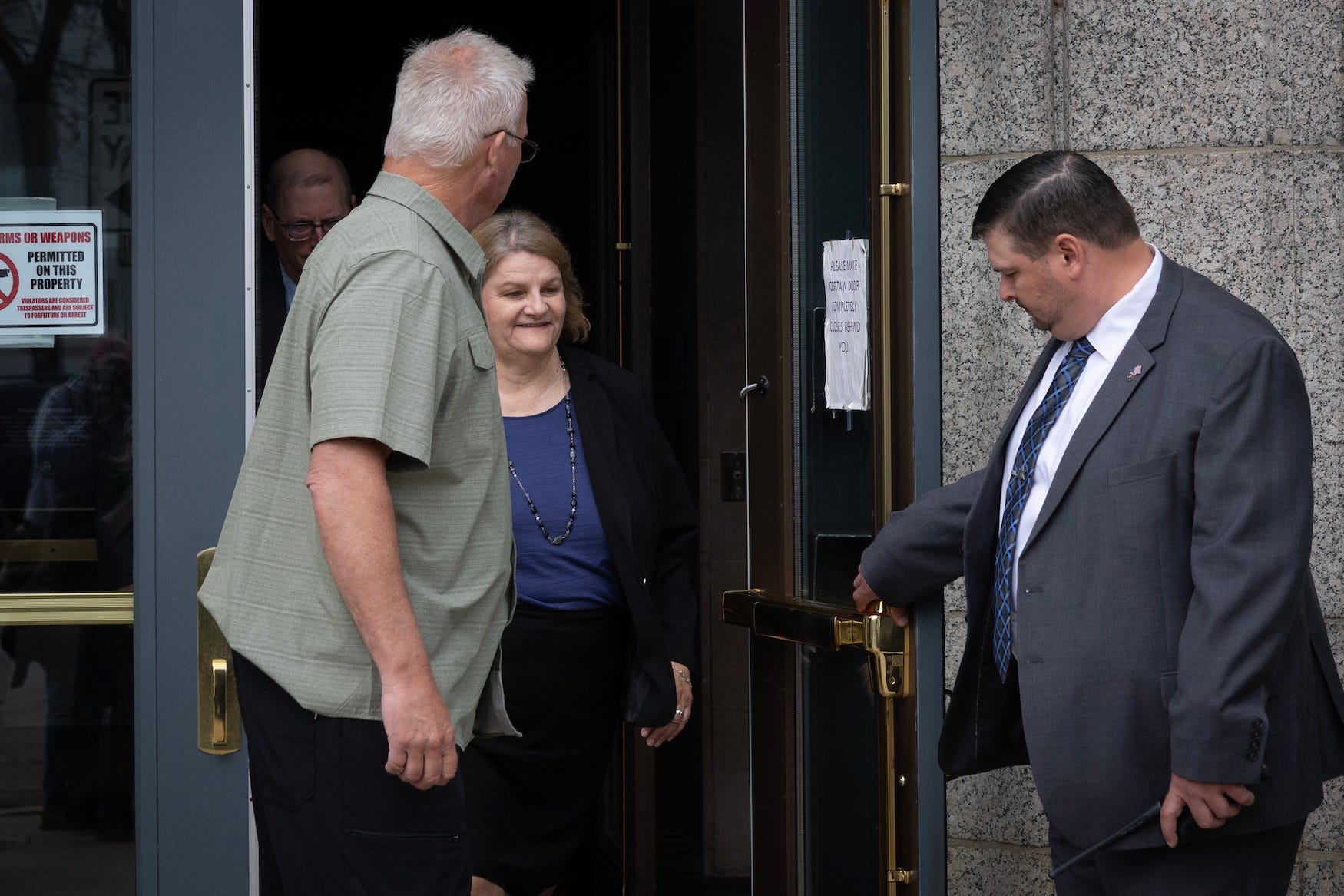
This All Rise News feature spotlights the law enforcement testimony in Judge Dugan’s trial.
For coverage of today’s testimony by Dugan’s fellow judge, click here.
The arrest of undocumented immigrant Eduardo Flores-Ruiz did not go smoothly for the six-member law enforcement team that showed up at Milwaukee County Circuit Court to arrest him on a very rainy April 18.
Court security told Immigration and Customs Enforcement deportation officer Joseph Vasconcellos that he needed an escort.
The team ultimately gathered in the hallway outside the courtroom of Judge Hannah Dugan, and Vasconcellos couldn’t hide his frustration in a text message to another officer.
“This is gonna be a pain in the dick,” Vasconcellos wrote, referring to Flores-Ruiz’s arrest.
“He started running”
Vasconcellos was right.
A face mask-wearing public defender kept photographing the plainclothes officers, who struggled unsuccessfully (and perhaps, in light of surveillance footage, clumsily) to be discreet.
Two judges confronted their team in the hallway about the arrest plans, sending members of their team to Chief Judge Charles Ashley’s office for guidance.
Instead of arresting Flores-Ruiz as planned, the officers ultimately confronted the defendant outside in the pouring rain. FBI agent Phillip Jackling said he told him: ‘Ruiz, F-B-’ and he started running.” Jackling and Vasconcellos chased the defendant by foot, and Vasconcellos caught Flores-Ruiz first.
Federal prosecutors would eventually blame Judge Dugan for the turbulent sequence of events, charging her with obstruction and concealing an individual from arrest. As Dugan fights those charges, her trial has opened a window into how shifting immigration priorities in the Trump 2.0 era has led to upheaval in Milwaukee county and throughout the country.
Roughly half a dozen law enforcement witnesses have testified so far in Judge Dugan’s trial, and about half of them were FBI agents designated to immigration enforcement teams.
Nearly half of the FBI agents in U.S. major field offices have been reassigned to immigration enforcement, The Guardian reported in October.
‘Frozen Water’
The flush of immigrant enforcement manpower quickly became evident in Judge Dugan’s trials.
Prosecutors intend to call up to 25 witnesses, and nearly a dozen have testified so far. FBI Agents Jeffrey Baker and Jackling are among those who were designated to ICE from the bureau. Asked whether he considered the reassignment a “downgrade” from his prior national security and anti-gang beat, Baker denied that was the case.
Other members of the team previously worked on more serious cases than that of Flores-Ruiz: Customs and Border Protection supervisory agent Joseph Zuraw said he spent nearly a decade on the Joint Terrorism Task Force. Vasconcellos had the battle scars of the violent cases to which he was assigned.
“During the course of my duties, I’ve been shot at, I’ve been stabbed,” Vasconcellos said, adding a litany of other troubling encounters. “I’ve had nerve damage in my neck from fighting with individuals [targeted for arrest].”
Although charged with domestic abuse, Flores-Ruiz faced only misdemeanor charges, and he was met with a six member arrest team flanked by FBI drivers and surveillance. Those agents chatted during the operation in a Signal chat room called “Frozen Water,” indicating ICE.
One of the chat participants, the Drug Enforcement Agency’s Bryan Ayers, had an avatar of a skull over a pill bottle with syringes substituting as crossbones. Another unidentified chat participant’s profile picture showed an image of a man licking a gun.
Dugan’s lawyer Jason Luczak indirectly compared the chats to Defense Secretary Pete Hegseth’s Signalgate scandal. The case’s law enforcement witnesses took different views of the messaging platform.
“I have since learned that they do not recommend [using Signal],” Agent Jackling said.
Zuraw, however, suggested that policy is changing in Trump 2.0.
Asked whether the Department of Homeland Security authorizes the use of Signal, Zuraw replied: “Currently, yes.”
“Dominated the hallway”
Dugan’s defense team has highlighted the chaotic and unguarded moments of the law enforcement team, and they lambasted the prosecution’s attempts to tie her actions to their difficulty arresting Flores-Ruiz.
According to prosecutors, Dugan led Flores-Ruiz and his lawyer Mercedes de la Rosa through a jury door that led to a restricted hallway. One of the exits of that hidden hallway led to a stairwell, and the other emptied into the public hallway where agents were waiting.
Flores-Ruiz and his lawyer left through the public hallway and passed a pair of agents along the way.
During opening statements, Dugan’s lead attorney Steven Biskupic noted that the case amounts to “10 feet, 11 inches,” the distance between the main entrance of Dugan’s courtroom and the side door where Flores-Ruiz exited.
Trump’s Justice Department also prompted several law enforcement witnesses to endorse their view that courthouse immigration arrests are “safe” and “routine,” repeating that line of questioning so often that they drew the ire of U.S. District Judge Lynn Adelman.
“We’re getting kind of repetitive here,” Adelman said.
But testimony has shown that, while courthouse arrests may be common, immigration ones are not.
The jury has seen candid emails from judges inside Milwaukee County Circuit Court expressing anger and confusion over the practice, seeking guidance from Chief Judge Carl Ashley over the practice.
Ayers, the DEA agent with the skull-and-crossbones Signal avatar, agreed during his testimony that he was aware of the controversy from media coverage.
After the operation, Ayers agreed that he said in a post-arrest report: “We dominated the hallway.”
Stay tuned for my Substack Live with Joyce Vance at 6:30 p.m. Central Time (7:30 p.m. ET).
This feature is part of ongoing All Rise News live coverage of Judge Dugan’s trial in Milwaukee, Wisc. To support this on-the-ground reporting about the cases you care about, consider becoming a paid subscriber if that is within your means.
With no guidance, how do the Judges proceed attempting to subdue the court’s proceedings?
I believe the Judge was doing what she felt would protect everyone in the court instead of a sideshow at a circus which ICE appears to create.
Thanks for your standard up to the second repotting, Adam. Judge Duggan’s is a case of supreme interest for many reasons, not least, the incorruptibility of the U.S. legal system.