


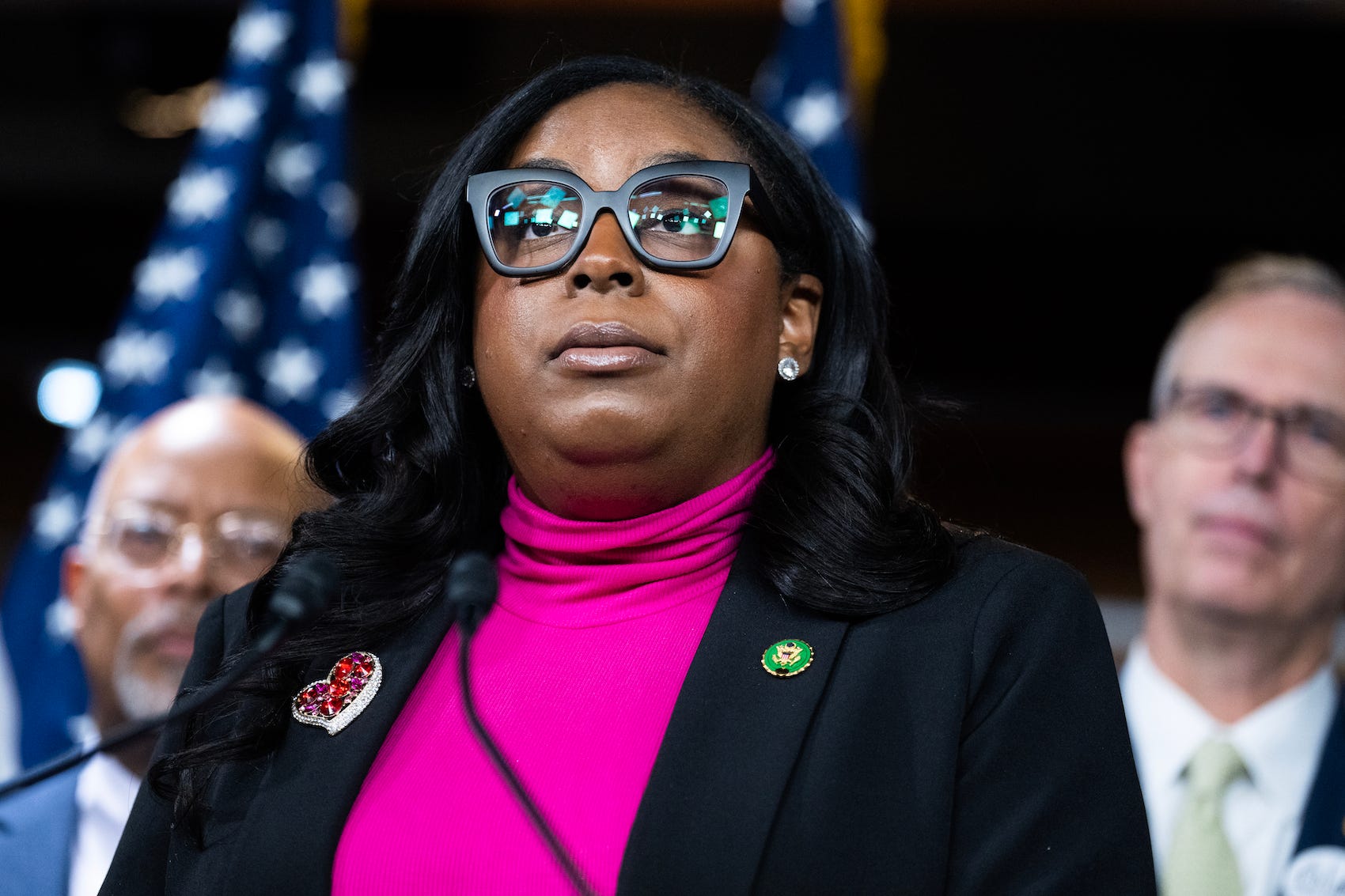
In tonight’s legal roundup, All Rise News breaks down the high-stakes oral arguments in the case of Rep. LaMonica McIver.
Also: Key parts of Trump’s executive order trying to seize federal control over voting get slapped down by a judge. A federal appeals court hands a blistering rebuke of Harmeet Dhillon’s voter data grab, and Don Lemon turns up the heat on Trump’s DOJ.
Now pregnant with her second child, Democratic Rep. LaMonica McIver of New Jersey could be forced to endure a federal trial on charges carrying a maximum sentence of up to 17 years imprisonment unless an appeals court intervenes.
On Wednesday, the Third Circuit Court of Appeals considered her attempt to throw out the case for vindictive prosecution, and one appellate judge used a Shakespearean analogy to acknowledge that the criminal process of a trial extracts its own price, whatever the outcome.
U.S. Circuit Judge Thomas Ambro noted that the purpose of a selective or vindictive prosecution isn’t necessarily a conviction, describing the sentiment of a weaponized process this way: “I want to see them under the pressure of having to deal with this, both the financial and the personal pressure — stress — that one goes under, and that’ll be enough for me to get my pound of flesh.”
A little more than a year ago, McIver visited the Delaney Hall immigration detention center in Newark, N.J., performing oversight with a congressional delegation. The visit got contentious after federal agents moved to arrest Newark Mayor Ras Baraka (D) on trespassing charges that later collapsed.
The Trump Justice Department continued to pursue its case against McIver, charging her with the same assault charge deployed against now-pardoned Jan. 6 rioters who brutally attacked police at the Capitol. By contrast, the government released heavily edited footage of McIver lightly brushing up against agents during a crowded melée near the security gate.
Supervisory Assistant U.S. Attorney Mark Coyne, a 12-year career prosecutor who now serves as Chief of the Appeals Division in the District of New Jersey, tried to bolster the case with his reputation.
“That hypothetical presumes that people like me would bring charges for vindictive reasons,” Coyne said.
But McIver’s attorney Paul Fishman noted that there’s already evidence that the call in his client’s case came down from Washington, D.C. McIver’s defense team obtained video clips showing that then-Deputy Attorney General Todd Blanche ordered Baraka’s arrest.
“These calls on cases involving members of Congress, we can’t be naive about this,” Fishman said. “They are not made in Newark.”
Ambro pressed Coyne on whether he had seen an assault case involving “similar level of contact” with officers during his career, and the judge added that he “struggled” to find a precedent.
“I don’t know if it’s a similar level of contact, but just recently we charged somebody for throwing an umbrella at a federal law enforcement officer,” Coyne replied.
U.S. Circuit Judge Cindy Chung, a Biden appointee, pressed the prosecutor about how he could square the case with the Constitution’s Speech or Debate Clause, immunizing members of Congress for conduct that takes place within the “legislative sphere.”
“If she were observing, but just standing very close to the mayor, and they said move, and she wouldn’t move, would that require inquiring into her motive?” Chung asked. “Is she not moving because she wants to observe, or is she not moving because she’s trying to resist? Would that inquiry violate the Speech or Debate Clause?
In briefing papers, Coyne said that the legislative privilege doesn’t include assaulting an arresting officer, but McIver’s attorney Paul Fishman memorably gave the counterargument.
“If any member of Congress walks into a bar, sees an ICE agent and decks him, it’s not covered, and that’s not what the law is,” Fishman said. “If the member is in the middle of doing an inherently, manifestly, or even ambiguously legislative act, it’s covered.”
Prosecutors argue that the appellate court doesn’t have jurisdiction before trial, and Judge Stephanos Bibas, a Trump appointee, noted that McIver ultimately could be acquitted.
Fishman responded: “I certainly hope that happens if we get there, but we should not get there.”
Even allowing a trial to proceed, Fishman said, hands the government a distressing power.
“If you put all of those things together, what this does is it gives the Department of Justice and the Department of Homeland Security the ability to interfere, impede, obstruct, thwart members of Congress who are doing exactly what they are allowed to do by law, and then when something happens, say, ‘Oh my goodness, this was an assault. She threw a ham sandwich, she threw an umbrella, she threw an elbow,’” Fishman said, his voice passionately rising.
“Where are we, judge, in 2026, that that’s the government’s defense to this patently awful prosecution of a sitting federal congressperson?” he asked. “This court has the power under the speech or debate clause to say, ‘No, that’s not right. What she was doing was authorized, and what she was doing was lawful, and what she was doing was constitutional.”
The judges ended the hearing without a ruling.
Judge blocks Trump’s proof of citizenship order
A federal judge nixed major portions of Donald Trump’s executive order intruding upon how states conduct elections on Wednesday, striking down requirements of documentary proof of citizenship and Election Day deadlines for receiving ballots.
U.S. District Judge Denise J. Casper, an Obama appointee, found a “substantial risk” of voter disenfranchisement if she didn’t act.
“On the other hand, there is no evidence in this record of widespread ‘illegal voting, discrimination, fraud, and other forms of malfeasance and error’ within American elections, which the executive order purports to safeguard against,” she observed in her 59-page memorandum and order.
Casper declared the provisions unconstitutional and void, finding that they violate the separation of powers and go beyond Trump’s powers.
Here are some highlights from the ruling:
Judge Casper described some of the barriers documentary proof of citizenship would have put for voting.
“Several forms of government-issued identification, including the majority of the REAL IDs administered by the plaintiff states, do not include citizenship information, […] and a substantial portion of voting-age U.S. citizens do not possess some of the more common forms of government-issued identification that do, such as a passport.”
She found that much of the evidence of harm was “undisputed.”
In addition to conflicting with state laws, Casper wrote of the mail-in deadline: “Likewise, the undisputed record shows that eliminating post-Election Day cure periods would risk disenfranchising tens of thousands of voters due to “minor ballot errors.”
She added that “the undisputed record shows that disqualifying ballots that are postmarked by Election Day but arrive thereafter would disproportionately harm military voters, elderly voters, voters with disabilities and voters in rural areas, all of whom face unique obstacles to mailing access and service.”
The order came in response to a 19-state coalition’s lawsuit, led by California Attorney General Rob Bonta (D).
Celebrating the decision in a statement, Bonta said: “We sued President Trump over his attempt to unilaterally impose voting restrictions across the country — and we won. Today, a federal district court ruled that every provision we challenged in the executive order is unlawful and reaffirmed that the power to regulate elections is reserved to the States and Congress. While we are proud of this result, we are clear-eyed that President Trump’s attacks on voting rights and our elections show no signs of slowing down. So let me be clear: we will keep fighting back every step of the way.”
Appeals court scorches voter-data grab
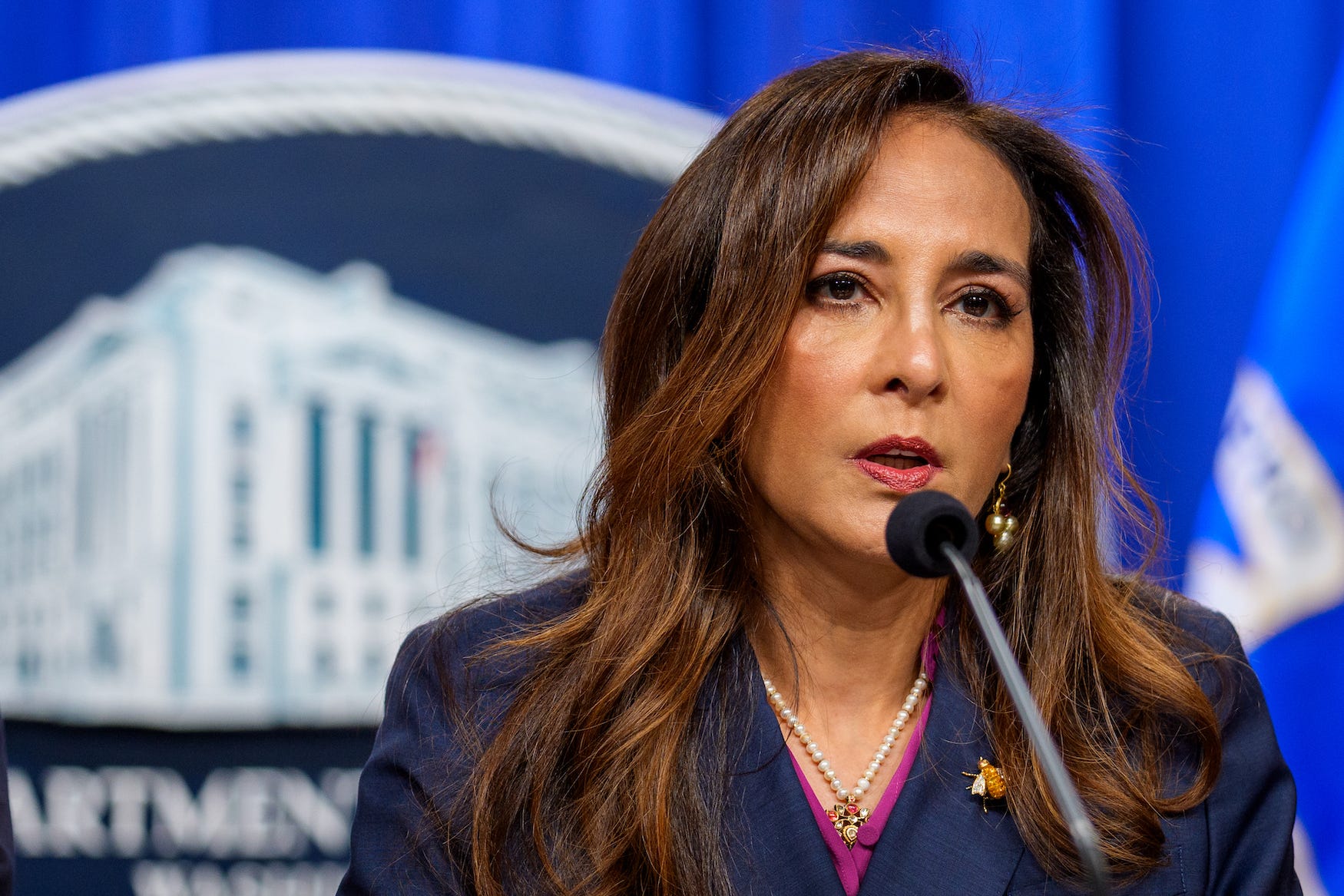
A federal appeals court delivered a blistering rebuke of the Trump Justice Department’s attempt to seize states’ voter data before the midterm elections — and attempting to justify it by turning the Civil Rights Act on its head.
“Back then, the government used this power to ensure that everyone who had the right to vote could freely exercise that right,” Sixth Circuit Judge Andre Mathis wrote in his ruling. “But today, the government invokes Title III for an inverse purpose—to ensure that some people have not voted.”
Since last summer, Trump’s former 2020 election lawyer turned Assistant Attorney General for Civil Rights Harmeet Dhillon has filed lawsuits demanding sensitive voting data across 29 states and Washington, D.C., and she has lost every attempt that has gone to a ruling.
To date, nine district courts have rejected her attempted voter data grab, and Wednesday’s Sixth Circuit ruling affirms a ruling in Michigan.
The Michigan records demanded by the Trump Justice Department included “dates of birth, partial social security numbers, and driver’s license numbers of every registered voter in the state.”
U.S. Circuit Judge R. Guy Cole Jr., a Bill Clinton appointee, joined the 2-1 majority decision.
Judge John Nalbandian, a Trump appointee, dissented. At least four Trump appointees have found against the government.
Read the ruling in full here.
Don Lemon revives push for grand jury records
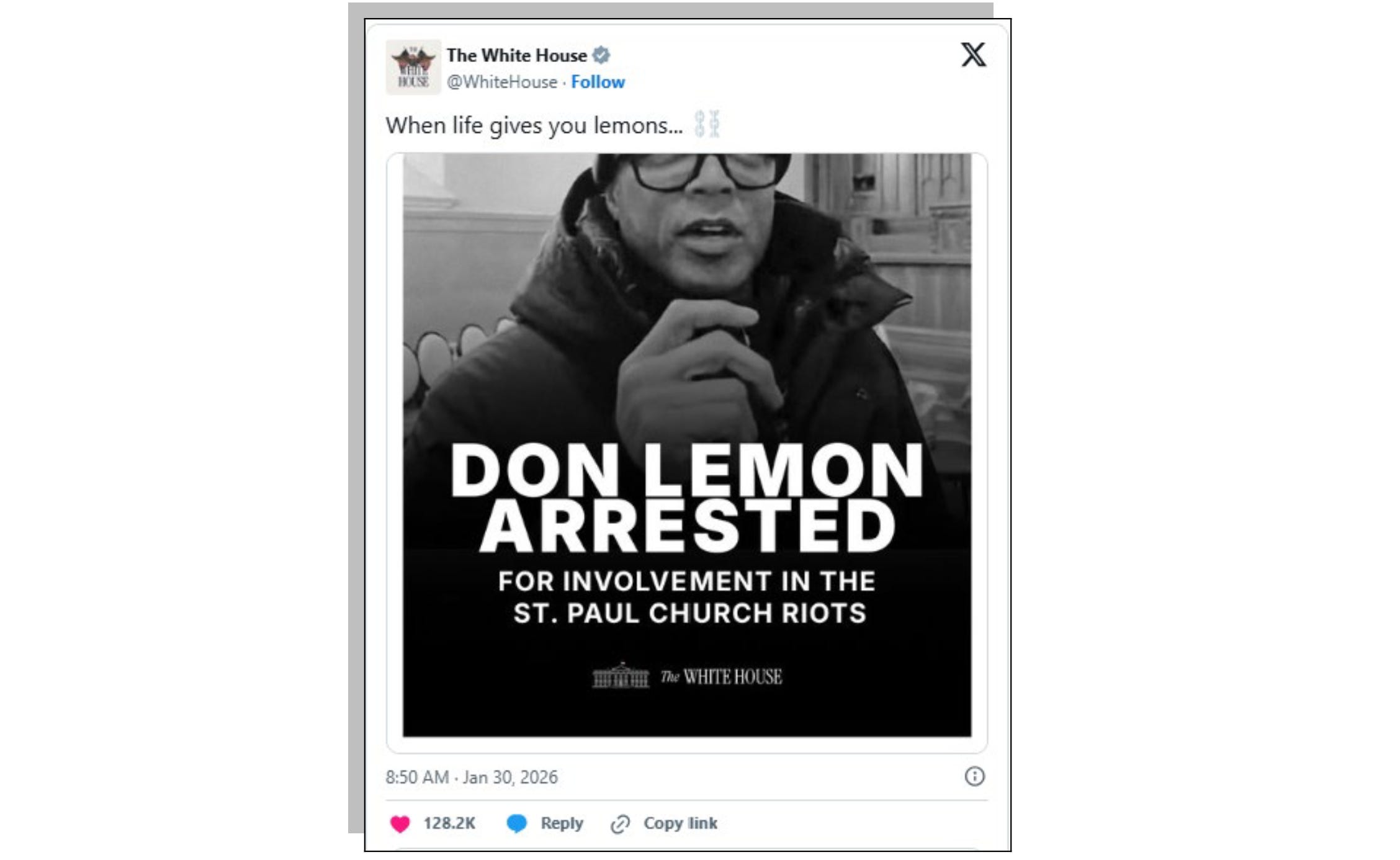
This screenshot of the White House’s official account gloating about Don Lemon’s arrest — before it even happened — appeared in a new motion today seeking another chance to obtain grand jury records to throw out his case.
Lemon filed the motion on Wednesday together with his fellow journalist and co-defendant Georgia Fort.
Both were indicted in January in connection with their reporting on a protest inside Cities Church in St. Paul, Minn., as prosecutors leveled charges under the FACE Act — a law designed to protect abortion clinics and places of worship — and a Reconstruction-era civil rights law.
Their attorney Abbe Lowell notes that the case began with a magistrate judge rejecting charges, part of what he describes as the case’s “checkered” history.
“There is substantial evidence of grand-jury irregularities in this case,” Lowell wrote. “Multiple judges, including at the Eighth Circuit, found there was no probable cause to charge Lemon and Fort. A federal agent falsely attested repeatedly to judges that Lemon and Fort engaged in ‘chanting’ inside the Church, including to obtain a search warrant for Lemon’s iPhone—an allegation not originally present in the denied complaint affidavit, and which was subsequently revised in future affidavits to clarify that only ‘some’ individuals had engaged in ‘chanting.’”
The defense said that the government admitted to “material misrepresentations about Fort in at least eight affidavits.”
Over in Chicago, the disclosure of grand jury records infamously sank the prosecution of anti-ICE activists known as the “Broadview Six,” but Lemon and his co-defendants have struggled so far to bring the documents to light. Grand jury secrecy is hard to penetrate, and a magistrate judge rejected their first attempt.
Their latest filing effectively serves as an appeal to the trial judge: U.S. District Judge Laura M. Provinzino, a Biden appointee.
Thank you for these detailed updates, Adam. We all need every bit of hope we can muster!
All Federal judges need to be cognizant of the fact that any indictments obtained by this Dept. of (in)Justice are suspect! They have no morality or ethics.