


Although it has “no precedent” in U.S. history, the Trump Justice Department’s criminal case against former FBI director James Comey would fit right into the English monarchy of the 1300s.
That’s a running theme of Comey’s motion to dismiss his indictment as incompatible with the First Amendment of the Constitution.
Comey’s lawyers point out that the indictment defies “dictionaries, context, precedent, and common sense,” but it is well-suited for a time when English subjects were “hung, drawn, and quartered for ‘imagining’ the death of the King.”
‘Treason by words’
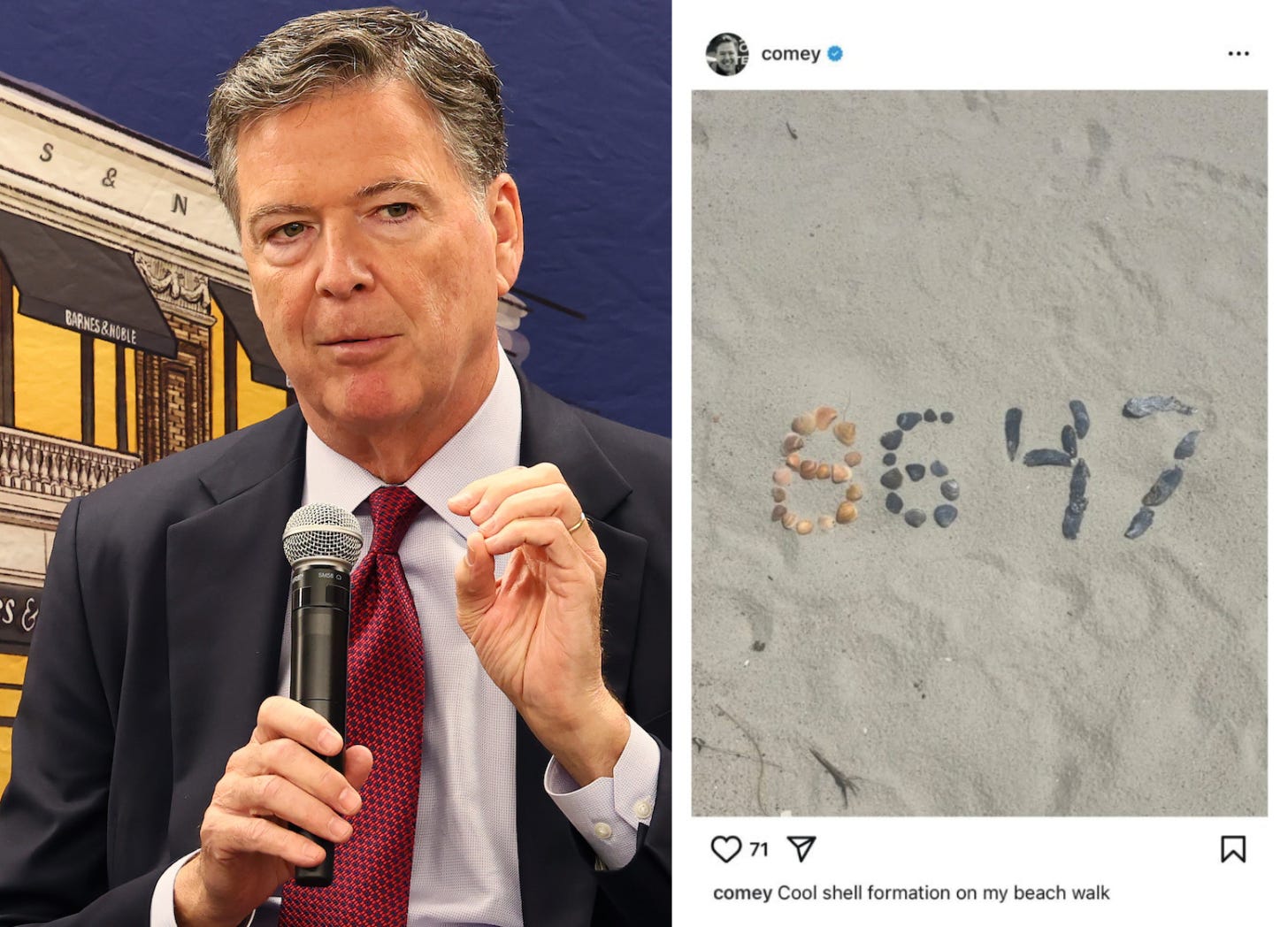
Charged with threatening Donald Trump’s life, Comey has been facing a two-count indictment because he photographed a collection of seashells on a North Carolina beach arranged to spell out “86 47” in May of 2025.
“Cool shell formation on my beach walk,” Comey mused in the caption of his Instagram post.
As Comey’s lawyers note, “86” is common restaurant slang for being out of a dish or throwing out a customer. The motion to dismiss cites three major dictionaries endorsing this definition: Merriam-Webster, American Heritage Dictionary of the English Language, and Oxford Dictionary.
But Comey quickly deleted the post after Trump loyalists claimed that the numbers meant “to kill” the 47th president.
Even if that “implausible” interpretation were true, Comey’s lawyers point out that this would not be a crime under U.S. law because the Founders of the U.S. Constitution rejected a legal regime which harshly punished imagined harm to the English crown.
“Beginning in the fourteenth century, English law made it illegal to ‘compass or imagine the Death of our Lord the King.’ […] That prohibition was interpreted to include ‘treason by words,’ under which ‘[w]ords themselves were regarded as the overt act of treasons.’ […] The treason statute was enforced against citizens who made general statements opposing the King—for instance, that the kingdom would have been better off “if the king had never been born.” […] Likewise, a man was indicted for ‘predict[ing] that the king would ‘soon die, with a view to alienate the affections’ of the people.’ […'] Prosecutions for ‘compassing the king’s death’ thus became a ‘principal instrument’ to ‘suppress a wide range of political opposition.’
The Founders repudiated this British practice.
Comey’s attorneys Joseph Zeszotarski, Patrick Fitzgerald, Ephraim McDowell and Rebekah Donaleski mine through U.S. history and precedent to make that case.
“For example, after George Washington signed the controversial Jay Treaty in 1795, the toast at a Virginia dinner party was to ‘[a] speedy death to General Washington,’” they wrote in their memorandum. “When John Jay returned to the United States after negotiating the same treaty, he ‘reportedly ‘wryly observed that he could have found his way across the country by the light of his burning effigies.’”
In 1835, “Vice President John C. Calhoun called President Andrew Jackson ‘a Caesar who ought to have a Brutus’ just days before an assassin attempted to take Jackson’s life,” the memo continues.
A ‘radical theory’
Even under the harshest light, Comey’s now-deleted Instagram post was far tamer. Comey didn’t arrange the shells to form “86 47.” He simply photographed it and wrote that he found the image “cool.” He then deleted the post when people claimed to take offense, writing in a follow up post: “I oppose violence of any kind.”
Comey’s attorneys point out that “thousands of items” of merchandise advocating to “86” U.S. presidents are available for sale on the internet. In 2020, a Republican politician formed a political action committee called Eighty-Six Trump PAC, and Michigan Gov. Gretchen Whitmer wore an “86 45” pin during Trump’s first term. Right-wing influencer Jack Posobiec posted “86 46” during Joe Biden’s presidency.
But Comey’s attorneys note that Supreme Court precedent allows explicitly violent political rhetoric about a president that falls short of a “true threat” or incitement.
In the “foundational” decision of Watts v. United States in 1969, the Supreme Court cleared the conviction of a Vietnam War protester who said: “If they ever make me carry a rifle[,] the first man I want to get in my sights is L.B.J.”
Close to two decades later in 1987, the Supreme Court ruled in the case of Rankin v. McPherson that a law enforcement official was unconstitutionally fired after remarking about an assassination attempt on President Ronald Reagan: “If they go for him again, I hope they get him.”
Comey’s attorneys point out that there’s no comparison between the statement ruled lawful by the Supreme Court, Trump’s own history of violent rhetoric, and the post at issue in this case.
“No authority holds that broadcasting to the world another person's expression of a well-known political slogan with at most only an attenuated, obscure, and implausible suggestion of a call to violence can constitute a true threat,” they wrote. “This court should not be the first to endorse that radical theory.”
Read their memorandum in full here, and check out my video breakdown below for Legal AF.
Love that this is coming down to a freedom of speech and/or imagining. Costing a lot of GD money. But still, in the end it may help someone to validate their freedom of speech and imagining in the future. And we need all of that, that we can get! If not, 'imagine' how AI would interpret future cases. Whoa! I wonder how AI is interpreting this case, now? Do the Supremes use AI to better their odds of holding sway while going against passed decisions? Better yet, are some of them going to pay to use DJT's new Insiders Trading for Buddies gambit? Such a world we live in!?!? :-)
The historical background is so interesting. There was, of course, the matter of Thomas á Beckett in the 12th century, with Henry II supposedly asking no one in particular, “Will no one rid me of this meddlesome priest?”, and living to regret his words when they were acted upon. That background may have added some moment to the prohibition of imagining the monarch’s death. The present instant is trivialized by the President’s limitless vanity although he is in as much danger as any prominent person always is.