


Tonight’s legal roundup:
Kash Patel’s denials of excessive drinking keep getting torn apart. A federal judge won’t return seized 2020 election ballots in Georgia, and another likely retaliatory prosecution brews.
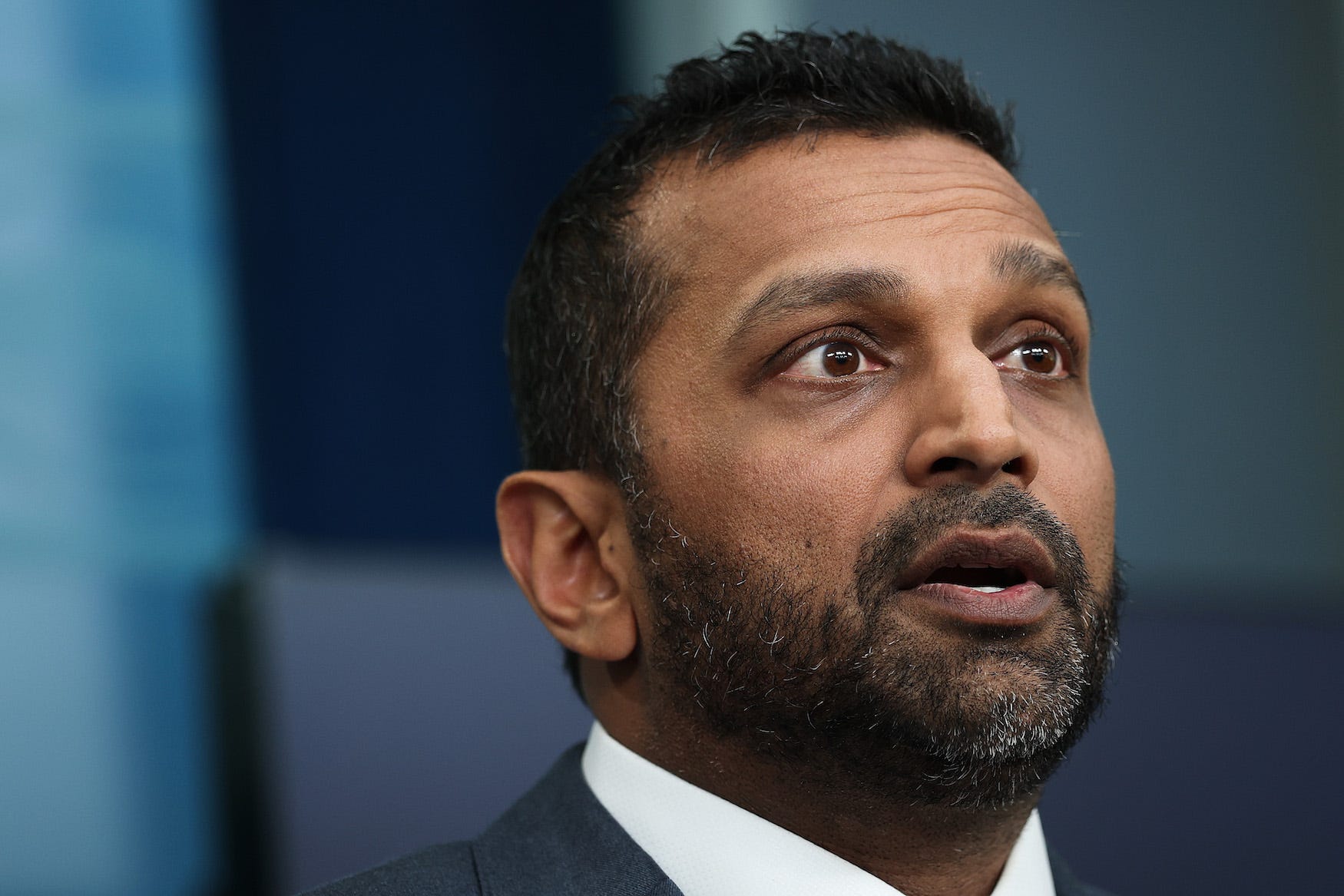
FBI Director Kashyap Patel ordered a criminal investigation into The Atlantic’s embarrassing exposé last month, in which two dozen sources accused him of excessive drinking and erratic behavior, according to reporting from MSNOW.
The hits kept coming against Patel from there.
Press freedom groups quickly denounced the alleged targeting of The Atlantic’s reporter Sarah Fitzpatrick, whom Patel is suing for $250 million in defamation damages on the legal theory that she used “sham sources.”
Legal observers quickly seized upon the contradiction: To win the lawsuit under the actual malice standard, Patel would need to prove that The Atlantic and Fitzpatrick knew or should have known that two dozen sources corroborating the reporting weren’t credible, but they ran with the story anyway.
“That is one way to refute reporting that you make erratic decisions that you don't think through — to launch investigations into the same sources that your defamation complaint implies don't exist,” the Freedom of the Press Foundation’s chief of advocacy Seth Stern quipped in an interview with All Rise News.
The FBI denied investigating Fitzpatrick in a statement to MSNOW, whose sources said that those assigned to the matter expressed discomfort about the directive.
Later in the afternoon, Fitzpatrick published a followup to her previous investigation about Patel, exposing an “unusual calling card” that makes it even harder for him to write off the accounts of The Atlantic’s two dozen sources. Patel has a personalized stash of Woodford Reserve bourbon, engraved with his name, title and the FBI shield, which he hands out as gifts.
The Atlantic obtained one of the signature bottles and posted a photograph of it on its website, reporting:
“Patel has given out bottles of his personalized whiskey to FBI staff as well as civilians he encounters in his duties, according to eight people, including current and former FBI and Department of Justice employees and others who are familiar with Patel’s distribution of the bottles. Most of them spoke on the condition of anonymity out of fear of reprisal.”
An FBI spokesperson acknowledged the bottles to The Atlantic, claiming it was part of a tradition.
That prompted this memorable fact-check:
The FBI also declined to provide images of bottles bearing the names of past directors. When I reached a former longtime senior FBI official to ask whether he’d ever seen personally branded liquor bottles distributed by a previous FBI director, he burst out laughing.
Before publishing the story, The Atlantic’s editor-in-chief Jeffrey Goldberg said that any criminal investigation targeting a reporter “would represent an outrageous attack on the free press and the First Amendment.”
“We will defend The Atlantic and its staff vigorously; we will not be intimidated by illegitimate investigations or other politically motivated retaliation; we will continue to cover the FBI professionally, fairly, and thoroughly; and we will continue to practice journalism in the public interest,” he added.
Hours later, the publication of the bourbon bottle story put those values into practice. Read the story in full here.
Look out for an interview with the Freedom of the Press Foundation’s Seth Stern soon on the All Rise News playlist on Legal AF.
Judge won’t order return of seized Georgia ballots

A federal judge refused on Wednesday to order the FBI to return the 2020 presidential election ballots seized from Fulton County, Ga., despite the “unprecedented” events leading up to that raid.
On Jan. 28, 2026, the Trump FBI seized more than 600 boxes of ballots from Fulton County, which quickly challenged the seizure in court.
In a 68-page order, U.S. District Judge J.P. Boulee, a Trump appointee, acknowledged that the search warrant justifying the raid was “far from perfect,” but he emphasized that the bar for ordering the return of evidence before an indictment is high.
“To apply the law differently here because of what this case is about, or whose records are at issue, would ‘defy our nation’s foundational principle that our law applies to all, without regard to numbers, wealth, or rank,’” Boulee wrote.
When first brought to light, the FBI’s affidavit revealed that Trump’s former lawyer Kurt Olsen issued a referral for the criminal investigation that led to the Fulton County raid. The affidavit didn’t disclose to the judge that multiple courts sanctioned Olsen for false election claims — or that the witnesses included conspiracy theorists whose attacks on the presidential race were discredited by independent reviews. One of those witnesses was convicted of voyeurism for secretly filming houseguests in his bathroom.
The FBI’s affidavit didn’t name a suspect accused of any unlawful conduct. Instead, authorities argued that a crime could have been committed “if” alleged irregularities in the 2020 election were caused intentionally. Fulton County argued that such reasoning replaced probable cause with “possible cause.”
Still, Boulee found that even showing that a warrant was “invalid” isn’t enough.
Under 50 years of case law, judges can only order the return of seized material by finding a “callous disregard” of the rights of the petitioner, resulting from intentional misconduct, he said.
Boulee cited a recent case showing the steep climb litigants face when trying to demand the return of seized evidence: Trump v. United States, in which the 11th Circuit overruled Judge Aileen Cannon’s attempt to interfere with the Mar-a-Lago investigation.
The 11th Circuit ruling is binding upon Boulee, who sits in Atlanta, where the appellate court is headquartered.
Attorney Abbe Lowell, who argued Fulton County’s case, didn’t immediately respond to a request for comment or disclose whether he would appeal the decision.
Read Judge Boulee’s order here.
Va. redistricting leader gets raided
Federal authorities raided the office of Virginia Senate President pro tempore L. Louise Lucas, who helped spearhead the efforts to redraw the congressional maps to give fellow Democratic officials a competitive advantage.
The nature of the investigation is unclear, but Justice Department officials already appear to be leaking evidence of political targeting to the press.
According to MSNOW’s Carol Leonnig, Trump’s former lawyer turned disqualified U.S. Attorney Lindsey Halligan had been pressuring prosecutors in the Eastern District of Virginia to bring charges against Lucas.
“I am told that Halligan believed that it would be good for the White House to be able to before the midterms […] accuse a prominent state Democrat in Virginia [of] bribery,” Leonnig said on air.
Watch a clip of the segment here.
Thanks Adam: Jeez, you got the head of the FBI transporting bourbon around the planet. He probably needs it to stiffen his spine. Maybe he uses it to loosen the lips of the accused. Who knows. He has turned his job into a five and dime dollar store. It was an embarrassment watching him chug a lug a lager with the American Olympic hockey team. Is he really the head of the FBI??
Adam, Ooff! … Good work earlier today with Glenn Kirschner. Justice matters. Giddyup!