


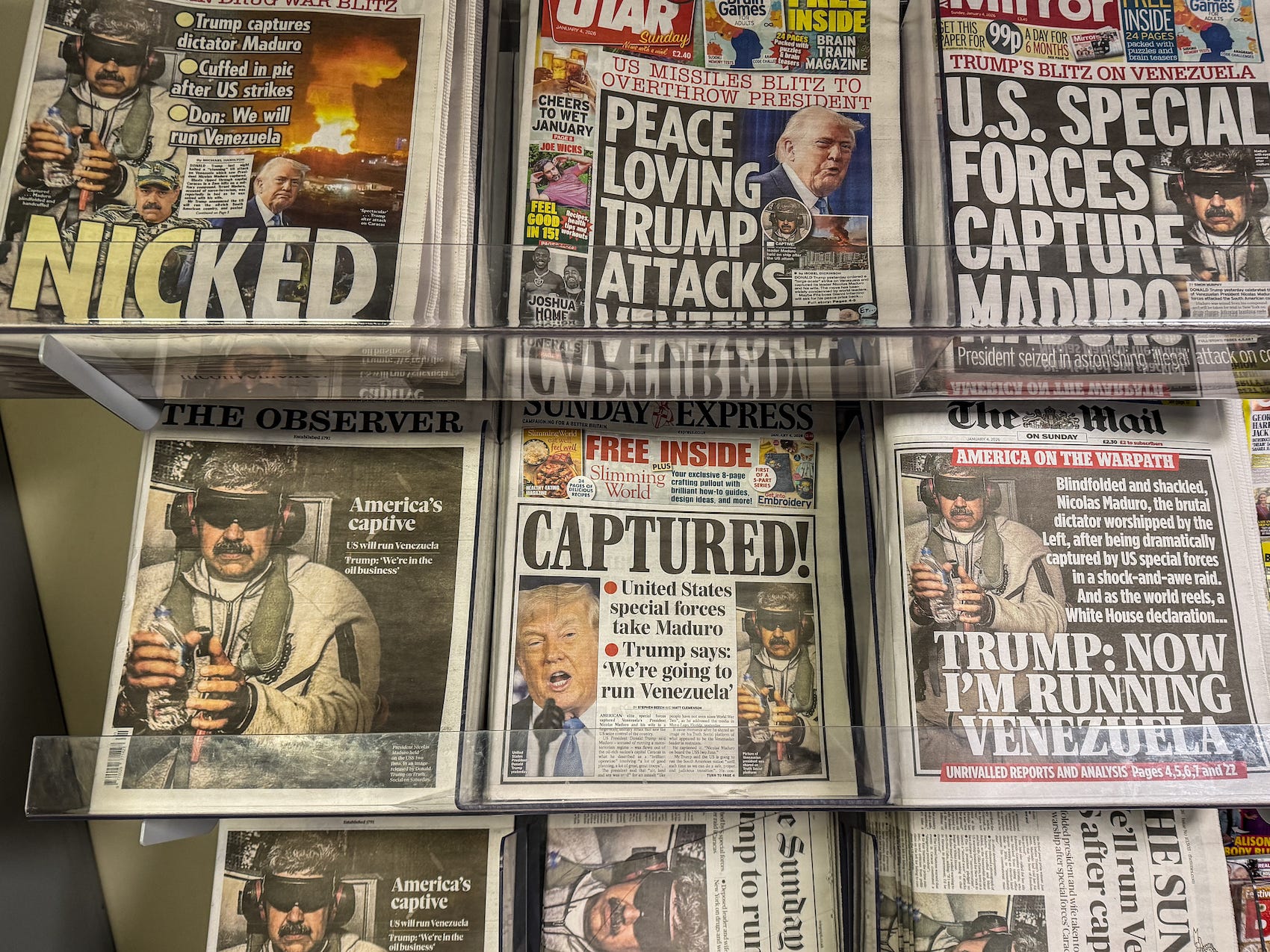
Stay tuned for live-from-the-courtroom coverage later today.
The prosecution of Venezuelan strongman Nicolás Maduro is a challenging story for legal journalism dedicated to the principles of democracy and the rule of law.
In power for more than 13 years, Maduro continued to rule after Venezuela’s opposition-controlled National Assembly declared him a usurper and an illegitimate president in 2019. The gold standard election observers at the Carter Center found that Maduro “falsely claimed victory” in the 2024 election, widely regarded as stolen. That’s why more than 50 countries, including most advanced democracies, refused to recognize Maduro.
Maduro now stands accused of a narco-terrorism conspiracy to transport “thousands of tons of cocaine” to the United States in order to enrich himself, his family, and his regime. Federal prosecutors claim that Maduro “ordered kidnappings, beatings, and murders against those who owed them drug money or otherwise undermined their drug trafficking operation.”
It’s also true that his reign ended with a U.S. military operation conducted without congressional consultation or approval during the presidency of Donald Trump, who unsuccessfully tried to subvert a free and fair election in 2020.
Both domestically and in foreign affairs, Trump’s views on democracy and the rule of law are well-known. Trump expresses affection for dictators, antagonism for democratic allies, and hostility for restraints on his power by courts, civil society and perceived political opponents.
Trump made no pretense that Maduro’s arrest had anything to do with advancing democracy. He left Maduro’s regime in place, rhetorically sidelined Venezuela’s opposition, and made the country’s vast oil reserves the centerpiece of his public statements.
Maduro’s prosecution may also serve to supercharge the most extreme ambitions of his immigration agenda.
Last March, Trump’s government justified the expulsion of more than 200 men to an El Salvador prison by invoking the Alien Enemies Act and arguing that the Venezuelan gang Tren de Aragua was involved in an “invasion” of the United States as a de facto arm of Maduro’s regime.
So far, judges overwhelmingly rejected that proposition.
One of them, U.S. District Judge Alvin Hellerstein, will be presiding over Maduro’s prosecution, which has Tren de Aragua’s leader Hector Guerrero Flores, named as a co-defendant in the indictment.
Most credible legal experts view the raid that nabbed Maduro as a violation of the U.N. charter, and the debate over its domestic legality largely revolves around whether the intent of the Constitution’s Framers has been diluted beyond recognition by decades of congressional abdication. The most frequently cited precedent is the drug trafficking prosecution of former Panamanian strongman Manuel Noriega, whose National Assembly had declared war on the United States.
Noriega’s convictions were upheld on appeal.
Political scientists have braced themselves for an international order where a government can whisk away a foreign national in the name of law enforcement, a norm that authoritarian nations would be eager to exploit.
“The law of the jungle is dangerous,” political scientist Ian Bremmer wrote. “What applies to your enemies one day can apply to you the next. Make no mistake where the world is heading here.”
As the criminal process advances, the government will be forced to reveal their legal justifications. Judges will have to decide what types of actions the courts will endorse, and whether the law of the jungle prevails when the executive wishes to execute an arrest of a foreign national.
If the case against Maduro goes to trial, the government will bear the burden to prove the allegations of the indictment beyond a reasonable doubt. This is how the 25-page superseding indictment begins.
“For over 25 years, leaders of Venezuela have abused their positions of public trust and corrupted once-legitimate institutions to import tons of cocaine into the United States.
NICOLAS MADURO MOROS, the defendant, is at the forefront of that corruption and has partnered with his co-conspirators to use his illegally obtained authority and the institutions he corroded to transport thousands of tons of cocaine to the United States. Since his early days in Venezuelan government, MADURO MOROS has tarnished every public office he has held. As a member of Venezuela’s National Assembly, MADURO MOROS moved loads of cocaine under the protection of Venezuelan law enforcement. As Venezuela’s Minister of Foreign Affairs, MADURO MOROS provided Venezuelan diplomatic passports to drug traffickers and facilitated diplomatic cover for planes used by money launderers to repatriate drug proceeds from Mexico to Venezuela. As Venezuela’s President and now-de facto ruler, MADURO MOROS allows cocaine-fueled corruption to flourish for his own benefit, for the benefit of members of his ruling regime, and for the benefit of his family members.
NICOLAS MADURO MOROS, the defendant, now sits atop a corrupt, illegitimate government that, for decades, has leveraged government power to protect and promote illegal activity, including drug trafficking.”
The people of Venezuela deserve to know what competent evidence the United States has to support the allegations. So do the people of the United States and the international community.
Without a doubt, there are millions of Venezuelans happy that Maduro is no longer in power. A government that is able to support these allegations might raise another question in the public’s mind: Is leaving Maduro’s regime in place, deal-making with his No. 2 for oil, and potentially sowing chaos and instability in the international order really justice?
Maduro’s arraignment begins at noon Eastern Time.
Find this newsletter’s regular listings of the week’s biggest court proceedings, protests, and more below, and subscribe for a full breakdown about what happened in court later today.
