


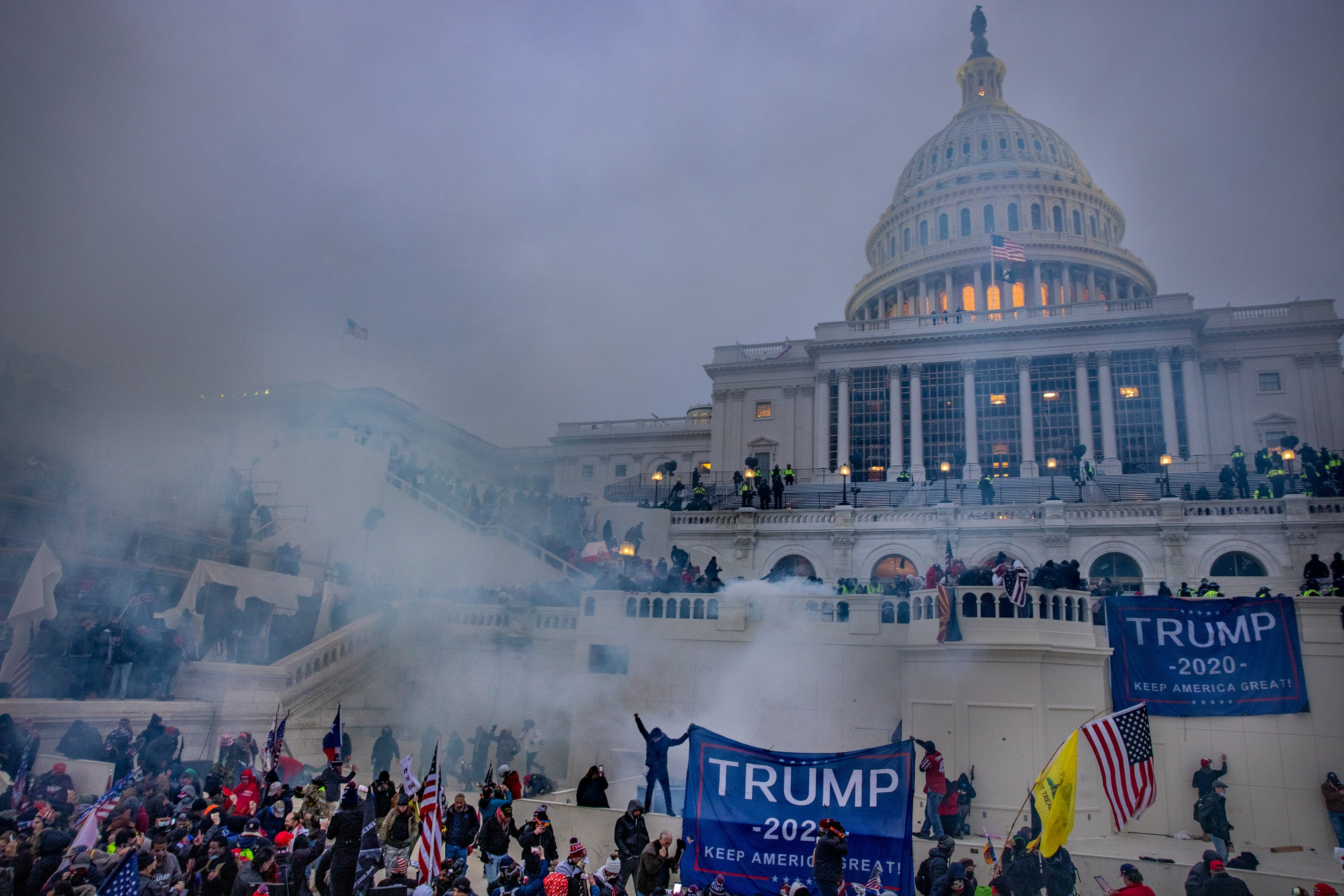
Is Donald Trump’s $1.776 billion slush fund to enrich his political allies and Jan. 6 insurrectionists alive or dead?
Call it Schrödinger’s slush fund: Trump’s former criminal defense attorney turned Acting Attorney General Todd Blanche pronounced it dead last week before Congress, but several lawsuits opposing it remain active.
Two of those cases will head to oral arguments this week, likely clarifying whether the federal judiciary has the power to bury it.
On Tuesday, the anti-corruption watchdog Citizens for Responsibility and Ethics in Washington (CREW) will ask U.S. District Judge Richard Leon to block the fund on the grounds that it was “purpose-built” to avoid public scrutiny, authorizing only the release of “confidential” reports to Blanche.
On Friday, another lawsuit led by former Jan. 6 prosecutor Andrew Floyd will ask U.S. District Judge Leonie Brinkema to block it on First Amendment grounds, noting that the fund’s legal documents define “weaponization” as “the sustained use of the levers of government power by Democrat elected officials, political and career federal employees, contractors, and agents.”
The Trump Justice Department wants to swat away these lawsuits by noting that Blanche told Congress “we are not moving forward with the fund,” rendering the issue “moot.”
Brinkema previously issued an administrative stay forbidding the creation of the fund or distribution of any claims, but it remains to be seen whether any of the lawsuits will survive in light of Trump and Blanche’s retreat.
Regardless of whether any of the lawsuits seeking to block the fund will survive, Trump and his government attorneys will likely face a reckoning on whether the concept itself represented a fraud on the court.
In Florida, U.S. District Judge Kathleen Williams launched an inquiry into whether to sanction any party “responsible” for Trump’s lawsuit against the Internal Revenue Service that he controls. Trump sought $10 billion in damages over the leak of his tax records in 2019 by an IRS contractor named Charles Littlejohn. There was never any credible theory about how Littlejohn’s leak could have damaged Trump to the tune of billions of dollars, and the statute of limitations on any claim had lapsed. Williams ordered Trump, the IRS and the Justice Department representing them both to answer allegations that the lawsuit was “collusive from the start” and an attempt to make the court a “victim of fraud.”
One of the 35 now-retired federal judges who urged Williams to open this inquiry told All Rise News that she was “unbelievably gratified” that the court is taking action.
“I certainly was of the generation that believed if something smelled bad, there had to be a cause of action,” former U.S. District Judge Nancy Gertner said in a video interview. “There had to be something one could do about it, and this slush fun smelled bad.”
She said that the extraordinary rebuke of Trump and Blanche could have been much larger because the former judges had to organize it within a week.
“There were people who were calling us after the papers had been filed to see if they could join — judges calling us to see if they could join,” Gertner said. “So there was a clarity to this issue that was extraordinary.”
Watch the interview in full below.
Even if Blanche truly abandons the fund, the Trump Justice Department would still be able to enter into confidential settlements with Jan. 6 rioters who file claims.
Physicist Erwin Schrödinger devised a thought experiment involving a cat in a sealed box and a radioactive atom with a 50 percent chance of a deadly breakdown. Until the box is opened, Schrödinger says, quantum theory holds that the cat must be treated as simultaneously alive and dead.
So it is with Schrödinger’s slush fund: The Trump Justice Department claims in court that “no money had been transferred to the Fund. No mechanisms were in place for formally submitting, receiving, processing, granting, or denying claims. None of the five contemplated ‘Members’ who would establish and administer such procedures for the Fund had even been appointed.”
That may be true, but under the legal documents creating the fund, no member of the public could contradict the government if it were otherwise.
There’s another reason to suspect the fund isn’t dead: As his recent “Meet the Press” interview showed, Trump keeps treating it as though it can resurrect at any time.
‘Designed to compensate the insurrectionists’
In a recent legal brief, Sens. Cory Booker (D-N.J.) and Bill Cassidy (R-La.) told a federal judge that Trump’s slush fund is “designed to compensate the insurrectionists who stormed the U.S. Capitol on January 6th.”
“They write not as partisans but as representatives of the taxpayers whose funds have been committed to this scheme without statutory authorization, and as legislators who retain a direct constitutional stake in ensuring that the Executive Branch does not convert the public monies into an instrument of political reward,” their attorneys wrote last week in an amicus brief.
This simple observation seems to be oddly taboo: that Trump designed the fund explicitly to reward those who violently attacked the U.S. Capitol on Jan. 6, 2021 to keep him in power.
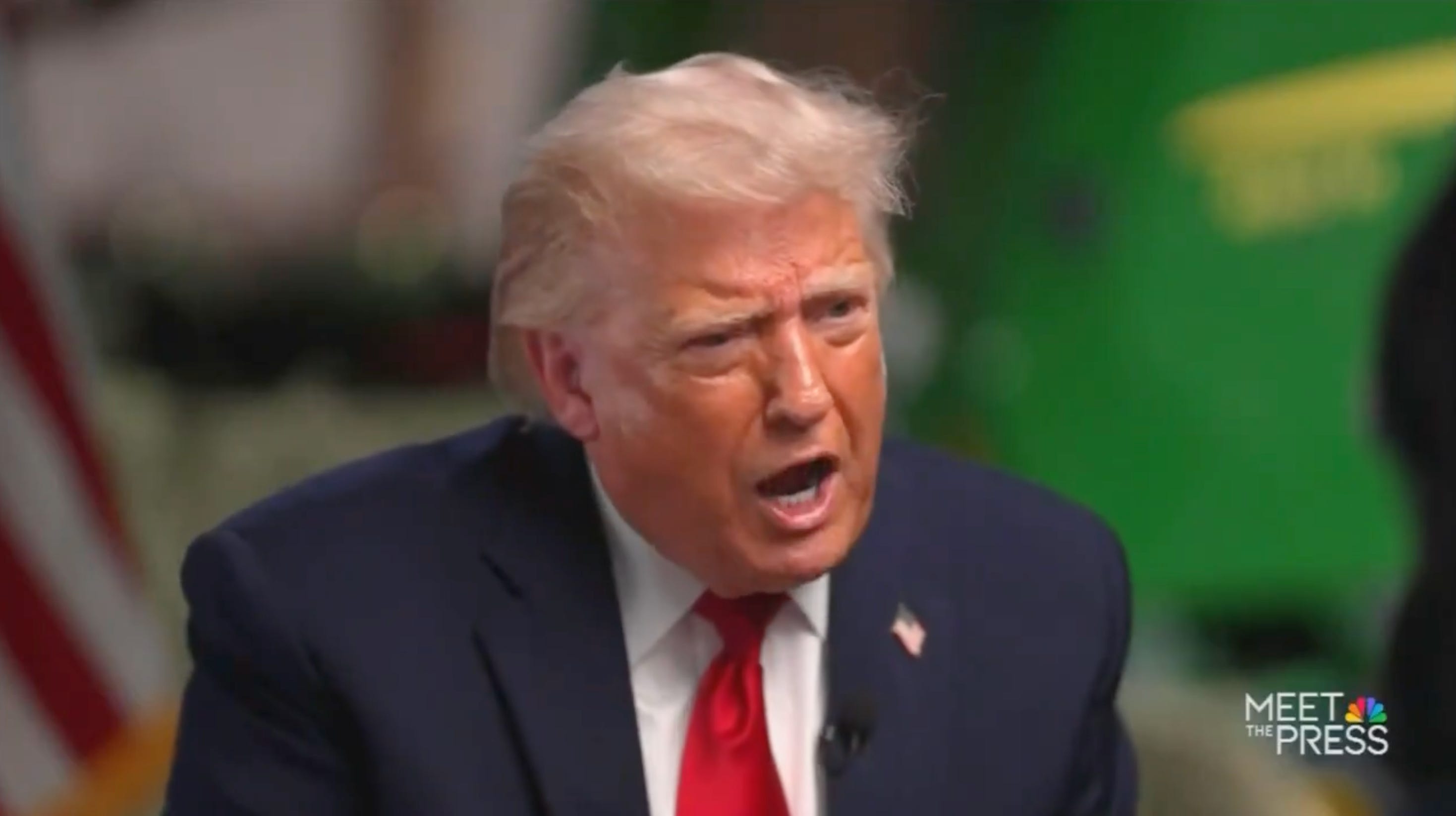
Consider Trump’s contentious interview with NBC News host Kristen Welker on “Meet The Press” on Sunday. Welker calmly and insistently reminded Trump that he had no evidence for his conspiracy theories and lies about the 2020 election and the recent primary race in California. Trump insulted her as “corrupt” and called her “darling,” as he threw his mic on the ground and stormed off the set.
Even as she offered a masterclass of cool professionalism, Welker’s questioning contained a tacit assumption that financially rewarding violent rioters may have been some kind of mistake.
“Do you think anyone who attacked police officers on January 6th should get taxpayer money?” Welker asked Trump.
By the time of the interview, there could no longer have been any doubt that the fund was designed to benefit the rioters. On May 19, Blanche testified that the Oath Keepers, Proud Boys, or “anybody” else who assaulted Capitol police with bear spray, pepper spray, Tasers, police batons, or other weapons could apply for compensation. Blanche has complete control over the fund’s operations and eligibility. If Trump or Blanche didn’t intend to reward violent rioters, they could have revised the fund to forbid payment to them, but they deliberately chose not to do so.
Trump used the opening to rewrite the history of Jan. 6 to cast “crooked cops” as the aggressors. He argued that the 172 rioters who pleaded guilty to assaulting law enforcement were pressured to do so, even though their assaults were caught on camera, and he bizarrely seemed to blame the entire melee on James Comey, who was no longer FBI director at the time.
There isn’t a singularly effective way of questioning Trump in a sit-down interview. He lies. He deflects. He insults. He stonewalls. He filibusters. He launches into conspiracy theories, and if he doesn’t like the questions, he attacks the journalist and news network hosting him, before pulling off the mic and walking off camera. And, most importantly for Trump, he disseminates his talking points and erodes trust in a free press before he leaves, which is why he always returns to the “fake news” he purports to despise.
Welker performed the ritual with as much skill and rigor as the format allows, pressing him on the evidence, providing the facts, and keeping a level head. It’s notable, however, that even in an interview as tough as Welker’s embeds a favorable assumption for Trump in the premise of the question, which entertains the possibility that rewarding violent insurrectionists isn’t Trump’s demonstrated goal.
That explanation may be too hot for Sunday morning TV, but it isn’t for two bipartisan senators addressing a federal judge.
“To deliberately deploy public funds, in violation of the Constitution and the laws of this nation, to compensate these perpetrators is to use the machinery of democratic government to subsidize an attack on that government’s most fundamental processes,” their brief states. “Congress itself, as both victim and the federal government’s sole appropriating authority, has a compelling institutional interest in ensuring that no public fund is converted into a reward for those who laid siege to it. A scheme deliberately designed to recast insurrectionists—including those who perpetrated violence against law enforcement officers—as victims and legitimate prosecutions as persecution does not merely rewrite history; it creates incentives for similar conduct in the future, with the explicit encouragement of the officials responsible for administering justice.”
All Rise News intends to cover the hearing in this case in federal court on Friday in Alexandria, Va.
Read the senators’ brief in full here.
If anybody believes Blanche won’t resurrect the fund if his boss says to do it, I have a bridge to sell them.
Great update, Adam! Thanks for your work to bring us the truth.