


SAVE your panic.
That’s the emerging consensus among voting rights experts in response to the Supreme Court’s shadow docket ruling on Friday letting states check the citizenship status of voters on the federal government’s Systematic Alien Verification for Entitlements (SAVE) database.
In an unsigned opinion on Friday, the Supreme Court’s supermajority paused a lower court order, which blocked Donald Trump’s executive order overhauling the SAVE database as unlawful. All three Democratic appointees, led by Justice Ketanji Brown Jackson, dissented, warning that disenfranchisement could result.
On one issue, however, all nine of the justices seemed to agree: The ruling wouldn’t have much of an effect on the 2026 midterm elections.
Here’s why: The Supreme Court’s ruling allows states to voluntarily use a modified SAVE database to check the citizenship status of voters, but states can no longer conduct these searches en masse.
The National Voter Registration Act (NVRA) requires states to “complete, not later than 90 days prior to the date of a primary or general election for Federal office, any program the purpose of which is to systematically remove the names of ineligible voters from the official lists of eligible voters.”
With the midterms approaching on Nov. 3, states are now within that three-month moratorium window.
Now, the Supreme Court’s majority said, only “individualized inquiries” are available.
In her dissent, Justice Jackson agreed that the “bright side” of the ruling would be its “minimal short-term impact.”
“States will at most conduct individualized voter-roll maintenance using the modified SAVE system ahead of the November elections,” she wrote in her dissent. “In my view, however, the harm caused by burdening or disenfranchising even a few lawful voters outweighs the nonexistent harm that the government experiences when it is prevented from taking an action that it likely lacks the authority to take.”
Former Justice Department attorney David Becker, who is the executive director of the Center for Election Innovation & Research, predicted that the decision “will not have any significant impact on the 2026 election.”
“The most important thing for voters to know is that they will continue to experience the same safe, secure, and reliable voting process in 2026 that they have in past elections,” Becker said.
That’s not to say that there is no reason for concern.
In June, U.S. District Judge Sparkle Sooknanan blocked Trump’s SAVE database overhaul as unlawful because it forced federal agencies to “haphazardly” combine and repurpose “private information of millions of Americans, including citizenship data that they knew to be unreliable.”
This included statutorily-protected Social Security data, which may include information submitted prior to naturalization.
The Supreme Court’s majority agreed that’s what happened to a voter in Louisiana, which used the modified SAVE database that inaccurately reflected her citizenship status.
Voters can check their registration status online.
Strike three for Missouri’s gerrymander
After three trips to the U.S. Supreme Court, the Missouri GOP’s attempted gerrymander is finally dead.
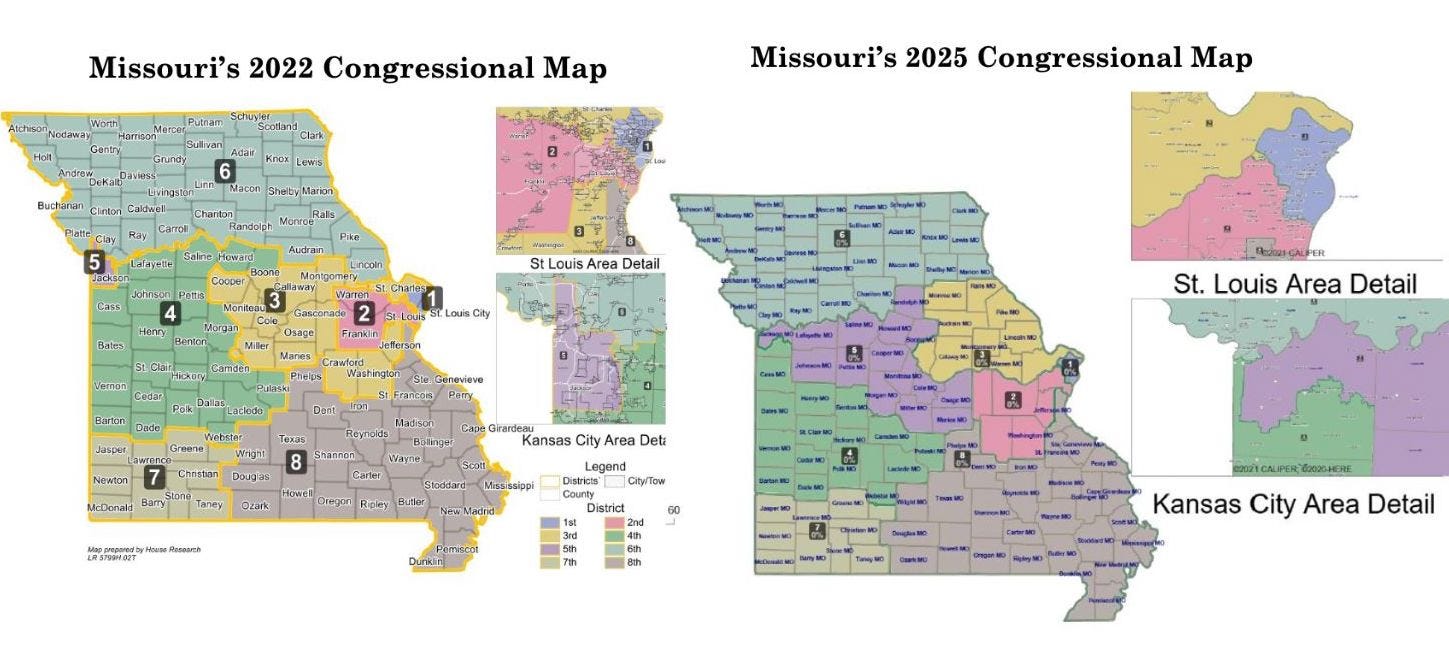
Missouri Republicans have tried to use a severely redistricted map for the upcoming midterm elections, but the group People Not Politicians defeated that effort every step of the way.
Under Missouri’s constitution, citizens can challenge redistricted maps by petitioning to force a referendum. People Not Politicians successfully gathered hundreds of thousands of signatures, and the Missouri Supreme Court found that this satisfied the requirement to force a vote on the new maps. That meant that the Missouri GOP’s 2025 gerrymander would have no legal effect until voters approved it.
The Missouri Supreme Court affirmed that ruling twice, and the Supreme Court twice declined to disturb that decision.
Missouri’s Trump-aligned Secretary of State Denny Hoskins was slow to learn the lesson and kept instructing election authorities to use the invalidated maps until he was found in contempt of court.
Then, in bizarre developments, the federal district court and the conservative Eighth Circuit Court of Appeals issued orders requiring the use of the voided 2025 maps in the midterms.
In a ruling with no noted dissents, the Supreme Court told the lower courts in no uncertain terms that its decision is final.
“The District Court and Court of Appeals should not enjoin or otherwise prohibit the use of the 2022 map in the 2026 congressional election in Missouri,” the opinion states. “And the District Court and Court of Appeals should not order or otherwise require Missouri to use the 2025 map in the 2026 congressional election in Missouri.”
Read more about the fight against Missouri’s gerrymandered maps and the fight to void them here.
The Supreme Court’s decision can be read in full here.
Anthropic’s blacklisting upheld on appeal
A D.C. Circuit panel dominated by highly conservative Trump appointees upheld the Pentagon’s blacklisting of Anthropic’s artificial intelligence as a “supply chain risk.”
U.S. Circuit Judges Neomi Rao and Gregory Katsas — two of the court’s most conservative jurists — approved Secretary of Defense Pete Hegseth’s designation of the company, which is predicated on Anthropic’s refusal to allow the use of its code for autonomous war-fighting and mass surveillance.
In a dissent, U.S. Circuit Judge Karen LeCraft Henderson said that Congress never intended to create blacklists of American companies based on mere disagreements with the Pentagon.
“It enacted the statute in response to calls from the U.S. intelligence community for legislation to meet the threat of ‘[h]ostile nation state and other bad actors’ infiltrating the federal government’s information and technology systems through its supply chains,” the dissent states, referring to the Federal Acquisition Supply Chain Security Act (FASCSA).
Judge Henderson said that the slippery slope could force contractors to agree to violations of “federal or constitutional law.”
“The Department here made good on its promise to designate Anthropic a supply chain risk after Anthropic declined the Secretary’s ultimatum to replace its use restrictions on Claude with a general provision permitting ‘all lawful uses,’” the dissent states. “But suppose the Secretary tells Anthropic’s presumed replacement to change its AI-use policies to permit any ‘functions that the Department deems necessary’ or it will share the same fate as Anthropic. […] According to today’s decision, that contractor will have a choice: Agree to the Secretary’s demands or risk being designated a national security threat under FASCSA.”
Read the D.C. Circuit’s opinion and dissent here.
Comey’s trial is postponed
Finally, a federal judge on Friday postponed the upcoming arraignment and trial of James Comey.
Comey was initially scheduled to appear in court next week for his arraignment on an indictment accusing him of threatening to kill Trump by posting a photograph of seashells on a beach arranged to spell “8647.”
He has multiple motions pending to dismiss the case, including on First Amendment grounds and for selective and vindictive prosecution.
Initially scheduled to stand trial in October, Comey’s attorneys also asked for more time to prepare.
The Trump Justice Department didn’t oppose the requested adjournment.
U.S. District Judge Louise Flanagan granted the request on Friday, agreeing to a January arraignment and February trial. The exact dates have not been set, and the judge noted that Comey’s motions are now “ripe” for a decision. She didn’t indicate when she would rule on them.
Good news relief, Adam. I will take that and run with it, whatever else may develop in the long term.
Thank you, Adam, for calming my fears. I do think we are going to be okay in California. Hopeful for everyone else.