


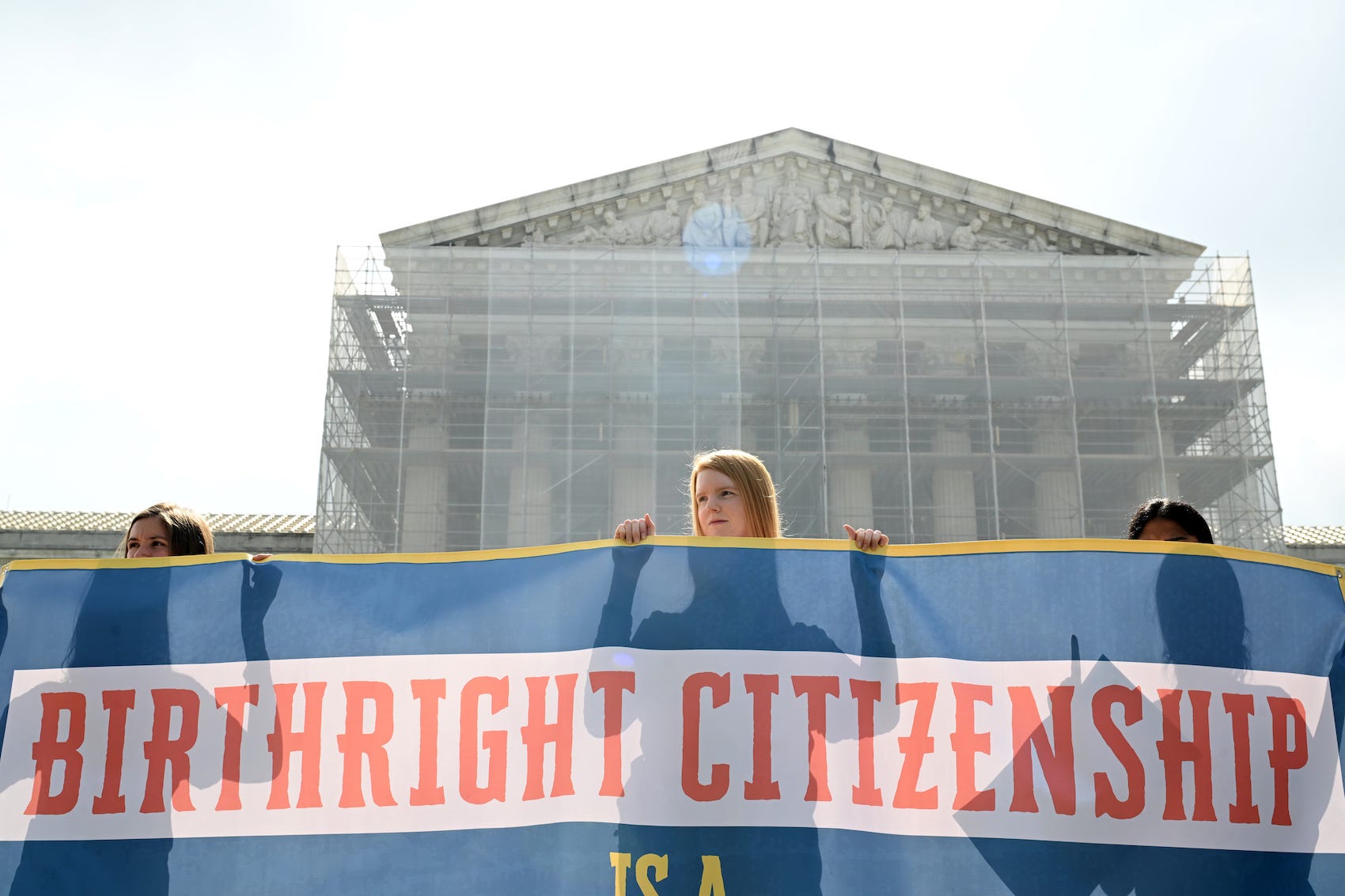
A federal judge has blocked Donald Trump’s second executive order restricting birthright citizenship, emphasizing that the highest court in the United States made itself perfectly clear the first time.
“The Supreme Court has spoken: Children in the certified class are ‘citizens at birth,’” U.S. District Judge Deborah L. Boardman wrote in a 36-page memorandum opinion. “Barbara is the law of the land. The President must follow it.”
In Trump v. Barbara, the Supreme Court reaffirmed by a 5-4 margin that the 14th Amendment of the U.S. Constitution enshrines the right to birthright citizenship. Six justices found that Trump’s first birthright citizenship ban was unlawful, and none of the dissenting justices found there was a categorical rule barring the children of undocumented immigrants from birthright citizenship.
“Barbara effectively invalidated the 2025 Executive Order as unconstitutional and dispelled any doubts about the meaning and scope of the Citizenship Clause of the Fourteenth Amendment,” Boardman wrote. “Or so it seemed.”
On Aug. 6, 2026, just one month after the Barbara decision came down, Trump issued his second birthright citizenship executive order. This time, he attempted to ban the children of a parent accused of being an “alien enemy,” a “foreign government employee,” or someone engaged in birth tourism.
Trump claimed that such categories of people weren’t “subject to the jurisdiction” of the United States, but Judge Boardman easily rejected that position. The Supreme Court construed those exceptions, such as the children of ambassadors, narrowly in the Wong Kim Ark decision — and reaffirmed that finding in Barbara.
“The 2026 Executive Order is almost certainly unconstitutional as applied to the certified class for the simple reason that the Supreme Court in Barbara already decided that the children in the class are citizens at birth,” Boardman found. “This Court must, once again, preliminarily enjoin enforcement of the President’s most recent attempt to strip the right to citizenship from them.”
During the first phase of litigation, the Trump Justice Department avoided a constitutional battle on birthright citizenship by challenging nationwide injunctions, which it succeeded in abolishing. The Supreme Court, however, allowed district judges to grant universal relief for class action lawsuits.
Citing that reasoning, Boardman wrote: “This indivisible injunction will ‘benefit the entire class’ by preventing the defendants from denying them the right to citizenship by birth.”
The Trump administration has invoked the Alien Enemies Act to justify stripping immigrants of due process rights before, and the judge noted those efforts to observe that the executive order could have been used to deprive Venezuelan immigrants of their constitutional rights to birthright citizenship, including an anonymous plaintiff identified in court papers as “Monica.”
“Even though Monica and her husband ‘are not, and have never been, members of Tren de Aragua,’ […] and even though Andrea and her child’s father are not members of La Nueva Familia Michoacana, their fears that they might be deemed alien enemies are well-founded,” Boardman said. “In the past year, in the immigration removal context, the government illegally removed Kilmar Armando Abrego Garcia to his native El Salvador after the government hastily labeled him an MS-13 member, even though he ‘was subject to a withholding order forbidding his removal to El Salvador.’”
Boardman noted that the Trump Justice Department described Abrego’s abduction from the United States as an “administrative error.”
Read the opinion in full here.
Note: An earlier version of this story has been updated to clarify the holding of the dissents in Trump v. Barbara.
Hurrah!! Nice to get some big good news tonight - thanks, Adam!! 🕊️
Wonderful! Thank you Adam for breaking the news with Good News! :-)