


A three-judge panel on Tuesday unanimously blocked the state of Alabama’s attempt to restore maps that the court previously found intentionally diluted Black voting power.
“Ultimately, we cannot see our way clear to requiring Alabamians to cast their votes in the 2026 elections under a districting plan tainted by intentional race-based discrimination,” their 79-page order states. “And under the unusual circumstances of this case, we conclude that a limited order requiring the Secretary to continue using this Court’s race-blind map will not disrupt Alabama’s elections (all candidates ran under the race-blind map until fifteen days ago, and all voters remain districted under the race-blind map in electoral computer systems).”
The three-judge panel — composed of two Donald Trump appointees and a Bill Clinton appointee — previously blocked the maps in 2023 for violating the 14th Amendment and Section Two of the Voting Rights Act.
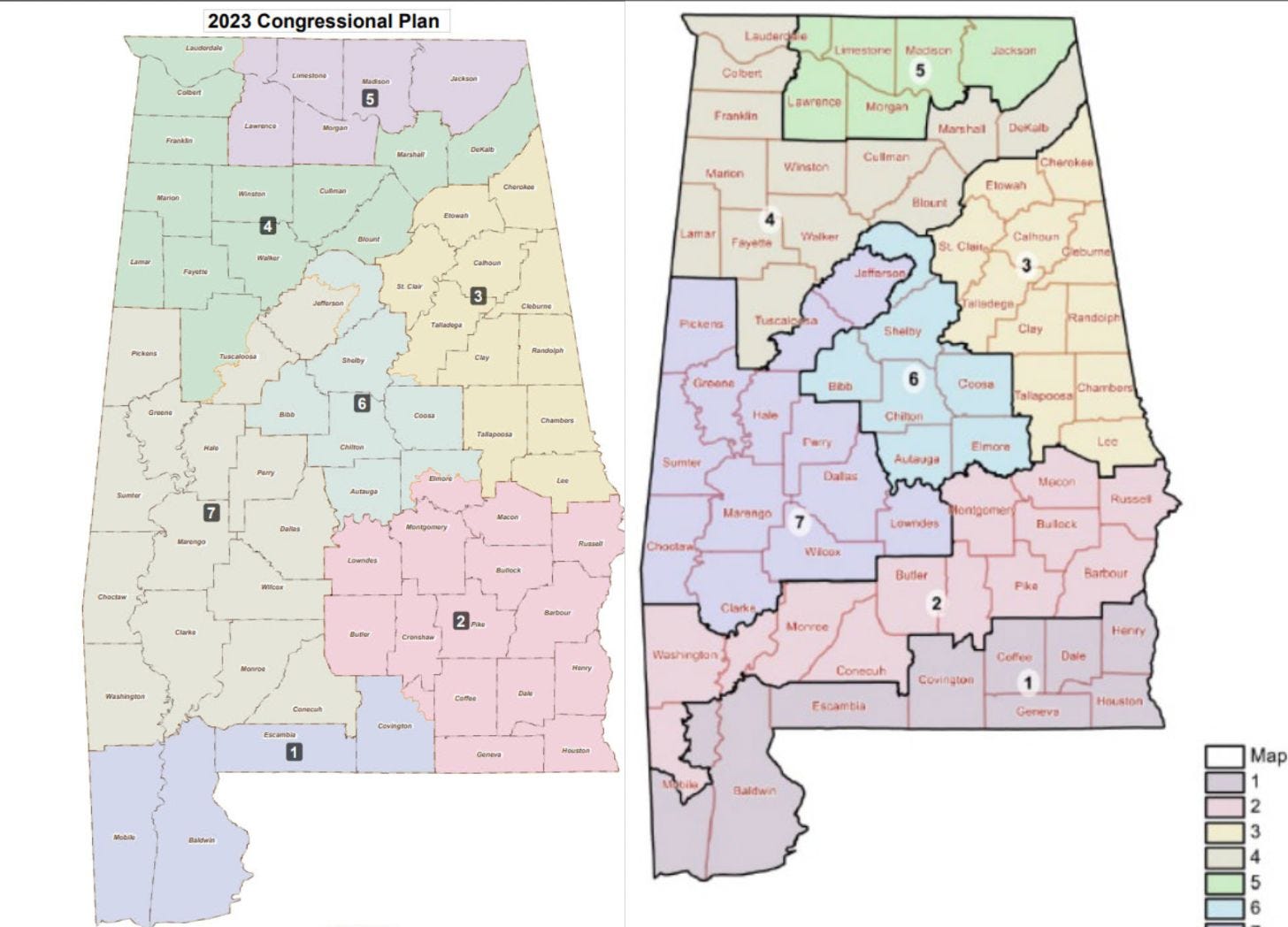
The racially gerrymandered maps would have reduced the number of Black-majority districts from two to one, by extension giving Republicans another likely seat.
Some life left in the “dead letter”?
On Tuesday, U.S. District Judges Anna M. Manasco and Terry Moorer and U.S. Circuit Judge Stanley Marcus found that the same reasoning stands today as it did three years ago, despite a new legal landscape.
“The [Alabama] Legislature well knew that a plan without an additional Black-opportunity district would dilute Black Alabamians’ opportunity to participate in the political process, and it intentionally enacted that very plan,” the order states. “Further, the Legislature well knew what dilutive mechanisms would prevent Black voters in Alabama’s Black Belt and Gulf Coast communities.”
In late April, the Supreme Court gutted the Voting Rights Act in Louisiana v. Callais, finding that Section Two of the landmark civil rights law required findings of intentional discrimination to enforce. Justice Elena Kagan’s dissent argued that the Roberts Court effectively turned the watershed legislation into a “dead letter” because state authorities tend to hide evidence of racial discrimination behind partisan advantage and other lawful considerations.
In the Alabama case, however, a three-judge panel painstakingly found intentional racial discrimination, following a trial featuring testimony from 51 witnesses and a court record packed with nearly 800 exhibits.
Despite the vast record, the Supreme Court’s conservative justices decided along ideological lines to grant the state of Alabama’s request to vacate that decision, pending another round of review “in light of Louisiana v. Callais.”
In a dissent joined by every liberal colleague, Justice Sonia Sotomayor noted that the lower court remained “free on remand to decide for itself whether Callais has any bearing on its Fourteenth Amendment analysis or if its prior reasoning is unaffected by that decision.”
The three-judge panel found that the latter was the case.
“Callais does not disturb our finding that the Legislature intentionally discriminated based on race when it passed the 2023 Plan,” the panel wrote. “Standing alone, this finding is sufficient for a preliminary injunction.”
‘No doubt’
The judges wrote that their review of the record leaves “no doubt” that the Alabama legislature intentionally discriminated based on race.
“We reach this conclusion with great reluctance and dismay and even greater restraint — only after another exhaustive analysis of an extensive record, as the Supreme Court’s remand order and its precedent instructs us,” the order states. “We reject in the strongest possible terms the State’s attempt to finish its intentional decision to dilute minority votes with a veneer of legislative regularity.”
Alabama’s Attorney General Steve Marshall (R) already vowed to “immediately appeal” to the Supreme Court, calling the maps “blandly unobjectionable.”
“Know this—in my mind, it is not a matter of whether we win this case, only when,” Marshall wrote in a statement.
Led by civil rights activist Evan Milligan, the plaintiffs behind the lawsuit also include Khadidah Stone, Letetia Jackson, Shalela Dowdy, Greater Birmingham Ministries, and the Alabama State Conference of the NAACP. They are represented by the Legal Defense Fund, American Civil Liberties Union, ACLU of Alabama, Hogan Lovells LLP, and Wiggins, Childs, Pantazis, Fisher & Goldfarb.
“We are thankful that the district court has again vindicated the constitutional rights of voters in the Black Belt, and we look forward to voting under a fair map this fall,” the plaintiffs and attorneys wrote in a statement. “The court saw through Alabama’s blatant attempt to reinstate a race-based congressional map that the legislature deliberately enacted to deny Black voters a voice in Congress.”
As a result of the ruling, the “race-blind” maps drawn by a court-designated special master will include two Black opportunity districts.
When the Supreme Court restored the 2023 maps, Justice Sotomayor warned her conservative colleagues that the decision would unleash “chaos” in the upcoming election. The three-judge panel wrote that its return to the status quo would have the opposite effect.
“On the unique record before us, we determine that enjoining the 2023 Plan will not disrupt Alabama’s elections,” the order states. “Requiring the use of the Special Master Plan will forestall an expensive, aggressive, and perhaps logistically impossible voter reassignment effort.”
Read the ruling in full here.
Thank you for a very clear statement of the background and details of the decision, Adam.
We must Fight like Ukrainians and Vote like Hungarians. Plus, continue to demand ALL the Epstein Files.