


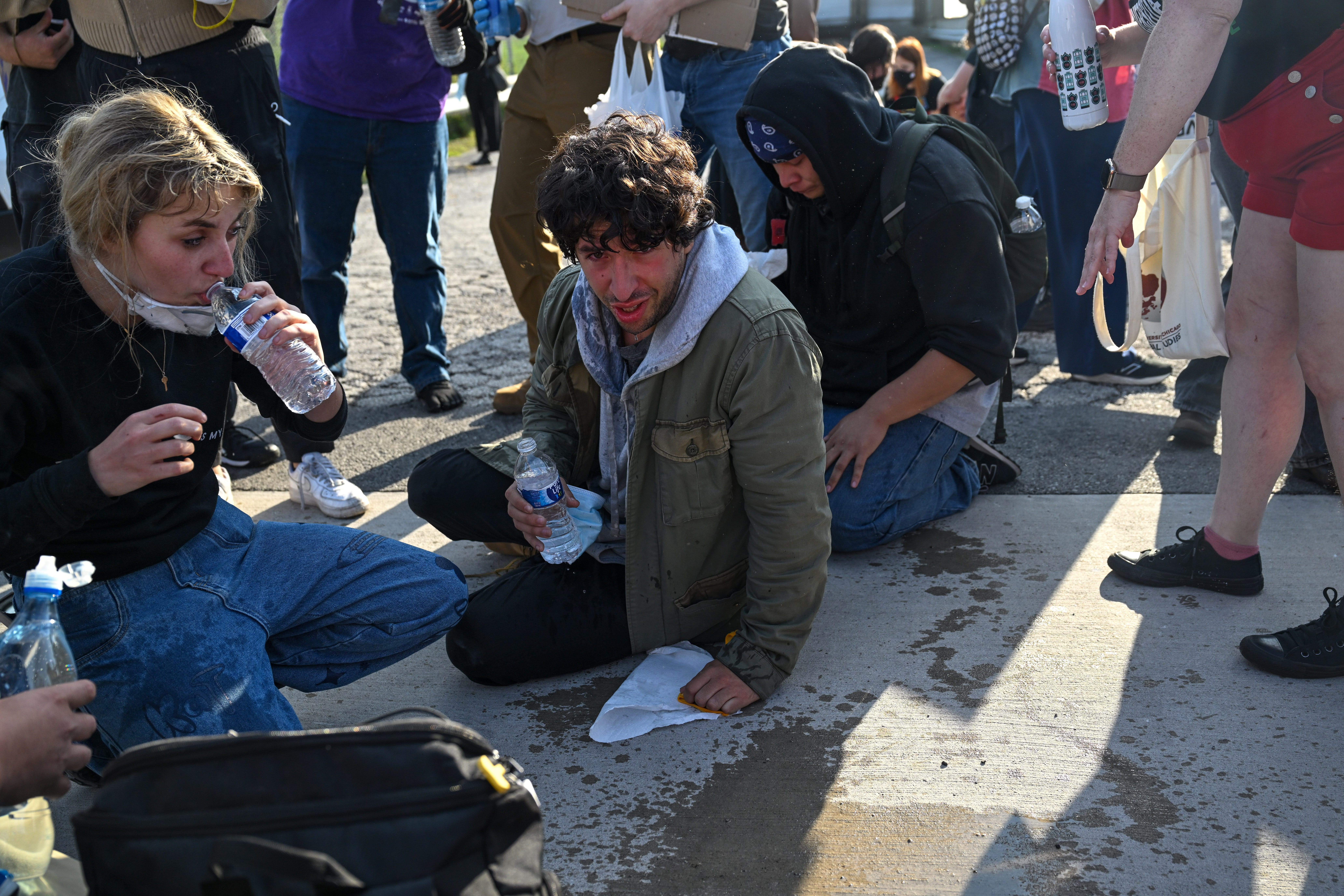
Three weeks of transcripts ordered released by a federal judge on Tuesday reveal the stunning exchanges between grand jurors and Trump Justice Department prosecutors pursuing an indictment of the “Broadview Six” before the high-profile protest case evaporated.
Federal prosecutors were forced to dismiss their case against six Chicago-based politicians and activists who protested outside an immigration facility in the Broadview neighborhood. The case collapsed last month days before an anticipated trial after a judge forced the government to reveal the transcripts.
U.S. District Judge April Perry initiated proceedings to determine whether the government should face sanctions for prosecutorial misconduct and potential ethical violations because of interactions with the grand jury that had previously been described but never seen publicly.
As summarized by a lawyer for one of the “Broadview Six” defendants, the transcripts reveal that the grand jury “repeatedly attempted to say ‘no’ to this sham political indictment.”
“The Department of Justice attorneys involved in this case refused to accept that reality or their Constitutional obligations, committing appalling misconduct and putting their DOJ marching orders above justice,” said attorney Christopher Parente, who represents Chicago politician and former defendant Brian Straw.
‘Second time is the charm’
Hitting the public record in a rush of nearly 200 pages, the first tranche of transcripts — documenting proceedings from three weeks in October 2025 — revealed the grand jury’s unfiltered appraisal of the case after the panel rejected an indictment a week earlier.
“I heard this case like last week, and I thought it was a crock of shit then and I still think it is,” a grand juror said.
Prosecutors didn’t reveal the fact that the grand jury initially returned a “no true bill” on the indictment until Judge Perry forced the disclosure.
Then-Assistant U.S. Attorney Sheri Mecklenburg, then the lead federal prosecutor on the case, can be seen in the transcripts cajoling the grand jurors, culling out those who expressed doubts, and telling the panel to trust her judgment in order to obtain an indictment weeks later.
“I am back because if you did not — between the questions and not getting an indictment, I did not do my job. I did not explain it to you well enough,” she told the grand jury after the first indictment failed. “I didn’t explain the law to you. I know we were running out of time, and I knew it at the time, but I realize it’s on me. I did not do my job last week well enough for you.”
A grand juror appeared concerned that the government would keep pushing the case until it got the outcome it wanted.
“Do you have unlimited tries?” the grand juror asked.
“Do we have — what did you ask?” Mecklenburg responded.
“Unlimited tries,” the grand juror pressed. “Like you keep coming back as many times as you want?”
“Well, I don’t think we have to worry about that,” Mecklenburg replied. “I think we’re going to be just fine.”
Her then-fellow prosecutor Matthew Skiba chimed in: “I think the saying is the second time is the charm.”
Although it was once extraordinarily rare for prosecutors to fail to obtain an indictment, Trump’s second term has seen grand juries repeatedly rejecting charges, including in the cases of New York Attorney General Letitia James and immigration protester Sydney Reid, both of which were rejected three times by grand juries.
In certain cases, prosecutors charged misdemeanors in a criminal complaint to avoid having to face a grand jury. One grand juror asked Mecklenburg whether prosecutors could charge misdemeanors without them, and she replied that how the government proceeded wasn’t the jury’s concern.
‘Vindictive political indictments’
Before the case’s dismissal, Judge Perry said that a prosecutor impermissibly “vouched” for the case, relying on her reputation rather than the evidence to supply probable cause.
Indeed, the transcript shows Merklenburg telling grand jurors that Skiba would “vouch” for her judgment.
“I said I want to go in front of the Thursday grand jury because I know you and I trust you and you know me and you trust me, and I would never ask you to charge somebody if I didn’t think there was probable cause and you know you’ve asked me before ‘Well, what about this person?’” she said in the transcript. “And I said ‘I don’t charge people unless I’m absolutely sure.’”
Along the way, Mecklenburg admitted to a “mia culpa” [sic] of ex parte communications with two grand jurors outside of the jury room.
“So I need to put it on the record,” she noted.
In May, Judge Perry noted that prosecutors initially redacted this and other potential misconduct from the transcripts that the government provided to her.
Mecklenburg ultimately withdrew from the case to accept a job with Sen. Dick Durbin (D-Il.) as counsel for the Senate Judiciary Committee, and she was fired from the job after accusations of grand jury misconduct surfaced in the “Broadview Six” case.
The blast radius of the “Broadview Six” case could reverberate far beyond the prosecutors involved in the case. Other defendants targeted by the Trump Justice Department — including journalist Don Lemon and the Southern Poverty Law Center — have cited the case to argue that typically secret grand jury proceedings require scrutiny in the Trump 2.0 era.
A “Broadview Six” attorney endorsed that view.
“More disturbing, these transcripts demonstrate Acting Attorney General Todd Blanche's public claims that the vindictive political indictments secured by his DOJ are meritorious because they come from grand juries are disingenuous at best, given the gross misconduct detailed here,” Parente said. “This DOJ has violated the good faith foundation of the grand jury process to weaponize indictments and subvert the law."
Once again, Adam, you’ve provided an in depth backstory I haven’t seen anywhere else 🙏🙏🙏🙏
Adam, thank you for providing the details of this corrupt mess. You’ve really fleshed out what a travesty this “case” is. Most of us non-lawyers don’t have a clear understanding of how the grand jury system is constructed or works. You shined a light on part of the justice system that is mostly a mystery to the people it serves.