


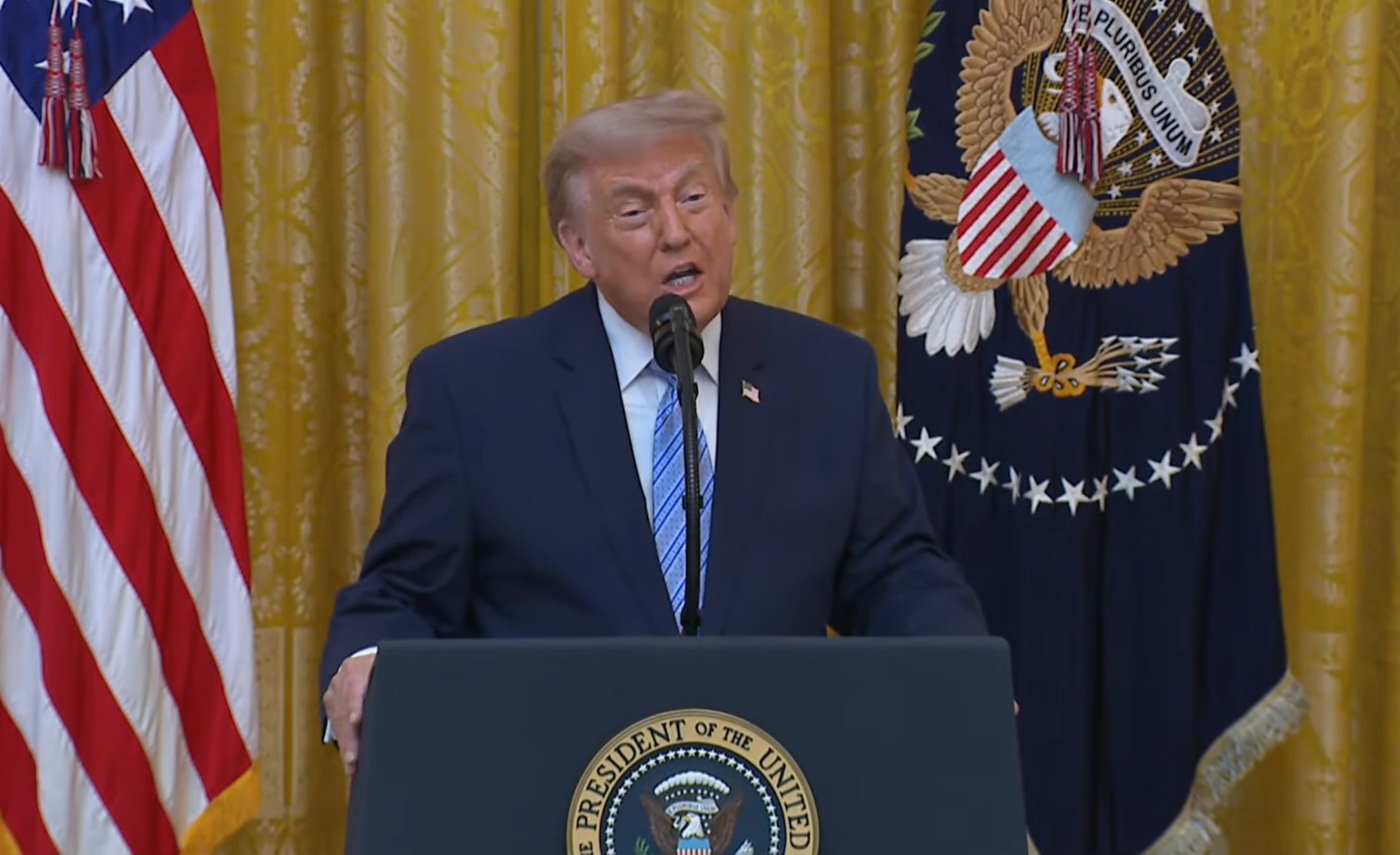
As widely expected on Thursday night, Donald Trump stood behind a podium emblazoned with the presidential seal in the White House and revealed his latest wave of lies about the 2020 presidential election.
Just like six years ago, Trump’s lies immediately collapsed upon scrutiny. None of the documents that Trump declassified backed up his outlandish claims about China, Venezuela, noncitizens or any other scapegoat for his defeat. Journalists and experts quickly debunked his narratives, and representatives of his government also contradicted them.
But before picking apart the details of Trump’s latest deceptions, some critical context should be established at the outset.
‘He knew’
As the evidence overwhelmingly shows, Trump knew and knows that he lost to Joe Biden in 2020. He wasn’t merely wrong or deluded about the result.
Leaked audio showed Steve Bannon boasting before the election that Trump planned in advance to falsely claim victory even if he lost. Trump privately admitted to aides that he lost, and he buried reports that his campaign commissioned and paid for affirming that there was no fraud. That is to say, the Trump campaign paid two firms hundreds of thousands of dollars to find the election was rigged. Instead, they confirmed that Trump lost.
Trump’s election subversion indictment hinged on the premise that he conspired to defraud the United States, and it was fraud because it was based on knowing deceptions, not mistakes of fact.
“Despite having lost, the Defendant was determined to remain in power. So for more than two months following election day on November 3, 2020, the Defendant spread lies that there had been outcome-determinative fraud in the election and that he had actually won,” Special Counsel Jack Smith alleged in the indictment. “These claims were false, and the Defendant knew that they were false. But the Defendant repeated and widely disseminated them anyway — to make his knowingly false claims appear legitimate, create an intense national atmosphere of mistrust and anger, and erode public faith in the administration of the election.”
Because of Trump’s re-election, a jury never rendered a verdict, but a grand jury found probable cause of a crime. A vast public record supports their judgment, including Trump’s statements, comments by those closest to him, and the information that was available to him.
“Crucially, not only was Mr. Trump’s voter-fraud narrative objectively false—he knew that it was false,” Smith wrote in his final report. “Mr. Trump’s false claims were repeatedly debunked, often directly to him by the very people best positioned to ascertain their truth. Campaign personnel told Mr. Trump his claims were unfounded; so did state officials, a White House official who engaged with Mr. Trump in his capacity as a candidate, and even his own running mate.”
Half a decade later, the same modus operandi is in place with a different but familiar rogues’ gallery.
‘Zero evidence’
Almost immediately after Trump said that U.S. election systems are “vulnerable to being rigged,” one of his surrogates went sharply off-message in a taped interview outside the White House.
Disgraced journalist John Solomon, who is a member of Trump’s election task force, told MSNOW’s Vaughn Hillyard that the declassified documents showed “zero evidence” that a “foreign power flipped the vote in 2020, ’22, or ’24.”
Solomon also admitted that there’s no evidence that Venezuela tried to compromise U.S. voting machines, a conspiracy theory peddled by ex-Trump lawyer Sidney Powell.
“No, the intelligence is very clear: They did it on their own machines,” Solomon said.
The concessions were remarkable in light of Solomon’s history. A key figure from Trump’s first impeachment, Solomon wrote a series of op-ed pieces in The Hill attacking then-U.S. Ambassador to Ukraine Marie Yovanovitch, who was viewed as an obstacle in Trump’s effort to gin up a political investigation into Joe and Hunter Biden. Solomon’s smear campaign contributed to Yovanovitch’s ouster, and The Hill criticized him for failing to disclose information about his sources before publication.
Since that time, Solomon has been mostly cast off from traditional news media and founded his own pro-Trump publication before landing his current White House position. Derek Harvey, who previously served as former Rep. Devin Nunes’ aide and tried to dig up dirt on the Bidens, is another figure linked to Trump’s Ukraine scandal on the task force. Acting Director of National Intelligence Bill Pulte, who helped gin up mortgage fraud investigations against Trump’s enemies, is also reportedly involved in the declassification effort.
In his speech on Thursday night, Trump blamed the “deep state” for allegedly covering up and overlooking purported vulnerabilities in U.S. election systems during his first term. But Trump rehired John Ratcliffe, his former Intelligence Director from his first term, as CIA director for his second.
Ratcliffe released a careful and lengthy statement scrupulously avoiding any claim that the 2020 election was compromised by fraud.
‘False manipulation narratives’
Trump’s declassified documents show that U.S. election systems are strong and resilient, not “broken” and “easily compromised” like he claimed.
One of the newly disclosed documents from the National Intelligence Council reinforces what election experts have long noted. U.S. election infrastructures are too diffuse of a patchwork of different states’ and municipalities’ systems and procedures for a foreign power to successfully attack.
“We assess that hostile actors could also manipulate systems that count or tabulate votes such as voting machines on a localized basis, but it probably would be difficult to coordinate a campaign to alter voting results on a wide scale,” the Council found. “Post-election audits and paper trails also most likely would uncover such efforts in nearly all U.S. states. Similarly, foreign actors would have difficulty coordinating a large-scale campaign to manipulate mail-in voting and robust postal tracking probably would detect any large-scale effort.”
The same document confirmed that the Russian government amplified conspiracy theories and misinformation about the Bidens.
“President Putin and senior Russian officials are overseeing efforts by proxies […] to spread claims about former Vice President Biden, as well as Ukrainian politicians and alleged Ukrainian influence in the 2016 U.S. election,” the document states. “These claims include that when the former vice president was in office, he engaged in criminal activity in his dealings with Ukraine and individuals tied to Ukrainian energy firm Burisma, Derkach, Kilimnik, and other proxy actors.”
Although Trump scapegoated China, the Intelligence Community doubted that Beijing interfered with or tried to influence the 2020 election. Trump claimed that the “deep state” suppressed the truth from his presidential briefings and the public, but the dissenting view focused on social media posts and official statements, not attacks on voting systems.
Declassified intelligence about Venezuela shows the strength, not weaknesses, of voting machines. According to a CIA note, the Venezuelan government “developed sustained interest and likely some capability in manipulating electronic voting systems, including Smartmatic technology,” but there was no evidence that the regime “successfully” compromised those systems.
In an undated, unsigned memo, Trump’s Department of Homeland Security claims to have found more than 250,000 noncitizen voter registrations. But there is no allegation that a single fraudulent ballot was cast or any evidence that the number should be believed. Similar claims have crumbled under scrutiny.
By distorting what the documents show, Trump is perpetrating the same threat to U.S. election security that the Intelligence Community feared from foreign adversaries: “false manipulation narratives.”
“Adversaries could make wholly fabricated claims, such as announcing that they have compromised all U.S. voting machines, a claim that would be difficult and time-consuming—or impossible—for the U.S. government to disprove,” the Council found in January 2020.
Quoting that line, election expert Stephen Richer, a fellow from Harvard University’s Ash Center, told All Rise News in a video interview: “That's consistently what the president does.”
In 2020, Trump lied about election security in furtherance of a criminal conspiracy to remain in power. Six years later, Trump has recruited figures associated with his previous scandals in the lead-up to the midterm election. It’s become common for even Trump’s critics to play off his obsessive lies about the 2020 election as motivated by his vanity and delusion, but those critics ignore the patterns and the history at their peril.
Look out for a full video interview with Stephen Richer this weekend on Legal AF’s All Rise News playlist.
Adam covers it well for us.
Per Andrew Weissmann’s book - “Liar’s Kingdom: How to Stop Trump’s Deceit and Save America” - laws must be implemented here in the US to penalize politicians who knowingly lie to the public, and election liars should face criminal charges and be barred from holding public office.
This 6-year long "holding breath until blue” is achieved,... may work. 💙 💙