


All Rise News subscribers make this live coverage possible.
Tearing into the federal government for an explosive 30 minutes, a federal judge in Virginia blocked the Department of Justice from taking any action to create or distribute money from Donald Trump’s $1.776 billion slush fund.
“You think this is lawful business?” U.S. District Judge Leonie Brinkema asked incredulously, referring to the fund.
Brinkema issued a preliminary injunction, which she said she would consider lifting if the government submits a sworn declaration from the attorney general and Treasury Secretary within one week affirming that the fund has been rescinded.
‘A huge gap in this record’
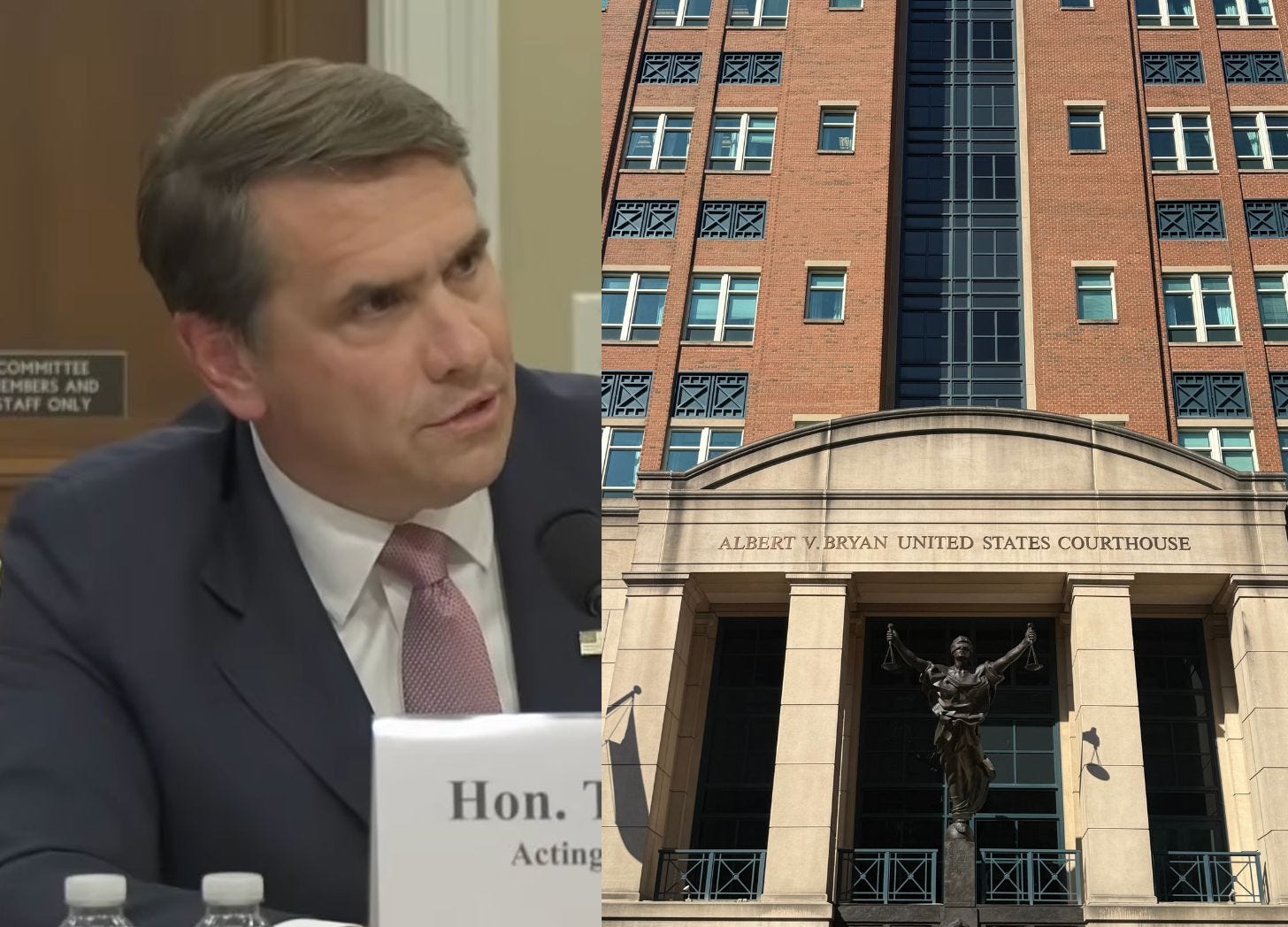
Last week, Acting Attorney General Todd Blanche recently told Congress that the fund is not moving ahead, but U.S. District Judge Leonie Brinkema said that the Justice Department would have a week to confirm that assertion with a sworn statement to stop her injunction from staying in place.
For the government, the less than half-hour hearing was contentious from the start, and Justice Department attorney Andrew Block received a tough reception from the moment that he registered his appearance on the record.
“You’re a brave man, Mr. Block,” Judge Brinkema told the attorney, who is the deputy for Stanley Woodward, the Justice Department’s third-ranking official and a lawyer representing Trump’s co-defendant in the classified documents case.
Earlier this week, D.C.-based U.S. District Judge Richard Leon declined to block the fund, finding the matter “moot” in light of Blanche’s claim that the fund was dead.
Judge Brinkema, however, recited passages from the transcript of Leon’s hearing and pointed out that Block ducked multiple questions about why Blanche didn’t rescind the legal documents creating the fund.
Noting that two days have passed, Brinkema asked: “Do you have an answer now?”
“No, your honor,” Block replied. “I don’t.”
Brinkema said that she “cannot believe given the significance of this case” that Block wouldn’t find an answer from more senior Justice Department officials.
“You understand that there is a huge gap in this record if we don’t have an answer to this question,” Brinkema said, quickly finding that the matter was “not moot.”
‘Beyond any reasonable doubt’
Unlike Washington, D.C., Brinkema is under the jurisdiction of the Fourth Circuit, where the case Porter v. Clarke held that “voluntary cessation” of allegedly illegal conduct isn’t enough to make a matter moot.
She noted that Trump said he was “disappointed” that the fund wasn’t moving forward, creating a strong incentive to revive it. Noting that the case law requires an “absolute certainty” that the offending conduct has been stopped for a case to be moot, Brinkema found “beyond any reasonable doubt” that the standard hasn’t been satisfied.
Quickly finding that the plaintiffs satisfied standing requirements, Brinkema said: “That jurisdictional issue doesn’t give the court concern.” She noted that the National Abortion Federation in particular would be directly affected by the part of the fund compensating those prosecuted under the FACE Act, a federal law that protects abortion clinics from harassment.
That left two issues for Brinkema to explore: the balance of harms and the public interest.
The challengers’ attorney Pooja Boisture, from the advocacy group Democracy Forward, said that there would be no harm to the government under the Justice Department’s theory.
“If what the defendants are saying is true, there is no harm from your honor filing a preliminary injunction in this case,” Boisture said.
Brinkema agreed.
Before issuing her order, the judge recited the conclusion of an amicus brief filed by Sens. Bill Cassidy (R-La.) and Cory Booker (D-N.J.), detailing what she noted was their “bipartisan” assessment of the purpose of the fund and the public interest in blocking it.
“To deliberately deploy public funds, in violation of the Constitution and the laws of this nation, to compensate these perpetrators is to use the machinery of democratic government to subsidize an attack on that government’s most fundamental processes,” their friend-of-the-court brief stated. “Congress itself, as both victim and the federal government’s sole appropriating authority, has a compelling institutional interest in ensuring that no public fund is converted into a reward for those who laid siege to it.”
Brinkema gave the government one week to provide a sworn declaration that the $1.776 billion fund has been fully abandoned.
What a fantastick question!! An arrow to the heart of this rotten corpse zombie administration:
"YOU THINK THIS IS LAWFUL BUSINESS?" stated Judge Brinkema. My champion!!
3 cheers and an elevation to the suprermes.
Thanks, Adam Klasfeld. Regarding the last line: what can Judge Brinkema do after the week has passed with no 'proof beyond a reasonable doubt'? Throw Blanche in jail for contempt? Recommend his disbarment? Actually forc e [who?] to release the slush fund money back to the Treasury, or wherever an expenditure not approved by Congress is held until such time as it is appropriately appropriated? Please explain!