


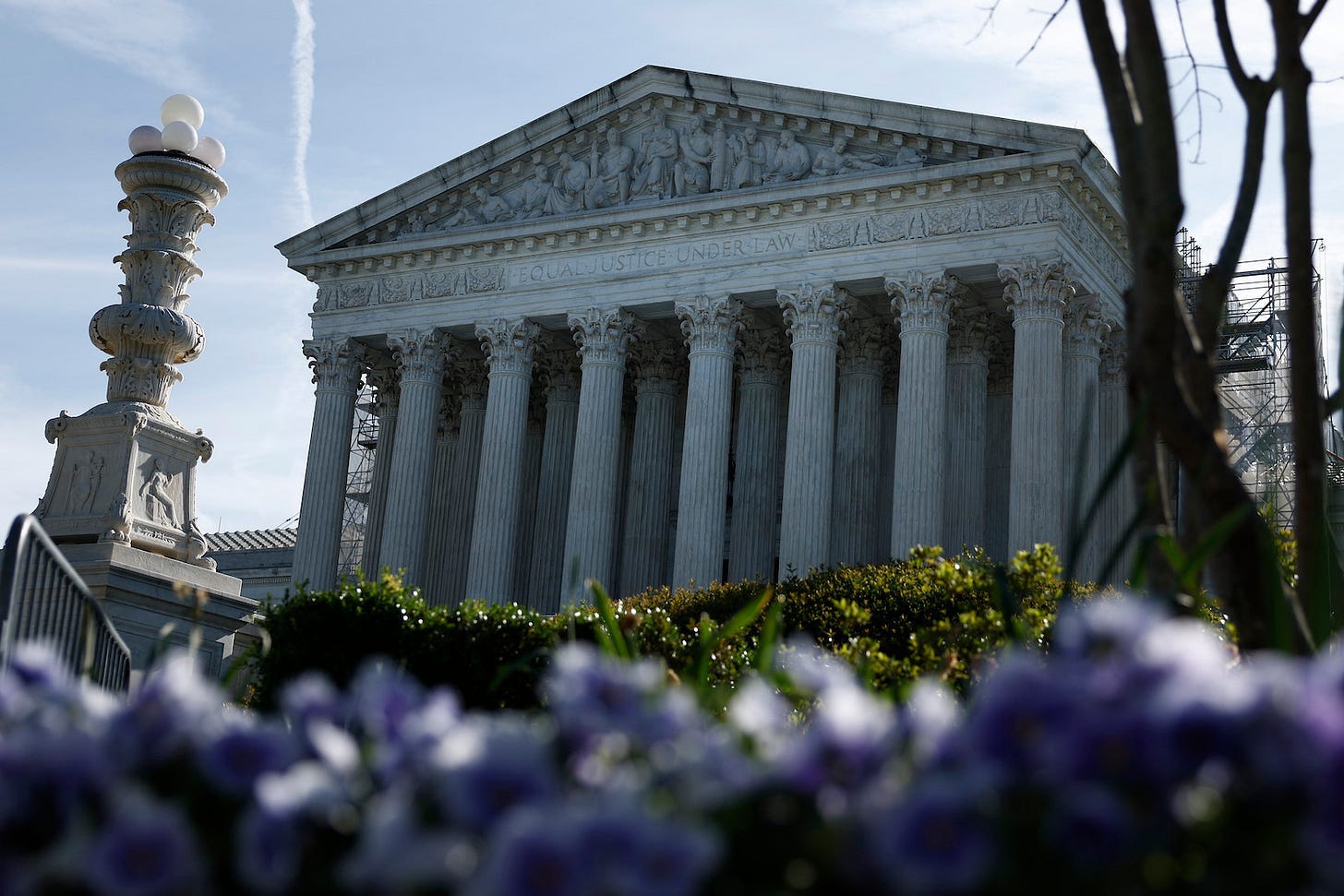
Tonight’s legal roundup kicks off with big SCOTUS news:
* The Supreme Court lifts one injunction blocking Trump’s attack on mail-in voting.
* The BBC roasts the basis of Trump’s defamation suit.
* Trump’s Post Office power grab takes focus.
The Supreme Court lifted one of the injunctions blocking Donald Trump’s executive order attacking mail-in voting before the midterm elections.
In a partisan 6-3 split, the conservative supermajority agreed with Trump’s procedural argument that the lawsuit was filed prematurely, and those justices declined to comment on the lawfulness of Trump’s attempt to federalize mail-in voting, which one federal judge already found to be a wildly unconstitutional usurpation of states’ power over election administration.
“The Court’s disposition of this application does not mean that any measure taken by the Government to implement the order will necessarily be lawful,” the majority opinion states. “On that score, time will tell.”
The majority’s ruling sparked two dissents: Justices Sonia Sotomayor and Elena Kagan emphasized in the first that the Supreme Court merely kicked the can down the road for resolution, and they said that outcome was unwarranted.
“Today’s decision does not address whether the President’s attempts to interfere with States’ administration of the November 2026 elections are lawful,” they wrote. “Nor does it suggest that the Executive Branch has any constitutional or statutory authority to implement the President’s directives. Instead, today’s decision merely postpones adjudication of those challenges.”
But Justice Ketanji Brown Jackson went much further, suggesting that the majority rewarded the Trump administration’s “gamesmanship.”
“Taking its eye off the ball, the majority misses the Government’s actual objective: to secure our imprimatur for its effort to foment chaos ahead of the November elections,” she wrote.
As previously reported on All Rise News, the Trump administration’s strategy is all in the timing. After arguing that the lawsuit was filed too soon, the government will likely argue that it is too late for courts to block the executive order because of the so-called Purcell principle. That’s named after the Supreme Court’s case of Purcell v. Gonzalez, which established the precedent that judges should not change election rules too close to an election.
In an interview earlier this month, former New Jersey Attorney General Matthew Platkin told All Rise News that the Trump administration’s timing arguments were “a kabuki theater-type exercise” to avoid any judicial intervention with a plainly illegal executive order.
“They’re trying to unconstitutionally interfere with the elections,” Platkin said. “They’re trying to tee it up procedurally so it maximizes their chance to get this through for this election because in many respects this election is the ball game, and they want to preserve control of both chambers of Congress.”
One of the two injunctions blocking the implementation of Trump’s executive order remains in place, and the administration will have to overturn the second in order for its attack on mail-in voting to go into effect.
The Center for Election Innovation and Research’s executive director David Becker held out hope for the ultimate outcome, noting that the U.S. Postal Service’s recent issuance of a final rule makes a separate challenge ripe.
“I expect that the states will file a new lawsuit and that this order will remain blocked for 2026,” he said.
As Supreme Court expert Steve Vladeck noted, however, the Purcell issue remains a wild card, and his breakdown of the variables of today’s ruling is a must-read to understand what comes ahead.
All Rise News will report on what happens — and how the affected states will respond if the Supreme Court ultimately allows Trump’s mail-in voting power grab before the midterms.
Read the ruling and dissent here, and revisit my previous interview with ex-AG Platkin below.
Trump’s lawsuit against the BBC by the numbers
The BBC’s motion to dismiss Trump’s defamation lawsuit against it answers the question: How does Trump even try to justify suing the U.K.’s biggest broadcaster in a Florida court over a documentary that never aired in the United States?
Recall: Trump is suing the BBC over a 12-second edit from its documentary, which captured two of his most incendiary lines from his speech before the Jan. 6th insurrection.
In a $1 billion lawsuit, Trump claims that the documentary defamed him by suggesting that he incited the riot. The BBC’s new motion denies that any such implication is false, let alone defamatory.
Setting aside the First Amendment issues, however, the bulk of the motion captures the absurdity of the jurisdictional hook used to get the lawsuit into a U.S. court. The BBC’s documentary never aired in the United States, and the network actively worked to prevent U.S. viewers from watching it without authorization.
According to the new motion, Trump claims to have found 34 attempts to view the BBC’s documentary without authorization in Florida using a virtual private network (VPN), a technology used to encrypt and disguise web traffic.
At its core, the BBC argues that Trump’s jurisdiction argument amounts to “34 unconfirmed, unauthorized attempts to play the documentary from Florida.” Those attempts came from 10 total users, and they were just “play-starts,” meaning that it’s unclear how much of the documentary was ultimately viewed in this way.
A dismissal of the case might be the best outcome for Trump. The BBC is playing hardball, seeking the testimony of Ivanka Trump, Jared Kushner and Don Jr., citing the Jan. 6th Committee’s findings about their scramble to push Trump to condemn the violence.
The BBC requested a federal court hearing on its motion to dismiss.
Read the BBC’s motion here.
Trump’s USPS power grab
Just in time for the Supreme Court’s ruling, the New York Times has published an article about Trump’s plans to reshape the U.S. Post Office.
The report begins:
“Four weeks before President Trump signed an executive order seeking to restrict mail voting, he filed four nominations for vacancies on the Board of Governors of the U.S. Postal Service.
All four were Republicans. Three have expressed doubts about who won the 2020 presidential election and the security of voting.
The selections broke with a longstanding practice of nominating board members in bipartisan pairs. Two of those nominees are on a fast track for approval, and could reach a full Senate vote when the chamber returns from recess in September. If confirmed, their appointments would effectively tip the board to a majority that is loyal to Mr. Trump.”
Expect Trump’s machinations with the U.S. Postal Service to become cast into sharper relief as the midterm elections approach. Read the full story here.
The Supreme Court nitpicked this one to death, claiming the suit was filed prematurely. No one had really been injured, had they? That brings to mind the woman from my state, Colorado, who sued the state because she "might" start a wedding website someday to offer her planning expertise, but gay couples "might" want her to plan their wedding, which would cause her to clutch her pearls in dismay. The Supreme Court found that her lawsuit was not at all premature and ruled in her favor against the state.
Is it just me or is, “time will tell,” an odd statement for the Supreme Court to make? How is the American public supposed to interpret their decision on this potentially disenfranchising scheme?