


In the wake of the birthright citizenship decision, the Trump administration’s misinformation and vilification campaign against the judiciary has taken on an apocalyptic tone.
Trump’s extremist senior advisor Stephen Miller declared that the Supreme Court had ordered the nation to “destroy itself.”
The claim, of course, is ludicrous: By a 5-4 margin, the justices upheld an understanding of the 14th Amendment that had been in place since its ratification more than 150 years ago, but they more generally affirmed a fundamental character of the nation since its founding. Chief Justice John Roberts illustrated in his majority opinion how the country inherited birthright citizenship from the English common law, and Justice Ketanji Brown Jackson emphasized how formerly enslaved people drew from that tradition in advocating for Reconstruction-era amendments to rebuild a “shattered empire” after the Civil War through a “Second Founding.” Jackson showed how the nearly successful attempt to change the fundamental character of the country hinged upon the “distortion of historical facts.”
Hysterical as Miller’s reaction to the Trump v. Barbara decision was, it paled in comparison to his rhetoric against district court judges more generally. Miller has accused federal judges of participating in a “judicial coup” of the government and labeled them “radical left.” He’s ratcheted up his demonization during a historic surge of threats against judges.
Ultimately, however, Donald Trump and Miller’s disinformation campaigns against an independent judiciary are hardly news. The judges’ response to these campaigns is.
‘An extraordinary march’
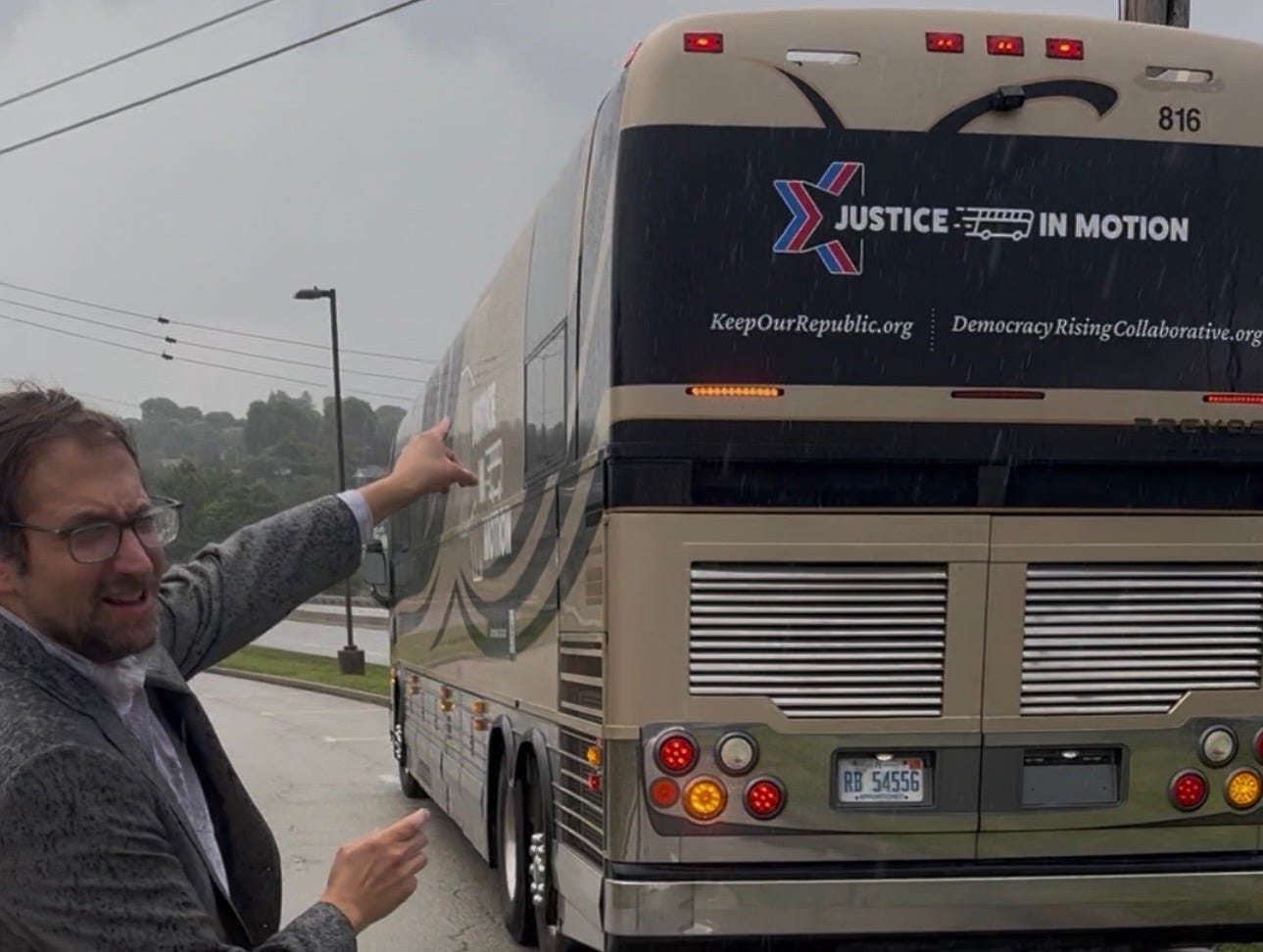
On Tuesday, sitting and retired judges from around the country respond to escalating attacks on the judiciary with a dramatic gesture to instill trust: They will be boarding a bus in western Pennsylvania and spend the next four days traveling through the Rust Belt, starting with the Keystone State before moving on to Ohio and Michigan to interact directly with communities.
The participants include a diverse spectrum of local, state, and federal judges, along with prominent attorneys. The Michigan Supreme Court’s sitting Chief Justice Megan Cavanagh and the Ohio Supreme Court’s retired Chief Justice Maureen O’Connor will be joining the tour, as will two former federal judges. O’Connor, an elected Republican and the first woman to hold her position, was vilified by her party for casting the deciding vote to invalidate a partisan GOP gerrymander.
O’Connor has company: She’s traveling with her dog, Giancarlo Cappuccino.
Other participants, including former Third Circuit Judge Timothy K. Lewis and former North Carolina Supreme Court Judge Bob D. Orr, have vocally criticized Trump’s attacks on the judiciary.
Organized by the Keep Our Republic and Democracy Rising Collaborative, the groups’ co-founders Steve Silverman and Daniel Miller told All Rise News that defending judicial independence is nonpartisan and patriotic.
“This is happening a couple days after our 250th birthday,” Miller noted in a phone interview. “Some people are viewing this time with a measure of hopelessness, pain and despair. But I think it’s also an opportunity for us to reclaim the values upon which this nation was founded — and the values upon which this country still stands for — and to celebrate those values.”
The tour also has a global resonance: The bus drive is inspired by Poland’s Tour de Konstytucja.
“We were in Warsaw, Poland in October with the Carter Center, and there we learned about the Polish judges and their heroism,” Silverman explained. “They did an extraordinary march through the city of Warsaw in their robes, which was an incredible moment of coming down out of their courtrooms and engaging in the community and marching. And they were joined by hundreds and thousands of other people, including judges from all over Eastern Europe, Central Europe and Western Europe.”
The European tour first launched in 2021, when Poland’s ruling party had been dismantling judicial independence. Judges there traveled around in a Volkswagen Microbus, demystifying a judiciary to people in towns and villages. Poland experienced a remarkable democratic resurgence years later, and the judicial tour remains a regular summer event in that country.
In the U.S. and Poland, Miller said that having judges visit local communities helps illustrate how the rule of law is a “kitchen-table issue.”
“It really does matter every day in your life,” Miller told All Rise News. “When you go to the bank and your money’s there, that’s the rule of law. If you get hit by a car and you have recompense, an ability to make yourself whole, that’s the rule of law.”
Since this newsletter’s launch, All Rise News has charted how judges have been adapting and responding to attacks on the U.S. judiciary.
Months after Trump’s inauguration, attorneys across the United States renewed their oaths to the Constitution in front of courthouses for Law Day, an occasion that lawyers had traditionally marked — if at all — in banquet halls rather than the streets. The organizers of that event explained that they took that “unprecedented” step because they can “no longer stand idly by as judicial independence and the rule of law are systematically taken apart.”
The group Speak Up for Justice has been hosting regular events highlighting threats against judges. Increasingly, judges have become victims of so-called “pizza doxxing,” receiving deliveries at their home addresses to communicate that the sender knows where they live. Often, the deliveries are sent in the name of Daniel Anderl, the murdered son of U.S. District Judge Esther Salas.
As reported by ABC News, the U.S. Marshals Service recorded 564 threats against judges last year, and 241 threats were logged as of only March of this year.
Look out for more information about the dates, times, and locations of “Justice in Motion” events on its website.
Uncanny timing
Through an accident of fate, the “Justice in Motion” tour happens to overlap with Wednesday’s sentencing of former Milwaukee County Circuit Judge Hannah Dugan, who faces possible imprisonment following her conviction late last year for obstructing the arrest of an undocumented immigrant.
In April 2025, Dugan’s arrest alarmed the legal community, inspiring condemnations from bar associations and legal groups from coast to coast.
The Trump Justice Department worked to maximize the sense of shock, subjecting Dugan to a highly unusual perp-walk where the FBI paraded her shackled into the courthouse. Then-Attorney General Pam Bondi called Dugan “deranged,” and FBI director Kash Patel posted a photograph of her on his social media account, long in advance of a trial.
Dugan’s attorney Stephen Biskupic said that the highly unusual spectacle forced Dugan to live the “life of a recluse,” and her conviction forced her to resign her judgeship.
Whatever sentence U.S. District Judge Lynn Adelman imposes will be read as sending a message. The charge of Dugan’s conviction carries a maximum 5-year sentence, but prosecutors calculated the sentencing guidelines between 15 and 22 months imprisonment. So far without elaboration, the Trump Justice Department requested a “serious” penalty.
“Anything less risks sending the opposite message — that personal loyalties, subjective viewpoints, or self-interest can supersede legal duty,” prosecutors wrote.
Dugan’s attorneys seek a sentence of time served, and her defenders say that she’s suffered enough, being forced to resign from a job that she loved.
“For her, it was an extraordinarily deep price to pay,” Milwaukee’s hugely popular former mayor Tom Barrett, who was a character witness at her trial, was quoted telling the court in her sentencing memo.
Dugan also enjoys broad public support in the legal community for taking what many applauded as a principled stand against the federal government’s intrusion into state and local judiciaries.
Throughout the debate over her prosecution, a critical voice has been understandably silent: Dugan’s, and she intends to speak about her actions for the first time at her sentencing.
Until now, Dugan’s defense has been at odds with the popular understanding of the case. Her defense team never portrayed her actions as civil disobedience, an argument that likely would have been barred as an impermissible attempt at jury nullification. Instead, Dugan’s lawyers argued at her trial that she never tried to prevent the arrest of undocumented immigrant Eduardo Flores-Ruiz, a defendant in her courtroom. Yes, Dugan admitted that she had serious qualms with and criticisms of the Trump administration’s policy of ICE arrests in courthouses. Most of the judges inside the Milwaukee County Circuit Court System shared those concerns, but Dugan argued that she simply tried to navigate the complicated legal landscape arising from that policy, not violate a federal law she personally opposed.
When Dugan finally speaks, the stakes will be high. Prosecutors have argued for a stiff sentence, in part, because of her “lack of remorse,” but any admissions that she makes could be used against her during her inevitable appeal. She also will be speaking for a legal community anxious about preserving judicial independence and in keeping with her personal conscience. Dugan’s sentencing memo describes her as a devout Catholic who “followed the Gospel message of serving others less fortunate.”
All Rise News plans to attend the proceedings in Milwaukee for the same reason this newsletter thoroughly covered her trial. Her story and sentence could profoundly shape the balance of power between the Trump administration and the state and local judges operating independently from the federal government.
Stay tuned for coverage of the sentencing hearing, which begins at 11:30 a.m. Central Time on Wednesday.
Education is why we are where we are in this country. As in lack of. I am very glad these judges are going out to spread some knowledge; it’s sorely needed. Thanks for this report Adam. I feel terrible for Judge Dugan 😢
Thank you for this.