


This article is informed by live coverage made possible by All Rise News subscribers.
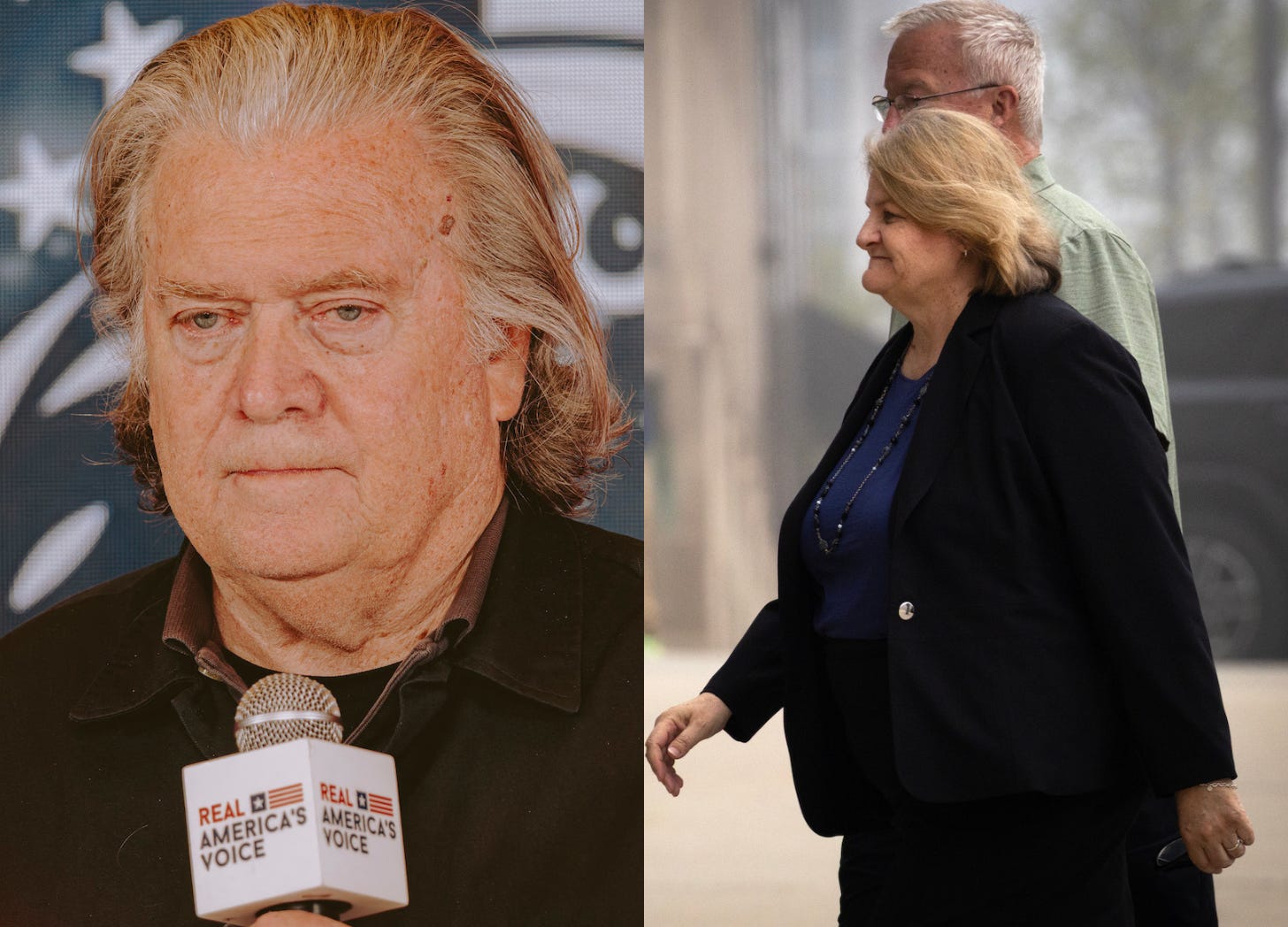
On the same day that the Supreme Court cleared the Justice Department to dismiss Steve Bannon’s convictions, a federal judge rejected former Judge Hannah Dugan’s effort to overturn her felony conviction.
The two developments, falling within hours of each other, significantly advance Donald Trump’s use of the Justice Department to reward his friends, target his enemies and advance his political agenda.
Federal juries found that Bannon and Dugan both tried to stand in the way of different types of lawful proceedings.
‘All hell is going to break loose’
For Bannon, it was the investigation of the House Committee to Investigate the Jan. 6 Attack on the U.S. Capitol. Bannon had plenty of material information for congressional investigators. Before people even went to the polls on Election Day in 2020, Bannon predicted that Trump would falsely claim victory.
On his “War Room” podcast, Bannon stepped up the election subversion campaign in the days before the insurrection. He ratcheted up pressure on then-Vice President Mike Pence to illegally withhold certification of Joe Biden’s victory and announced on the eve of the riot: "all hell is going to break loose tomorrow.”
It took time for Bannon’s defiance of the House Jan. 6th Committee’s subpoena to be rewarded.
After losing his D.C. Circuit appeal, Bannon fully served his four-month sentence, and Trump’s Justice Department moved to erase the convictions by retroactively dismissing his indictment. The Supreme Court’s decision hasn’t ended that process, only cleared the way for that outcome as the case returns to a lower court.
“The judgment is vacated, and the case is remanded to the United States Court of Appeals for the District of Columbia Circuit for further consideration in light of the pending motion to dismiss the indictment,” the Supreme Court’s order states.
The Supreme Court declined to consider the Trump Justice Department’s invitation to consider the effect of Bannon’s claims of executive privilege or attacks on the legitimacy of the House Jan. 6th Committee. It’s unclear what discretion, if any, the D.C. Circuit has once the motion to dismiss Bannon’s indictment returns to the lower court.
In his criminal referral, Jan. 6th Committee Chair Bennie Thompson (D-Miss.) wrote that Bannon’s defiance hampered the investigation.
“If any witness so close to the events leading up to the January 6th attack could decline to provide information to the Select Committee, Congress would be severely hamstrung in its ability to exercise its constitutional powers with highly relevant information informing its choices,” the referral said. “Information in Mr. Bannon’s possession is essential to putting other witnesses’ testimony and productions into appropriate context and to ensuring the Select Committee can fully and expeditiously complete its work.”
Former federal prosecutor Harry Litman and I unpacked the development in a Substack Live earlier today.
‘I tried to help that guy’
Contrast Bannon’s case with that of Milwaukee County Circuit Judge Dugan, who was convicted last year of obstructing an immigration proceeding — namely, the administrative arrest of Eduardo Flores-Ruiz, a criminal defendant in her courthouse.
Just shy of a year ago, six federal agents showed up to Milwaukee County Circuit Court to arrest Flores-Ruiz, who was charged with domestic violence.
A federal jury found that Dugan had tried to obstruct Flores-Ruiz’s arrest by sending him and his attorney through a restricted hallway with two exits. The side door led to a stairwell leading out of the building, and the other door led to the hallway where the agents were waiting. Flores-Ruiz ultimately left through the hallway door, mere feet away from one of the agents, and he was safely arrested and deported. But an audio recording played for the jury suggested that wasn’t the plan.
A snippet of the audio captured Dugan saying “the side door.”
Judge Kristela Cervera, the government’s star witness, testified that Dugan told her she was “in the doghouse” with the chief judge because “I tried to help that guy,” apparently referring to Flores-Ruiz.
Throughout Dugan’s trial in December, there was little to no evidence that any “help” for Flores-Ruiz was personally motivated — and an avalanche of testimony and exhibits showing the upheaval that ICE enforcement inside courthouses wrought on the Milwaukee County Court system.
Milwaukee County’s Chief Judge Carl Ashley issued a press release warning that the policy could “significantly damage the integrity of the court system” by discouraging immigrants and marginalized groups from “attending court hearings, seeking legal assistance, or reporting crimes.” Ashley stood by that assessment in his courtroom testimony, and reams of internal emails showed judges struggling to navigate the legal boundaries of where and how ICE could execute arrests.
For the prosecution, none of those policy disagreements mattered.
“What happens when someone with the highest duty to uphold the law decides that it doesn’t apply to her?” Assistant U.S. Attorney Kelly Brown Watzka said during closing arguments in December. “It undermines the entire justice system.”
It’s an attractive statement of principle, and it clearly resonated with the jury. The Trump Justice Department’s conduct in the Bannon case shows that it only applies — strictly and severely — when the defendant is opposing rather than advancing Trump’s agenda.
‘Temperament of an autocrat’
The verdict in Dugan’s case shows that jurors understood the case like much of the public did.
They believed that Dugan objected to the Trump administration’s policy of executing immigration arrests inside courthouses on a policy level, but their oaths as jurors didn’t allow them to consider that disagreement in determining whether she was guilty of the crime charged.
Dugan’s defense wasn’t one of civil disobedience. Her attorneys said that Dugan always intended to send Flores-Ruiz to the public hallway, where the agents were waiting.
Yes, Dugan disagreed strongly with a policy that complicated her job and made immigrant crime victims less likely to seek justice from the legal system. The evidence showed that she repeatedly and sharply questioned the limits of ICE’s power to execute arrests inside the courthouse. Her attorneys said that the confusion over that policy amounted to reasonable doubt, and prosecutors said that she simply didn’t like the answers.
That U.S. District Judge Lynn Adelman rejected Dugan’s motion for a new trial or an acquittal was little surprise. It’s extremely difficult to overturn a jury’s verdict in post-trial motions, and Adelman previously ruled against Dugan on most of the central issues of her appeal, including immunity and the jury instructions.
As a jurist, Adelman has written openly about Trump’s threat to the rule of law in a Harvard Law & Policy Review article titled “The Roberts Court’s Assault on Democracy.” In the 2020 article, Adelman said that Trump has the “temperament of an autocrat,” leading the Seventh Circuit to rebuke him for the appearance of political rhetoric. Whether the experience made the judge cautious in his handling of Dugan’s case, Adelman could be safely assumed to be keenly aware of the danger of Trump’s attacks on the judiciary.
It remains to be seen whether Judge Adelman will have any more criticism of Trump’s authoritarian instincts during Dugan’s sentencing for her felony obstruction conviction, which carries a maximum five year penalty. Most legal experts doubt that she will receive that harsh a penalty, but the felony conviction likely ended her judicial career. She resigned earlier this year, and she continues to fight her conviction on appeal.
One thing is for certain: Dugan’s case isn’t the type of prosecution that the Trump Justice Department retroactively tries to torpedo following a conviction.
If the execution of the law is going to be impeded, an ally who does it to make hell break loose for Trump will get a pass. A judge who inconveniences immigration agents in order to maintain open access to her courtroom for everyone seeking justice will bear the full weight, force and burden of the law.
Correction: This story has been updated to reflect the fact that Dugan resigned earlier this year.
This whole charade of "justice" and the "letter and spirit" of the law really, deeply saddens and disheartens me. Steve Bannon is a criminal, doing his very best to subvert democracy, democratic values, and has completely disregarded any sort of rebuke from our judicial system, and, as the disgusting, rabble-rousing, crony of the current occupant of the White House that he is, will, just as in the case of the treasonous Mike Flynn, get away with basically "flipping the bird" at the US courts of law... I'm sure it won't be long until he sues the doj for wrongful inprisonment or some such nonsense, to the tune of millions of tax-payer dollars, just as Michael Flynn has done, with the Trump doj opening the bank vault and inviting him to help himself.
Judge Dugan, otoh, gets convicted for trying to maintain HER courtroom in the way she saw fit... I can't say whether what she did was criminal conduct, but JFC it seems like the fox is guarding the henhouse in the US these Orwellian days...
Great article and great podcast with Harry Litman.I do believe in Karma and feel Steve Bannon will continue to cross the line. I really feel bad about the judge.