


Judge Breyer says the only check and balance Trump wants is a “blank one.”
Support journalism that explains why he can’t have it.
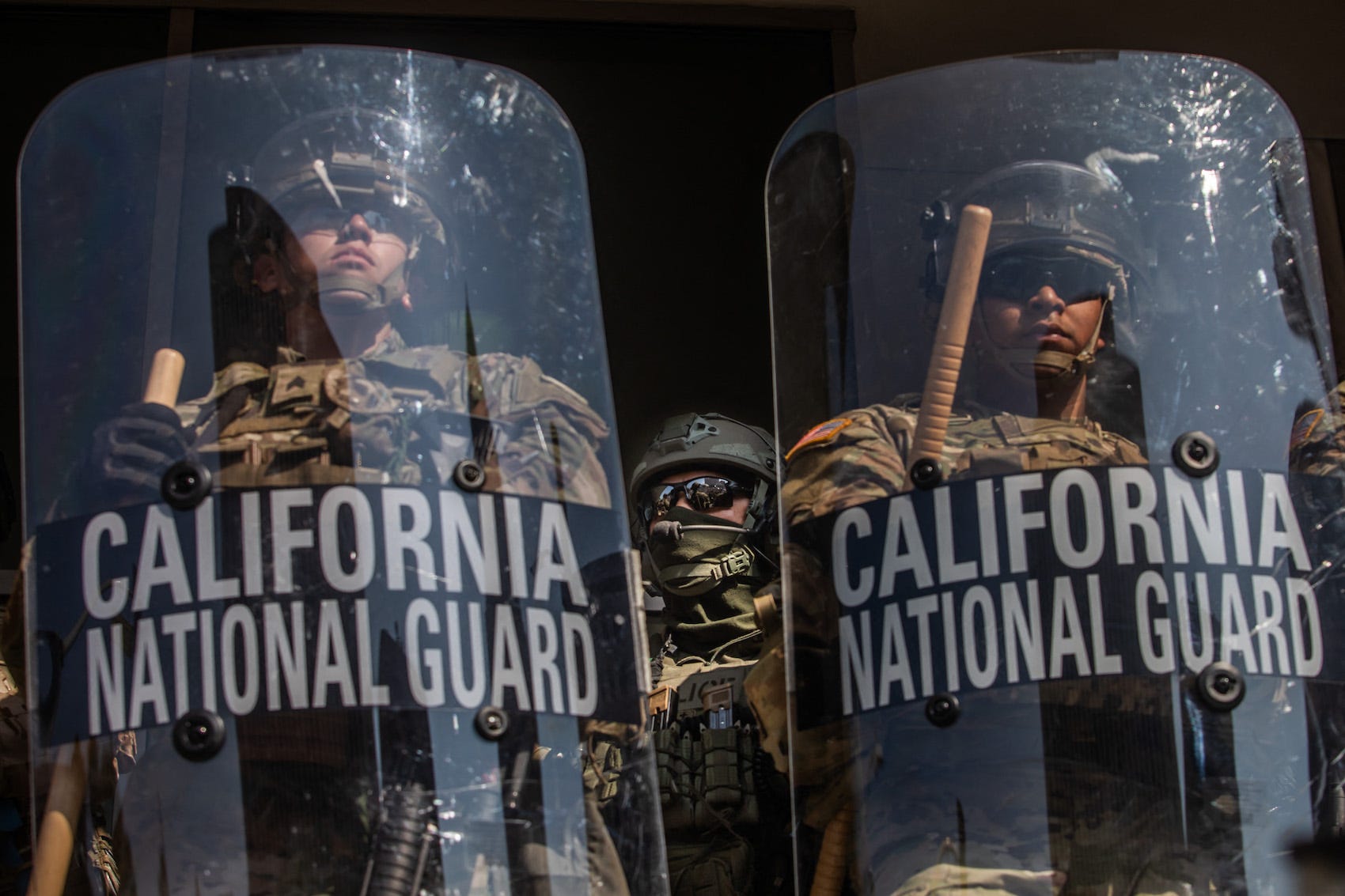
Six months after deploying to Los Angeles, the California National Guard troops federalized by Donald Trump have been ordered to be returned to state control.
“The Founders designed our government to be a system of checks and balances,” Senior U.S. District Judge Charles Breyer wrote in a 35-page opinion. “Defendants, however, make clear that the only check they want is a blank one.”
This is the second time that Breyer has ordered control of the California National Guard to be returned to the Golden State. The first time, Breyer ruled the deployment unlawful under 10 U.S.C. § 12406, but the Ninth Circuit overruled him on the grounds that Trump had a colorable basis to argue that troops were necessary to execute the laws applying a highly deferential standard. The appellate court, however, rejected the Trump Justice Department’s position that federalization orders could not be scrutinized by judges.
After that time, Breyer conducted a trial where he determined that troops violated the Posse Comitatus Act, prohibiting the military from engaging in civilian law enforcement with limited exceptions. Trump’s Department of Defense extended the initial federalization order multiple times, raising a question about whether the extended deployments were subject to judicial review.
Breyer answered with a resounding yes.
“Indeed, at the motion hearing, Defendants confirmed their position that, after an initial federalization, all extensions of federalization orders are utterly unreviewable, forever,” Breyer wrote. “That is shocking. Adopting Defendants’ interpretation of Section 12406 would permit a president to create a perpetual police force comprised of state troops, so long as they were first federalized lawfully. Such a scenario would validate the Founders’ ‘widespread fear [of] a national standing Army,’ which they believed ‘posed an intolerable threat to individual liberty and to the sovereignty of the separate States.’”
During a recent hearing, the Justice Department argued for the continued deployment because a single person in Los Angeles threw two unlit Molotov cocktails into a federal building on Dec. 1, injuring nobody.
“The Court shares Defendants’ concerns about public safety: all citizens in this country deserve to feel safe, and it is a core function of government to ensure that safety,” Breyer wrote. “Yet it is also a core right of the people to be able to gather in protest of their government and its policies—even when doing so is provocative, and even when doing so causes inconvenience.”
Judge Breyer found that the public interest tipped in favor of having civilian law enforcement.
“The Court also notes that it is contrary to the public interest to have ‘militarized actors unfamiliar with local history and context’ roaming the streets,” the ruling states. “Rather, ‘the public has a significant interest in having only well-trained law enforcement officers deployed in their communities and avoiding unnecessary shows of military force in their neighborhoods.’”
Breyer paused his decision until Monday, setting the stage for a prompt Ninth Circuit appeal.
Read the 34-page order granting the preliminary injunction here.
Adam,
Thank you for your clarity and for your persistence. Not to mention your obvious knowledge and astute intelligence.
Our Legal System often seems impenetrable, so your clarity is more than appreciated.
The big question is, can it hold?
onward
A 9th circuit appeal continues the ping pong appellant game. If the 9th circuit upholds the Federalization, then what? This is such a game.