


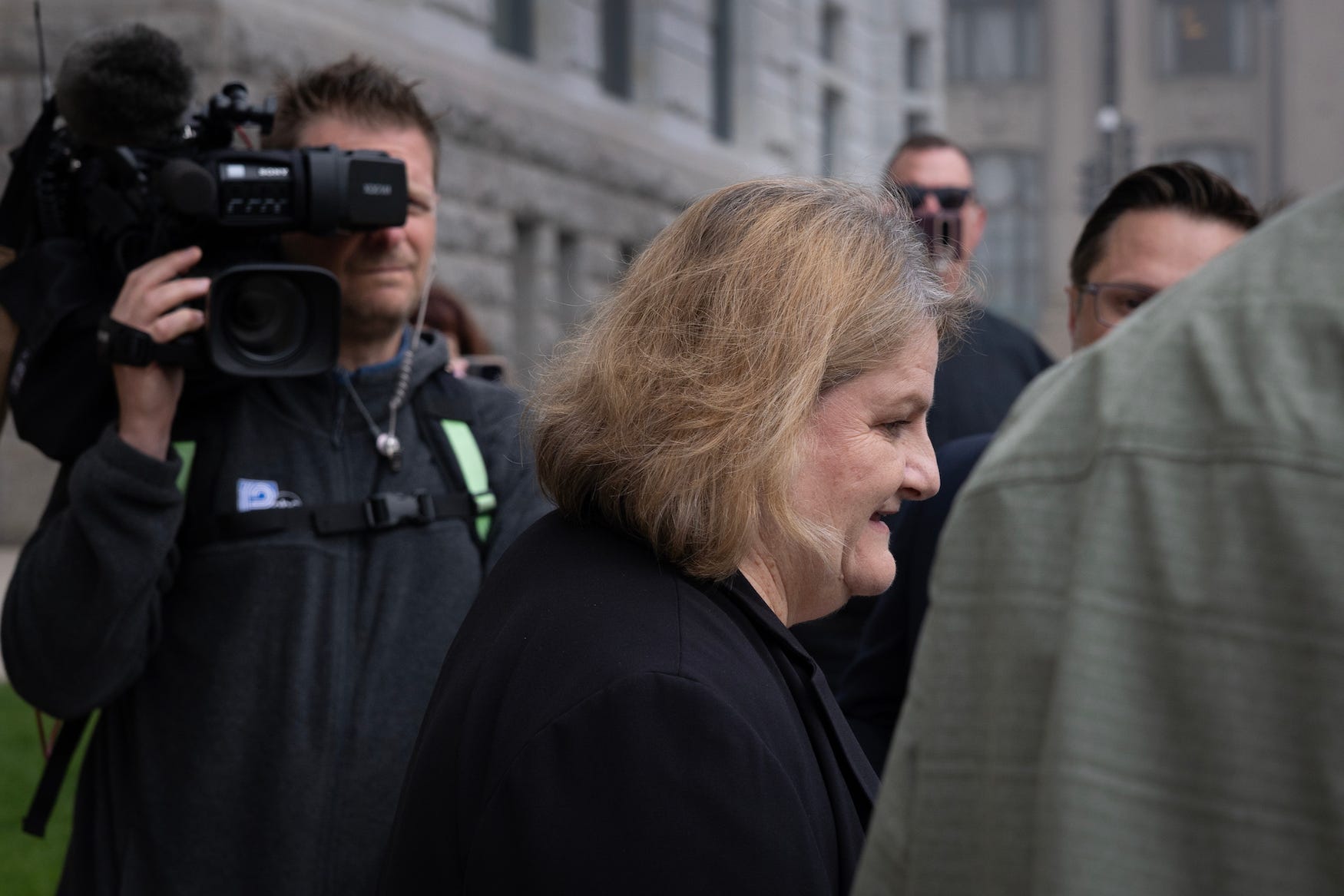
This story is part of ongoing All Rise News live coverage of Judge Dugan’s trial in Milwaukee.
Don’t miss upcoming analysis and verdict watch.
Milwaukee County Circuit Court Judge Hannah Dugan’s defense attorney urged a jury to be a check on “government overreach” on Thursday, warning that becoming a “rubber stamp” on the charges could have profound consequences for the justice system.
"Make no mistake: This went all the way up to the top,” Dugan’s attorney Jason Luczak said. “This went all the way up the government."
Finding Dugan guilty following “an unprecedented trial” would “green-light prosecutions” of judges, sending a “chilling effect” that will harm access to justice in the United States, Luczak said.
"They're trying to make an example of Hannah Dugan,” Luczak said. “They're trying to besmirch her reputation, her honest reputation."
“You took an oath”
The practice of Donald Trump’s immigration police to conduct arrests inside courthouses has sparked anger, confusion and fear inside the places where people try to access justice.
Assistant U.S. Attorney Kelly Brown Watzka told a jury that this reality should not inform their decision about whether to find Judge Dugan guilty.
"On this first day in this courtroom, you took an oath: Just like the defendant did,” Watzka told the jury.
Prosecutors want the jury to find that Dugan violated her oath by helping an undocumented immigrant named Eduardo Flores-Ruiz evade arrest.
“What happens when someone with the highest duty to uphold the law decides that it doesn’t apply to her?” Watzka said, answering later. “It undermines the entire justice system.”
Dugan’s attorney ridiculed the proposition that is what her client did.
"To act like this is Judge Dugan going out on a limb for Eduardo Flores-Ruiz?” Luczak scoffed. “Give me a break!"
“Riddled with doubts”
Most of the basic events in Judge Dugan’s case are undisputed.
On April 18, six federal agents showed up to Milwaukee County Circuit Court to arrest Flores-Ruiz, an undocumented immigrant charged with domestic violence in Dugan’s court.
Once informed about ICE’s presence, Dugan walked into the hallway with fellow Judge Kristela Cervera to confront the agents and referred them to Chief Judge Carl Ashley after they said that they had an administrative warrant, not a judge-signed one. Two federal agents stayed behind in the hallway, and Dugan called Flores-Ruiz’s case.
Dugan sent the defendant and his attorney through the jury door into a restricted hallway with two exits: a private stairwell and a public hallway, where agents were waiting.
Flores-Ruiz and his attorney took the latter option and walked by two federal agents, but prosecutors claim that the plan was to send him down the stairs.
But Flores-Ruiz’s attorney Mercedes de la Rosa gave the opposite testimony, insisting that Dugan told her to exit through the side door into the public hallway.
Watzka tried to play down that testimony by suggesting that de la Rosa was protecting Dugan.
Beyond de la Rosa’s uncontradicted testimony, Luczak cited a list of reasons he said the jury should find Dugan not guilty.
"I would say that this case is riddled with doubts," he said.
“A friend or the enemy of the government”
The prosecution’s argument for finding Dugan wanted to send Flores-Ruiz down the private stairwell largely hinges upon a quiet, grainy audio recording and testimony from a court reporter and a judge.
On the recording, Dugan allegedly can be heard saying: “I’ll do it…. I’ll take the heat.”
According to the transcript, the words “down the stairs” and the “wrong door” can be heard. Court reporter Joan Butz testified that the door that led to the hallway was the wrong one.
"There's no way to spin 'down the stairs' to make it sound better,” Watzka said. “There's no logical explanation for the stairs discussion other than to help Eduardo Flores-Ruiz evade arrest."
But Luczak noted reasons to distrust the audio and the government’s transcript, which includes the presence of an “unidentified male” and omits comments made in Spanish.
“If you don’t trust the evidence the government is putting forward, it’s just another reasonable doubt,” Luczak said.
One of the government’s star witnesses, Judge Cervera, rhetorically convicted Dugan by telling the jury: “Judges shouldn’t help criminal defendants evade arrest.”
Luczak slammed that “gratuitous” comment as one that damaged her credibility. Cervera acknowledged that she sent her sister a text message warning her about ICE’s presence in the courthouse, and the defense attorney suggested that Cervera threw Dugan “under the bus” to save herself.
"That's what happens,” Luczak said. “You're either a friend or the enemy of the government."
“A polarizing issue”
During opening statements, prosecutors claimed that ICE arrests in courthouses were common, but Luczak emphasized how the trial revealed how unusual and disruptive those practices have been during Trump’s second term.
"Were they being honest with you?" Luczak asked.
Prosecutors claimed that Dugan knew that it was clear that ICE was allowed to arrest people in the courtrooms of the public areas, but the agents themselves followed Dugan’s instructions to seek Chief Judge Ashley’s guidance on the issue. Ashley did not affirmatively approve of the hallway arrests.
Luczak said that everyone was confused, and there would have been no need for agents to receive guidance if the law was so clear.
"They wanted to play word games and say, ‘He didn't say we didn't have a green light,’” Luczak said.
To convict Dugan, a jury must find that the judge acted “corruptly,” a proposition her defense said smacks of “government overreach.”
"The government wants to paint Dugan's actions in the worst light possible and everyone else's actions in the best light possible,” Luczak said.
During rebuttal summations, Assistant U.S. Attorney Richard Frohling said that immigration enforcement policies may be controversial, but the rule of law should not be a “polarizing issue.”
Luczak urged the jurors to reject Judge Dugan’s “unjust prosecution.”
"Justice is not what the government is seeking today,” Luczak said. “They're just wrong."
"It's your decision and justice is within your hands,” Luczak said.
Closing arguments ended at 2 p.m. Central Time.
U.S. District Judge Lynn Adelman instructed the jury before they began deliberations at 2:25 p.m. CT.
Big thanks for covering this trial. I believe It is one of the most important legal events this year.
Thank you Adam, that’s a lot to take in. Hope you get some rest before you do a podcast.