


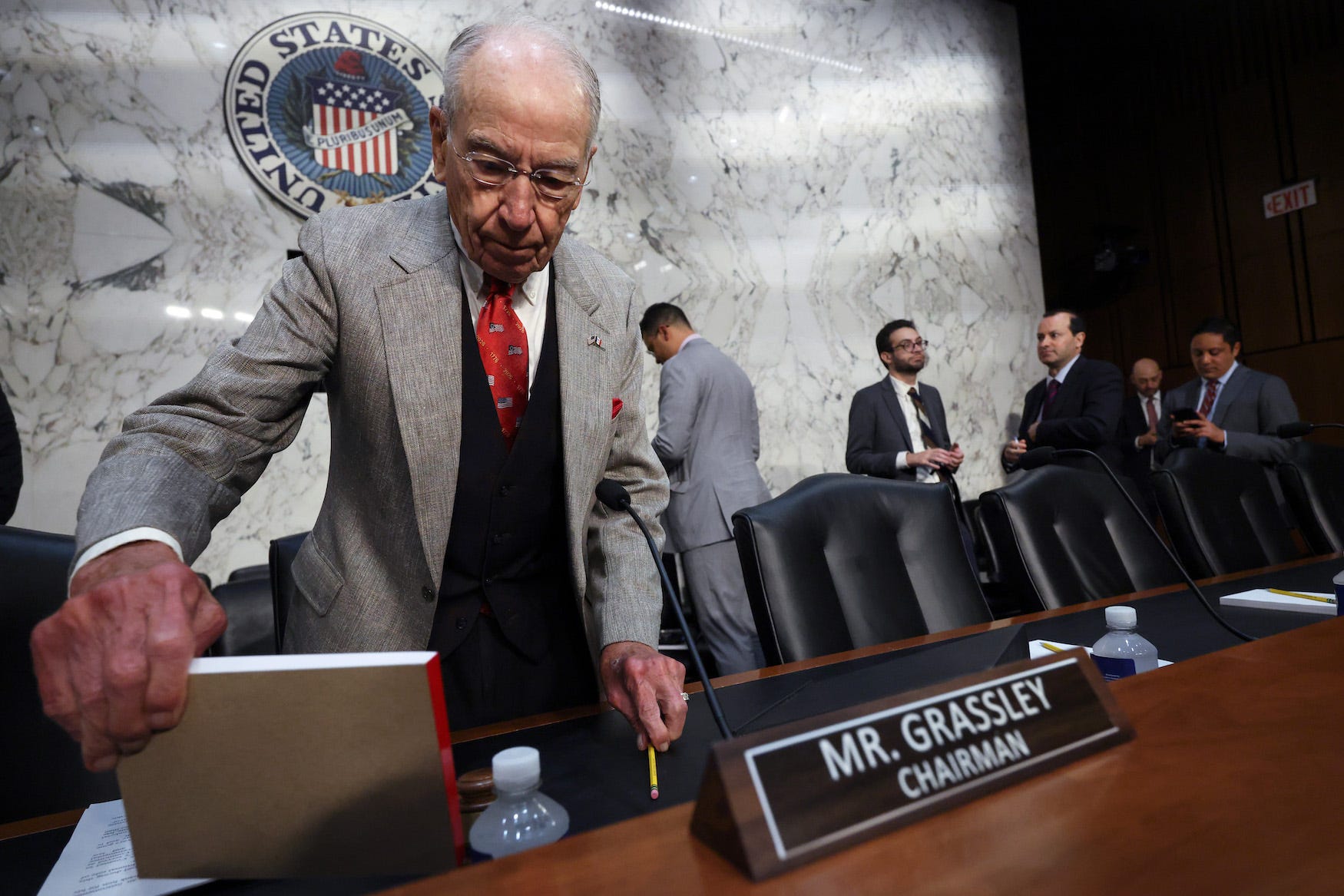
Two days after securing the support of his lone GOP holdouts, Acting Attorney General Todd Blanche cleared the Senate Judiciary Committee in a 12-10 party-line vote on Tuesday.
Republican Senators John Cornyn of Texas and Thom Tillis of North Carolina initially demanded that Blanche revise a purported settlement agreement to eliminate an arrangement that Cornyn called a “payout pot for punks.” They also wanted restraints on sweeping tax amnesty for Trump and his family, which Forbes estimated could erase more than $600 million in potential liabilities.
Blanche ultimately provided neither concession, leaving the purported settlement — slammed by one federal judge as a sham — completely untouched.
The Trump Justice Department is seeking to overturn federal rulings forbidding its use in any court. Blanche frequently insists that the $1.776 billion fund to reward Jan. 6 rioters and other Trump allies is “dead,” but the agency he leads continues to fight legal roadblocks to enforcing its terms.
Although Blanche rescinded an order that would have set the fund into effect, multiple Senators noted that the initial contract between Trump and the government he leads is in place.
Addressing Cornyn directly, Sen. Cory Booker (D-N.J.) told the Texas Republican that his supposed deal with Blanche was “all hat and no cattle.”
Sen. Sheldon Whitehouse (D-R.I.) pointedly asked: “What’s left of this Committee?”
“What’s left of this Committee when we don’t demand straight answers from witnesses?” Whitehouse repeated, citing the Justice Department’s refusal to turn over information about what happened to the $50,000 that the FBI reportedly handed to Tom Homan in a bribery sting.
Whitehouse added that FBI director Kash Patel “virtually certainly lied to this Committee sitting in front of us.”
“I don’t know where this Committee goes after it stops being taken seriously because all you have to be is on the right partisan side to get this Committee to roll over and play dead,” he said.
In press interviews following the hearing, Cornyn struck a fatalistic note about his power to check the executive branch.
“There’s nothing we can do to rein in the President when he says he likes the fund and wishes that it still exists,” Cornyn said.
He then added, inaccurately: “But the fact of the matter is it’s dead.”
Tillis skewered the Trump Justice Department’s case against former FBI director James Comey for posting a photograph of seashells spelling out “86 47” on a beach: "Some bonehead in North Carolina thinks that that's a crime."
Blanche, who will advance to the full Senate chamber for confirmation, announced and stridently defended the case against Comey when it was unsealed.
In tonight’s legal roundup, the Trump DOJ racks up its 20th straight loss in voter-data cases. A Senate probe uncovers an Epstein-related “60 Minutes” segment that never aired, and a federal judge writes a rueful “epilogue” to the Oath Keepers seditious conspiracy case.
If you haven’t already, and have the means to do so, consider supporting this work by becoming a free or paid subscriber.
Trump DOJ extends voter-data losing streak
In one of the growing list of ironies concerning Blanche’s path to confirmation, the Acting Attorney General cleared Committee on the same day that reports emerged about his 20th consecutive defeat in a spate of litigation.
The Justice Department hasn’t won a single victory in the series of 30 lawsuits seeking sensitive voter data from 29 states and Washington, D.C.
Assistant Attorney General Harmeet Dhillon, a former Trump election lawyer turned Civil Rights Division chief, has led the spate of litigation, losing in every court that she entered.
Blanche and Dhillon cited the Civil Rights Act in order to obtain the data, floating an interpretation of the law rejected by judges appointed by presidents across the political spectrum, including several Trump appointees.
In June, a Sixth Circuit judge said that the Trump administration had turned the purpose of the law on its head.
“Back then, the government used this power to ensure that everyone who had the right to vote could freely exercise that right,” Sixth Circuit Judge Andre Mathis wrote. “But today, the government invokes Title III for an inverse purpose—to ensure that some people have not voted.”
The sensitive voter information varies state by state, and the latest defeat happened in Colorado, where nonpublic information includes date of birth, address, last four digits of the voter’s social security number, and driver’s license number, according to the ruling.
“The authorities cited by the United States do not support its position,” U.S. District Judge Phillip Brimmer, a George W. Bush appointee, found.
Read Brimmer’s ruling here.
A ‘60 Minutes’ Epstein probe never aired
Earlier this year, “60 Minutes” caught wind of a hot story.
Its then-top correspondent Sharyn Alfonsi sat down with Sen. Ron Wyden (D-Ore.), the top Democrat on the Senate Finance Committee who had been pursuing a follow-the-money investigation into Jeffrey Epstein’s financial transactions.
On Tuesday, Wyden disclosed the fruits of his investigation in a 67-page report titled “Looking the Other Way.” The document revealed the existence of his unaired interview with CBS for the first time and delivered bombshell findings about Epstein’s business relationships with major banks and billionaires.
“Bank of America likely violated federal anti-money laundering laws by failing to properly screen and report $170 million in payments from Leon Black to Jeffrey Epstein,” the report charges.
Wyden described Black, the billionaire of Apollo Capital Management, as “Epstein’s single largest source of funding.”
“Epstein relied heavily on large payments from Black to bankroll his sex trafficking activity,” the report states.
Wyden also found that J.P. Morgan Chase likely violated federal anti-money laundering laws.
Epstein survivors filed scores of lawsuits seeking compensation for alleged complicity in the sex trafficking conspiracy, resulting in large settlements from Black, Epstein’s estate, J.P. Morgan Chase, Deutsche Bank, and Bank of America adding up to more than $900 million.
“These settlements may have been reached in order to preempt depositions of ultra-wealth individuals or high-ranking bank executives,” the report states. “These settlements also prevented damaging information from coming out through litigation.”
Wyden’s report explains how “60 Minutes” missed the scoop.
“On March 26, 2026, Senator Wyden sat for a taped interview at a Senate Finance Committee hearing room with former 60 minutes correspondent Sharyn Alfonsi. The interview was part of a broader segment being prepared by 60 minutes regarding the conduct of Wall Street banks and the government of the U.S. Virgin Islands with regard to Jeffrey Epstein and his associates. Over the course of the interview Senator Wyden answered questions related to his multi-year investigation into transactions financing Epstein’s sex trafficking operation and potential consequences for banks over potentially willful violations of federal anti-money laundering laws.
However, shortly after the taping of the interview with Senator Wyden, CBS News Leadership led by Bari Weiss made the decision to fire Sharyn Alfonsi. As a result, the interview with Senator Wyden will not be aired and it is unclear whether Bari Weiss and CBS News leadership will allow the broader segment to ever be aired.”
Months before that interview, Alfonsi sharply criticized Weiss and other network leadership over their last-minute stalling of a segment about torture inside El Salvador’s CECOT prison, a story delayed following objections from the White House. Alfonsi accused the network of censorship and was fired months later.
Bloomberg News, which first reported the story of Wyden’s findings, reached out to CBS for comment. CBS said that the story on the Epstein investigation wasn’t ready by the end of the last season but the network wouldn’t confirm whether the segment would eventually air.
Read Wyden’s report here.
Oath Keepers seditious conspiracy case dismissed
“Reluctantly,” a federal judge found that he lacked the power to refuse to dismiss the Jan. 6th related seditious conspiracy convictions of Oath Keepers leaders and members.
“This is the last of the prosecutions seeking to hold accountable those responsible for the events of January 6,” U.S. District Judge Amit Mehta wrote in a 15-page opinion and order. “That book is now closed. Today’s epilogue diminishes the gravity of that day, denigrates the work of the prosecutors and law enforcement officers who secured these convictions, and excuses criminal acts that caused a centuries-long pillar of our democracy—the peaceful transfer of presidential power—to buckle. The court cannot write a different ending.”
The order closes the case of Oath Keepers founder Stewart Rhodes and several other leaders and members of the right-wing extremist group, including Kelly Meggs, Kenneth Harrelson, Jessica Watkins, Roberto Minuta, Joseph Hackett, David Moerschel, Thomas Caldwell, and Edward Vallejo.
“The government thus asks to absolve these Defendants of crimes against the United States itself,” the order states. “In this court’s view, that is not in the public interest.”
But Mehta, who presided over their trials and over the pending civil cases against Donald Trump, made clear that he believed that the Trump Justice Department’s desire to dismiss the case left him with no other lawful outcome.
“Ultimately, though, this judicial officer’s mere difference of opinion is of no moment,” he wrote. “Courts lack the authority ‘to deny a prosecutor’s Rule 48(a) motion to dismiss charges based on a disagreement with the prosecution’s exercise of its charging authority.’”
The judge made clear that prosecutors didn’t claim that any of the defendants had an unfair trial.
“The government does not say that the charges were legally deficient or that the evidence presented is insufficient to sustain Defendants’ convictions,” he wrote. “It confesses to no prosecutorial misconduct, nor does it assert any denial or compromise of a defendant’s rights. And it does not identify any legal error that resulted in an unfair trial or a wrongful conviction (except perhaps as to the obstruction of an official proceeding counts). Remarkably, then, the government does not maintain that dismissal is in the public interest to rectify a fundamental error or a grave injustice.”
The Oath Keepers trial revealed the full scope of the extremist group’s attempt to stop the certification of Joe Biden’s election.
On Jan. 6, 2021, members of the group — styling themselves as a “quick reaction force” — stashed a stockpile of weapons inside a Comfort Inn in Arlington, Va., which they had planned to ferry over the Potomac River to the U.S. Capitol if Trump invoked the Insurrection Act.
Trump never gave that command, and so the firearms remained inside the hotel.
Mehta narrated what happened to their peers who went to the Capitol.
“Meanwhile, a line of roughly ten Oath Keepers, decked out in military gear, had arrived at the Capitol grounds, marched up the eastern steps, and entered the building. A witness testified that Meggs told them all that, once inside, ‘We were going to try to stop the vote count.’ Half of them headed towards the Senate chamber, where they attempted with others to storm past a line of police officers. The other half ended up in front of Speaker Nancy Pelosi’s office. Meggs later would brag to a friend, ‘We looked for her.’ Not long after, a second group of Oath Keepers would make their way inside the Capitol, where they clashed with police officers attempting to clear the building. Due to the extraordinary bravery and courage of law enforcement, Congress was able to reconvene later that night and certify President-elect Biden as the winner of the 2020 presidential election.”
Days after the riot, Rhodes still had not abandoned his plan to keep Trump in power, setting up a meeting with an intermediary whom he’d hoped would personally lobby Trump to invoke the Insurrection Act, witness testimony revealed. That last-ditch effort also failed.
On a personal note:
In 2022, I covered the Oath Keepers trial on the ground in Washington, D.C., witnessing the testimony and evidence about the planning of the attack on the U.S. Capitol and its aftermath. The proceedings revealed the extreme lengths to which far-right, paramilitary groups went to keep Trump in power. Those revelations received too little attention at the time, and there continues to be an active effort to downplay and bury its history.
The first half of Mehta’s ruling provides a concise and gripping account of the trial. Read it here.
“When the law no longer protects you from the corrupt, but protects the corrupt from you – you know your nation is doomed.”
Ayn Rand
“President Donald Trump called the prison sentences of Oath Keepers and Proud Boys leaders "ridiculous and excessive". Defending his commutation of their sentences, Trump stated: "These are people who actually love our country, so we thought a pardon would be appropriate". Referring to the defendants charged in the January 6 attack, he also called them "the hostages".
I love the country I live in, not the hot mess the Heritage Fascists have constructed using papier mâché and dirty diapers. They have failed. My country has prevailed.