


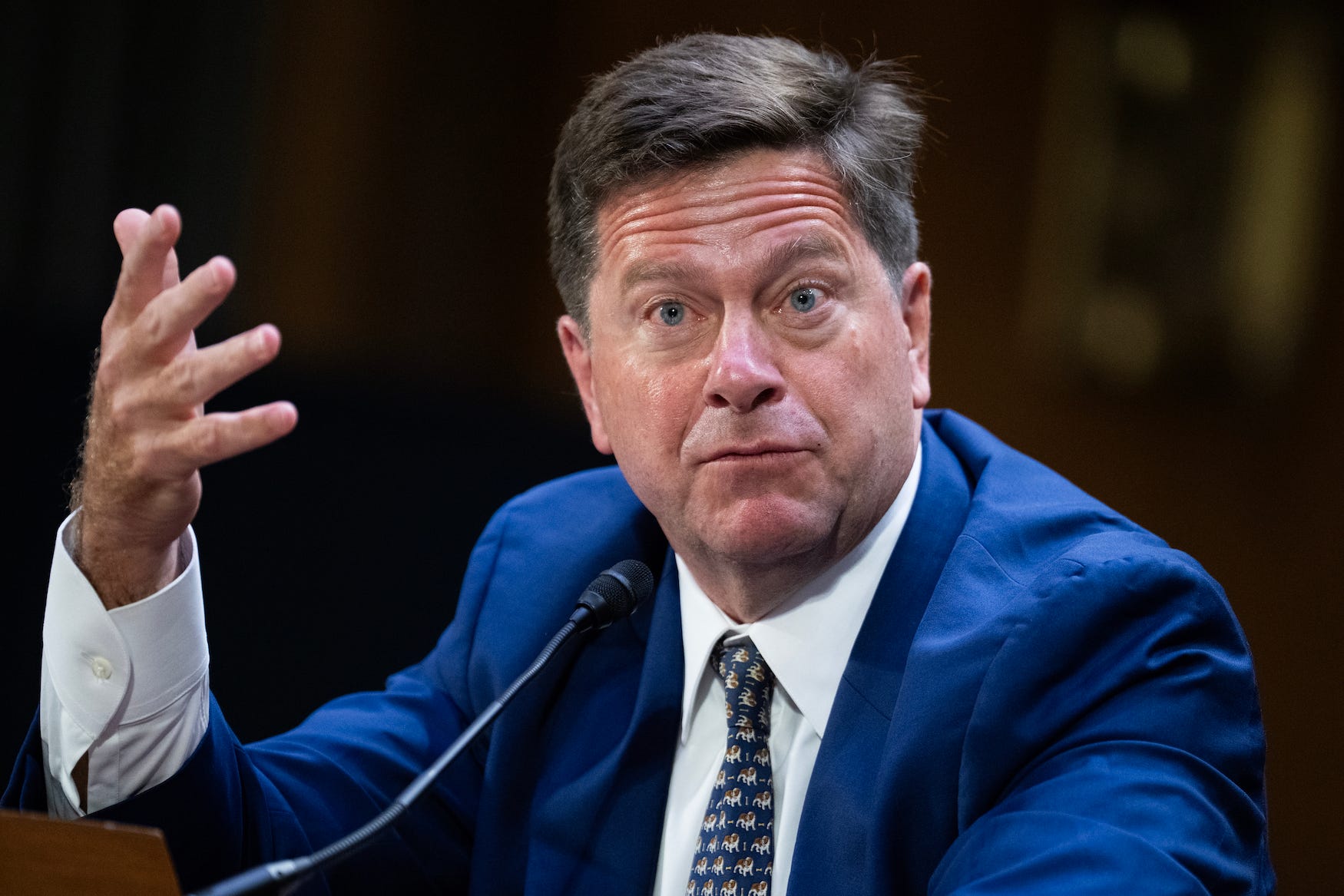
During his recent Senate confirmation hearing, Jay Clayton couldn’t bring himself to admit that Donald Trump lost the 2020 presidential election, and Joe Biden won a free and fair race.
In other words, Clayton passed his audition for Director of National Intelligence, and Senate Republicans rewarded him for it with a 51-47 party-line vote on Tuesday.
Clayton, who has no experience in the intelligence community, previously served as the U.S. Attorney for the Southern District of New York. He never previously served as a federal prosecutor either, but he has the attribute most prized during Trump’s second term: fealty to his boss.
During Trump’s first term, then-U.S. Attorney Geoffrey Berman testified that Clayton was an “unqualified choice” to serve as his successor, and he refused to step down from his position until his deputy Audrey Strauss could take his place. It turned out that Clayton’s rise hadn’t been scuttled, only delayed until Trump’s second term.
Trump was rewarded for his patience with a U.S. Attorney who went along with what two federal judges described as a “diversion” regarding the Epstein files. Clayton also didn’t stand in the way of purging prosecutors who had fallen out of Trump’s favor, like Maurene Comey, who built the cases against Jeffrey Epstein and Ghislaine Maxwell — and is the daughter of the ex-FBI director Trump hates.
During his tenure as director of the Securities and Exchange Commission, Clayton built up some bipartisan goodwill, and he was once praised by Sen. Mark Warner (D-Va.), the top Democrat on the Senate Intelligence Committee. That across-the-aisle appeal evaporated as Clayton became a regular Trump booster on CNBC’s “Squawk Box,” using that platform to sow baseless doubt about the recent California elections.
Despite insisting he wasn’t an “election denier,” Clayton repeatedly ducked questions about Biden’s electoral victory in 2020. He acknowledged the basic fact that Biden was “certified” the winner, but he refused to testify that Trump lost the race.
Sen. Jon Ossoff (D-Ga.) called Clayton out on the disconnect during heated questioning that sounded the death knell of the then-U.S. Attorney’s ability to secure a single Democratic vote for his promotion. Clayton also dodged questions about whether he would follow in his predecessor Tulsi Gabbard’s footsteps by attending an FBI raid of election facilities.
Days before the government withdrew the subpoenas he authorized against New York Times reporters and their family members, Clayton swore that prosecutors followed all of the usual procedures for grand jury investigations involving members of the news media. A federal judge debunked that claim shortly after the confirmation hearing, leading press freedom advocates to question whether Clayton had perjured himself.
Ultimately, none of these controversies stood in the way of a single Republican vote, putting Clayton in charge of the U.S. intelligence community with the midterm elections approaching.
The Senate confirmation took place hours after another election-related setback, which is covered in the next item of tonight’s legal roundup.
D.C. Circuit demurs on mail-in ballots
A federal appeals court rejected an effort by national and local Democratic parties to block Trump’s executive order concerning mail-in ballots.
The D.C. Circuit’s ruling, however, was more procedural than final, finding that the legal effort was premature because the Trump administration hadn’t yet taken any efforts to implement the order.
“In particular, Plaintiffs’ request for preliminary relief ‘is premised on the threatened impact’ of the Executive Order after it is implemented and if in violation of federal law,” the judgment states. “In addition, the Executive Order, which is not self-executing, directs the agencies to act only to ‘the extent feasible and consistent with applicable law, including but not limited to the Privacy Act of 1974,’ and so requires compliance with the very legal limitations about which Plaintiffs are concerned.”
“If the defendant agencies take steps to implement the Executive Order in a manner that violates federal law or the Constitution, Plaintiffs can promptly seek relief, which the district court and this court can decide in as expeditious a manner as circumstances require.”
Read the 8-page judgment here.
Blanche faces an ultimatum
Sen. John Cornyn announced on Tuesday that Todd Blanche hasn’t satisfied the condition required for the Texas Republican to support his confirmation for Attorney General.
“Fake news alert: there is no ‘deal’ on Blanche nom,” Cornyn’s social media account posted today. “They know what they have to do.”
POLITICO reported that Cornyn conditioned his vote on Blanche rewriting the so-called settlement agreement used as the legal basis for the $1.776 billion slush fund and tax audit amnesty for Trump and his family. Cornyn reportedly demanded that Blanche modify the agreement to nix the slush fund and restrict the “scope” of the waiver, though the details remain unclear.
By press time, Blanche hasn’t acceded to Cornyn’s demand, and he will need every Republican vote to advance from the Senate Judiciary Committee on Thursday. Outcast from Trumpworld, Cornyn will be departing from the Senate after his term expires because Trump endorsed his scandal-plagued opponent Ken Paxton, the twice-indicted and once-impeached state attorney general.
Although Cornyn boasted about voting with Trump more than 99 percent of the time, Trump called him “very disloyal” for being slow to endorse him for a second term. It’s unclear why Cornyn conditioned his support of Blanche on the modification of an agreement that’s been hobbled by two federal judges. One judge blocked the creation or operation of the slush fund, and another barred the use of the settlement agreement in any court or administrative agency.
It’s likewise unclear why Blanche has been so resistant to committing to writing what he testified to repeatedly: that the fund is “dead” and the tax audit waiver isn’t a sweeping immunity agreement from more than $100 million in potential liabilities.
For now, it remains to be seen who will blink first — and whether the outcome will ultimately sink or stall Blanche’s nomination.
Blanche’s nomination heads to a vote on Thursday.
Many thanks for the update, Adam. Fingers crossed that Blanche’s nomination advances no further.
The criminal conspiracy continues.